Huberman Says Staying Awake Makes Eyes More Sensitive To Dopamine Lowering Light
Stanford neuroscientist Andrew Huberman cites a Cell study linking light between about 11 p.m. and 4 a.m. to lower dopamine.
 Andrew Huberman · Master Your Sleep & Be More Alert When Awake
According to Stanford neuroscientist Andrew Huberman, the longer someone stays awake, the more sensitive the eyes become to light.
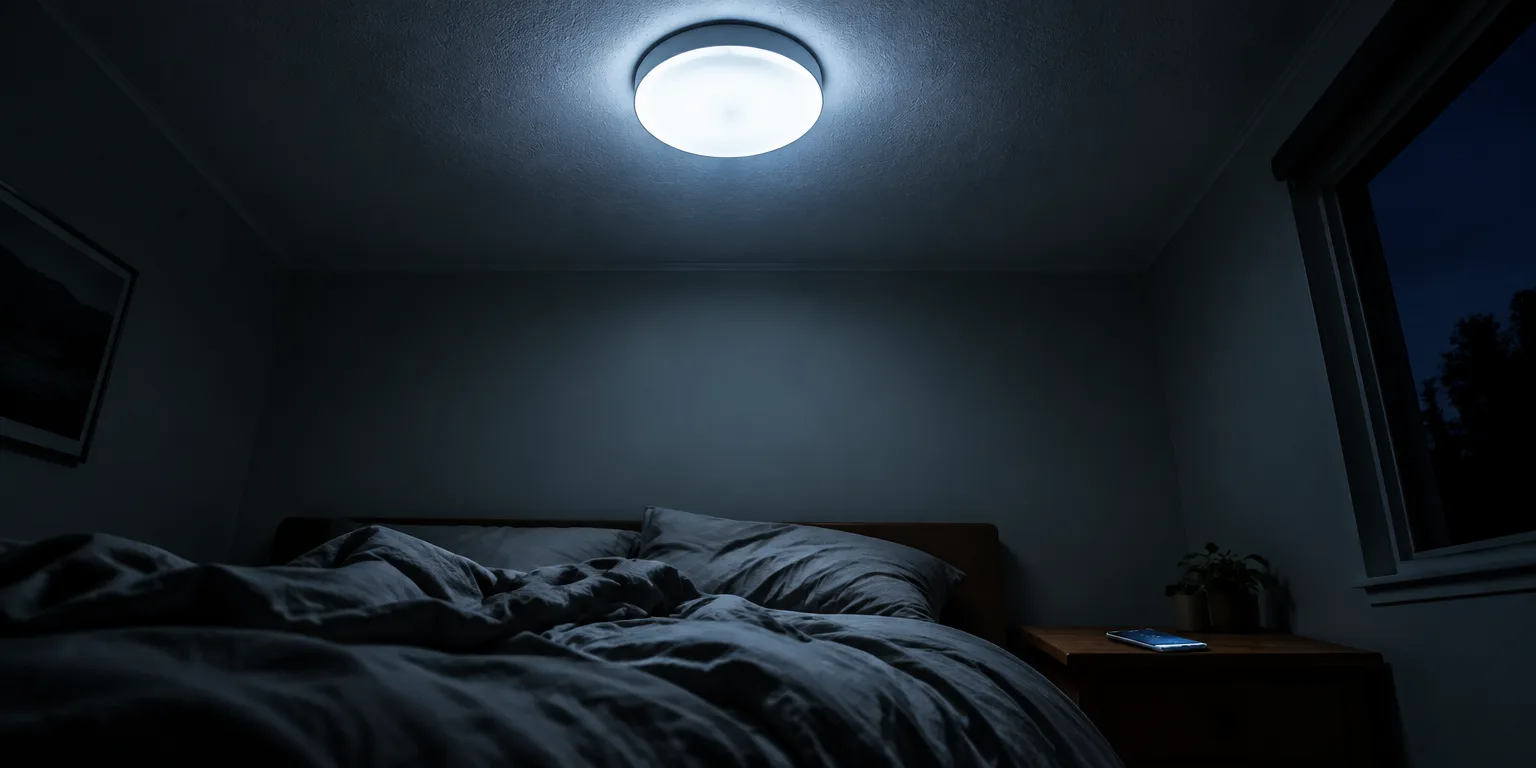
After 10, 12, or 14 hours awake, even faint light from a screen or an overhead fixture can push the brain clock later and make sleep harder to start. The account depends on special eye cells that send light signals to the brain's clock for sleep timing.
Those cells sit mainly in the lower retina, the light sensitive layer at the back of the eye. Because the lens flips the image, that lower patch looks mainly upward, toward overhead space where sunlight normally appears.
In this account, overhead fluorescent light is worst for activating those upward looking cells, softer yellowish or reddish overhead light is less bad, and dim light placed low is least bad. Red light, in the same account, does not trigger the pathway.
For the overnight effect, Huberman cites a Cell paper by neuroscientists David Berson and Samer Hattar. His reading is that light reaching the eyes between about 11 p.m. and 4 a.m. suppresses dopamine, a brain chemical that supports good mood and works as a kind of internal antidepressant.
The route he describes runs from the eyes to the habenula, a tiny paired structure inside the thalamus, the brain relay hub. When that area becomes active, Huberman says people “feel less happy and more disappointed,” which is why he calls it the disappointment nucleus.
He says this can inhibit learning and can contribute to depressive symptoms while awake.
Questions people ask
Why would lower dopamine matter for mood and learning?
In Huberman's account, dopamine is a brain chemical that supports good mood and works like an internal antidepressant. When its release is suppressed, learning can be inhibited and people feel less happy.
Why would an overhead light matter more than a low lamp?
The clock reporting cells sit mainly in the lower retina, which looks upward because the lens reverses the image. Light from above is therefore more likely to reach those cells than light placed near the floor or on a desk.
Does one brief trip to the bathroom at night have the same effect?
In Huberman's account, occasional brief exposure, such as a bathroom trip or reading on an overnight flight, is not going to be a problem. The concern is repeated late night exposure from phones and bright room lights, because retinal sensitivity is already high after many hours awake.