Mary Queen of Scots Accused Her Spymaster of Tampering to His Face
Without a lawyer beneath Elizabeth's empty throne, she faced Burghley, her longtime adversary, and the spymaster she had just met.
 The Rest Is History · 696. Elizabeth I vs The Catholics: Killing the Queen of Scots (Part 6)
On the morning of Oct. 14, 1586, the judges filed into the presence chamber on the first floor of Fotheringay Castle in central England. At one end of the room, beneath a great cloth embroidered with the royal arms, stood an empty throne.
The throne belonged to Queen Elizabeth I of England, who was not present but dominated the room anyway. Around a central table sat three benches of commissioners, privy councillors and peers appointed to try Mary Queen of Scots for plotting Elizabeth's murder.
Mary entered shortly after nine o'clock in a dark velvet gown with a white headdress and a veil falling over her hair. Everyone stood and removed their hats, honoring her royal rank, and she answered with a slight incline of her head. Then she saw that her own chair had been placed below Elizabeth's throne, a sign she was to be judged as a subject, and she protested.
She had no lawyer. The three ladies in waiting with her were the only women present and the only people in the room sympathetic to her. Directly in her line of sight sat William Cecil, Lord Burghley, Elizabeth's chief minister, who had worked for decades to bring her down. Farther away sat a man she had only encountered that same morning, Sir Francis Walsingham, Elizabeth's Secretary of State and spymaster.
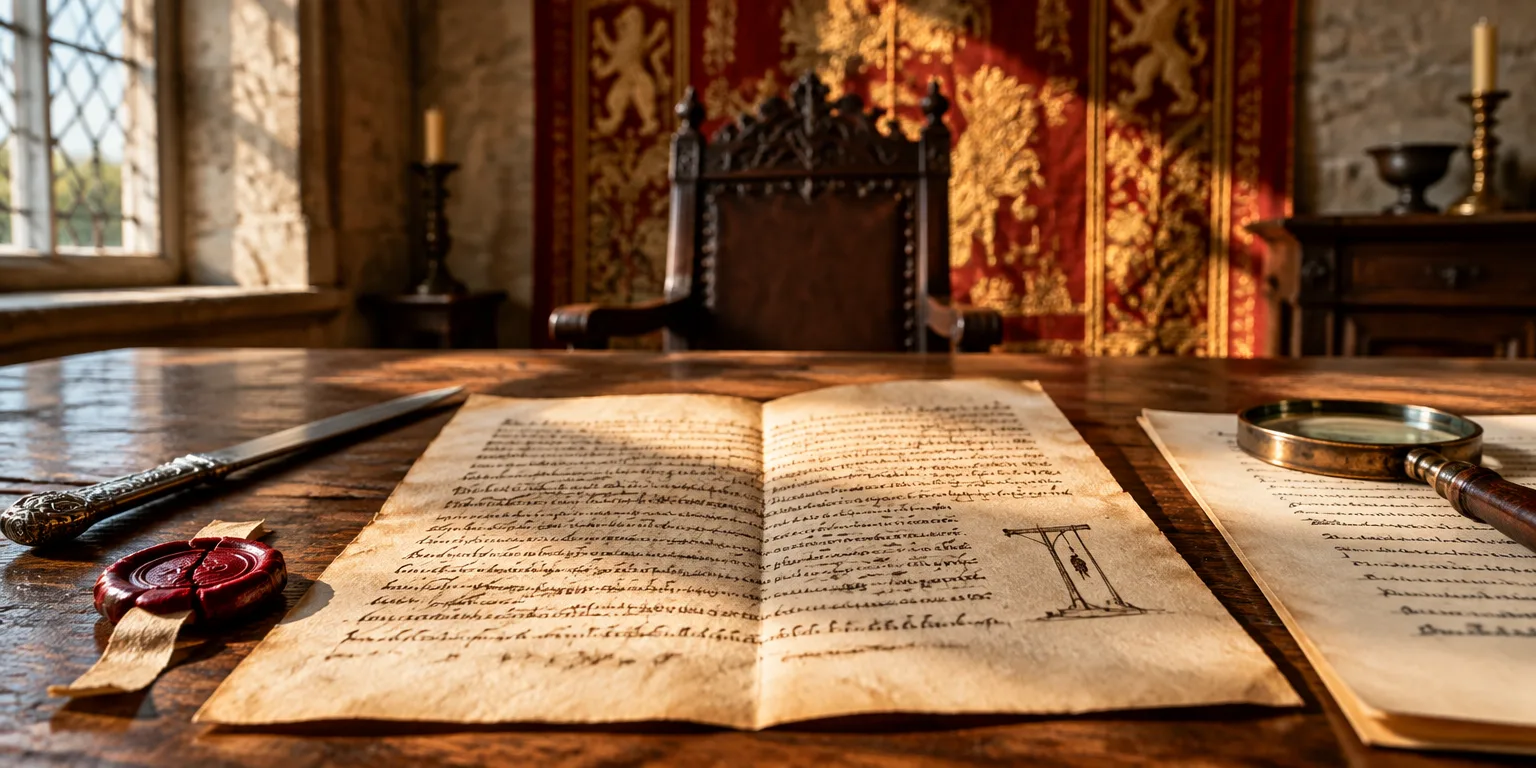
The case against her was paper. Thomas Phelippes, Walsingham's codebreaker, had laid out her secret correspondence for the commissioners to study, including the letter he had marked with a sketch of the scaffold and called the bloody letter. When Mary understood that Walsingham had been opening and reading her secret correspondence, she was stunned and sobbed.
Then she attacked. Mary said she was not answerable for what the conspirator Anthony Babington had written to her, that the letters bearing her name were in another hand, and declared, "can I be responsible for the criminal projects of a few desperate men, which they planned without my knowledge or participation." Looking straight at Walsingham, she accused him, correctly, of tampering with her letters.
Walsingham answered. "I call God and all the world to witness that as a private person, I have done nothing unworthy of an honest man and as Secretary of State, nothing unbefitting my duty." The historian Stephen Alford called the reply "a masterpiece of subtle wordplay that said everything and nothing at the same time."
She turned next to Burghley. Years earlier she had written asking him to plead her case to Elizabeth, not knowing how hard he had worked to destroy her. Now, as if seeing it clearly for the first time, she told him, "you are indeed my enemy." He replied, "I am the enemy of the enemies of Queen Elizabeth."
By the end of the second day she seemed to understand that no argument would change the coming verdict. She rose, said she forgave the commissioners for what was a show trial, crossed the room to Walsingham, and spoke privately in his ear. No one heard what she said, but watchers saw that it angered him. Then she turned back to the room to proclaim herself innocent once more. "I place my cause in the hands of God."
Questions people ask
Did Walsingham actually tamper with Mary's letters?
Yes, in a practical sense. His codebreaker Thomas Phelippes intercepted Mary's letters, decoded them, copied them, and resealed them so perfectly that recipients never knew. Walsingham's famous denial worked because he distinguished between acting as a private man and acting as Secretary of State, leaving room for official interception while denying dishonorable forgery.
What was the bloody letter?
The bloody letter was Mary's reply of July 17, 1586, to Anthony Babington, a young Catholic gentleman plotting to free her and kill Elizabeth. Intercepted through the beer barrel used to smuggle mail, it appeared to approve Babington's plan to set six gentlemen to murder Elizabeth. Phelippes copied it for Walsingham and drew a gallows on the copy.
What happened after the trial?
A guilty verdict came ten days later in London, but Elizabeth hesitated for months to sign the death warrant. She feared war with Catholic Europe, the precedent of killing an anointed queen, and giving Spain an excuse to invade. Mary was finally executed at Fotheringay on Feb. 8, 1587.