Matching Lessons to Visual or Auditory Styles Does Not Help You Learn
Experiments show matched lessons score no better, because what sticks is the idea, not the pictures or words that carried it.
 Veritasium · The Biggest Myth In Education
Ask a classroom of students whether they are visual learners or auditory learners, and most will have an answer. The surprise is that students who got lessons matched to their supposed style did no better on tests than students who got mismatched lessons.
In one rigorous test, researchers first sorted students into visualizers, meaning people who prefer pictures, and verbalizers, meaning people who prefer words. Students had two help buttons when they faced a difficult explanation, one for a short animation and one for written text, and their choices were recorded along with their answers to preference questions.
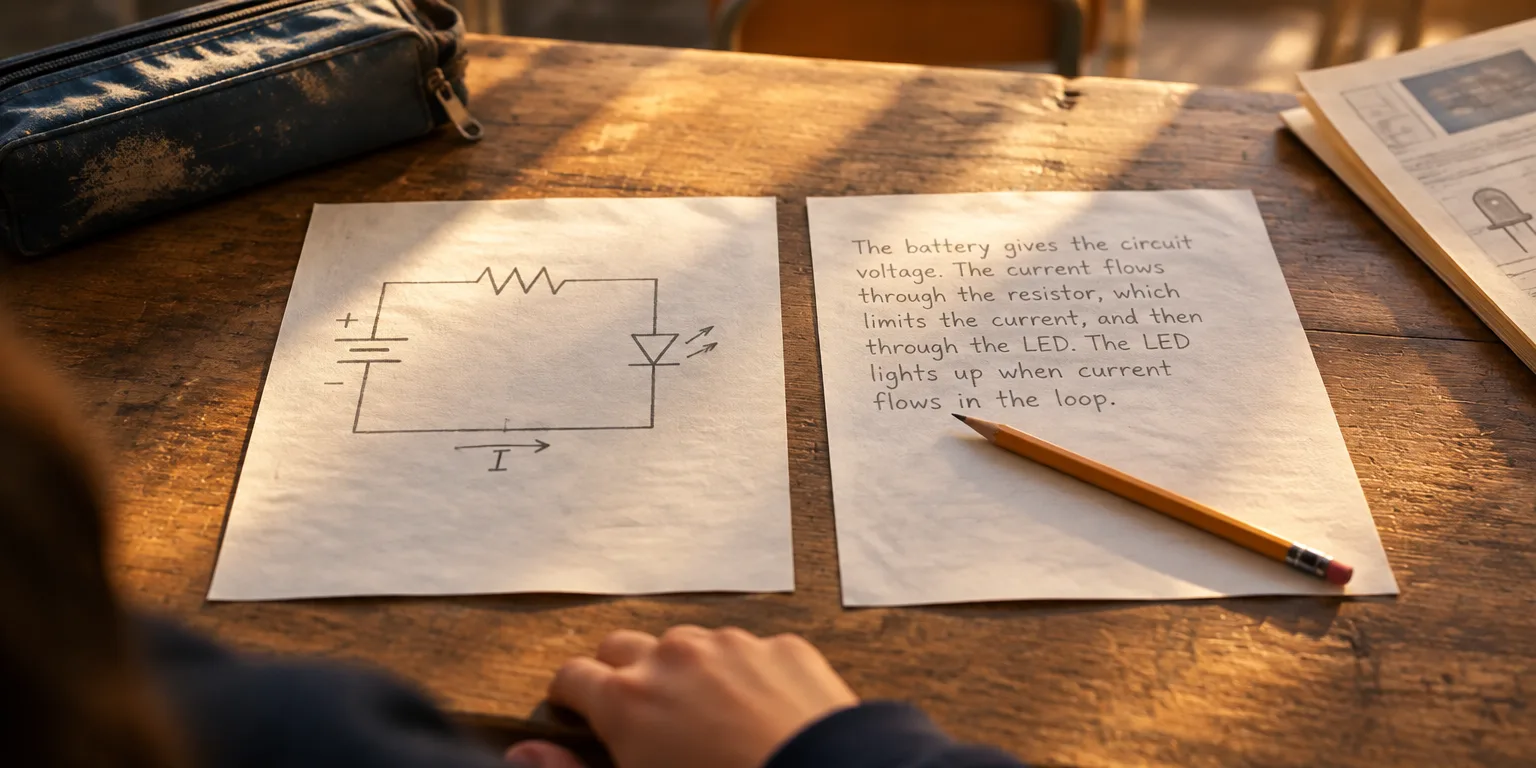
Each student was then placed by chance into an electronics lesson that was either text based, with definitions that popped up over key words, or picture based, with annotated diagrams. The students who got the lesson that matched their supposed style scored no better on the final test than the students who got the mismatched lesson. The same result held when the researchers repeated the experiment with 61 adults who had not attended college.
What students report doing tells the same story. In a 2018 study, more than 400 university students in Indiana took the popular VARK questionnaire, which sorts people into visual, auditory, reading and writing, or hands on learners. By the end of the semester, an overwhelming majority said they were studying in ways that were supposedly incompatible with their style, and the minority who did study to match performed no better in the course.
The researchers argue that the reason is that what matters for recall is the meaning behind a presentation, not the senses that delivered it. What sticks is not the exact shape of an image or the pitch of a voice, but the idea it carried.
Some subjects do demand a particular sense. Music should have sound, and geography needs maps. A person with perfect pitch may remember musical tones better, and a person with strong visual and spatial reasoning may learn country locations faster. But learning style theory predicts that someone with an ear for tones should absorb every subject better through sound, and that is not what happens. For geography, maps work best for the majority.
In a 2009 review of the research, the authors wrote, "the contrast between the enormous popularity of the learning styles approach within education and the lack of credible evidence for its utility is, in our opinion, striking and disturbing."
Questions people ask
What is VARK?
VARK stands for Visual, Auditory, Reading-Writing, and Kinesthetic. It was proposed by New Zealand school inspector Neil Fleming as a way to describe preferred modes of learning. It was never based on evidence that students naturally fall into those four groups.
Does this mean pictures and diagrams are useless for learning?
No. Research supports a multimedia effect, where words plus pictures together teach better than either alone, for almost everyone. The point is that good visuals help all learners, not just self-described visual learners.
If matching does not work, what does improve learning?
Studies point to active thinking, testing yourself, spacing practice over time, and directly confronting common misconceptions. For remembering lists, techniques like repeating items or linking them in a story work far better than worrying about learning style.