Microwaves Turn Gas Into Carbon Rain That Builds Diamonds Atom by Atom
The process is slower than crushing carbon under pressure, but its fine control makes diamonds for optics, cooling electronics, and quantum tech.
 The Wall Street Journal · The Complex Tech Behind Growing Diamonds in Minutes | WSJ Tech Behind
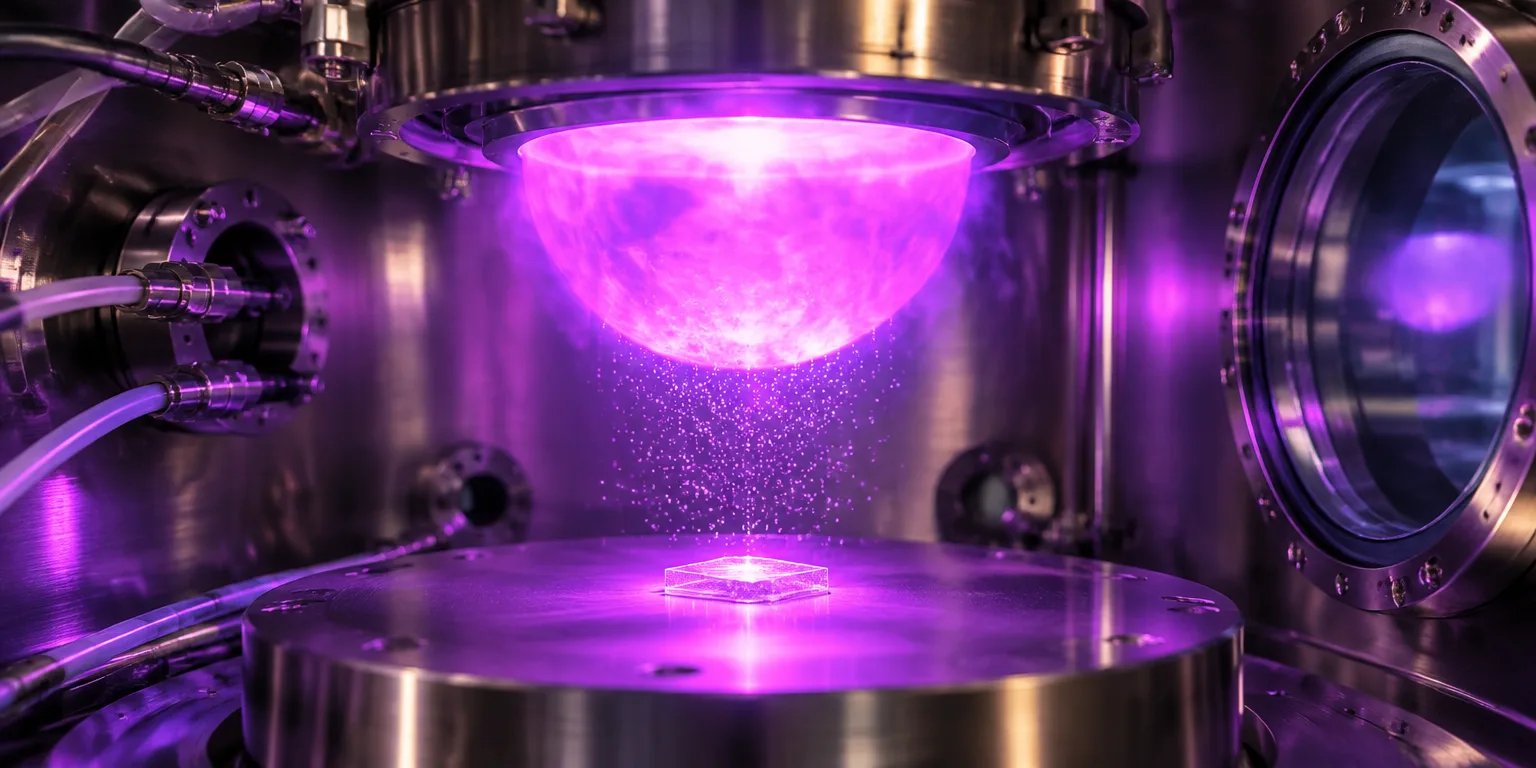
To grow a diamond without mimicking the crushing force deep inside the earth, start with a tiny diamond and make it rain carbon.
That is the essence of chemical vapor deposition, or CVD, one of two main ways to grow synthetic diamonds. Technicians arrange diamond seeds on a surface and place that surface into a chamber. Then they fill the chamber with very pure gases that include a source of carbon.
Microwaves then pump energy into the gases until they become plasma, a superhot, electrically charged state where atoms break apart and float as ions. By carefully controlling the temperature and pressure inside the chamber, scientists coax carbon atoms out of that glowing cloud to fall onto the seeds. There they lock into place, building up diamond one atomic layer at a time.
It is slow work. CVD grows diamond much more slowly than the other main method, which uses enormous pressure and heat to crystallize carbon in minutes or weeks. But what CVD loses in speed, it gains in control. Operators can fine tune the conditions more precisely than they can inside a high pressure chamber.
That precision is the payoff. CVD diamonds are typically made for demanding technical jobs such as optics, systems that pull heat away from powerful electronics, and quantum technology, where even a tiny flaw can matter. Once grown, the crystals are machined to size and tested before use.
Diamond is just carbon atoms bonded tightly together in a repeating lattice, a simple structure that gives both sparkle and extreme strength.
Questions people ask
How long does it take to grow a diamond this way?
It depends on the size and quality needed, but CVD is measured in days to weeks rather than minutes. Carbon adds only micrometers per hour, so thick crystals for optics or electronics require long, uninterrupted runs.
Are lab-grown diamonds the same as natural diamonds?
Yes, chemically and structurally. Both are pure carbon locked in the same tight crystal lattice. The difference is history: one grew over billions of years underground, while the other was built layer by layer from plasma in a lab.
Why would quantum technology need diamond?
Tiny irregularities in the crystal can be exquisitely sensitive to magnetic fields, electric fields, and temperature. Engineers can use those irregularities as sensors, and CVD gives them the clean starting material needed to create the irregularities on purpose.