Navy Pilots Saw Strange Objects Off Virginia Beach That Could Stop Dead and Then Outrun Jets
Pilots tracked objects from the ocean surface to 40,000 feet, then logged one within 50 feet of their jets.
 Popular Mechanics · Navy Officer Says Underwater UFOs Are Legitimate Threats. The Evidence Is Hard to Ignore.
In the summer of 2014, Navy Lt. Ryan Graves was flying a training mission off Virginia Beach, Virginia, when he began noticing strange returns on his F/A-18 radar. The blips held still and then moved with startling speed and precision, and they returned flight after flight.
Graves, a fighter pilot, first dismissed the returns as a glitch. But the anomalies kept appearing on the jets' advanced sensors. The contacts could hang motionless, then sprint away faster than sound, recorded from the ocean surface to 40,000 feet. Graves said they were sometimes stationary at 0.0 Mach, other times moving at 250 to 350 knots, and sometimes supersonic at 1.1 to 1.2 Mach, at "All altitudes" and "always over the ocean."
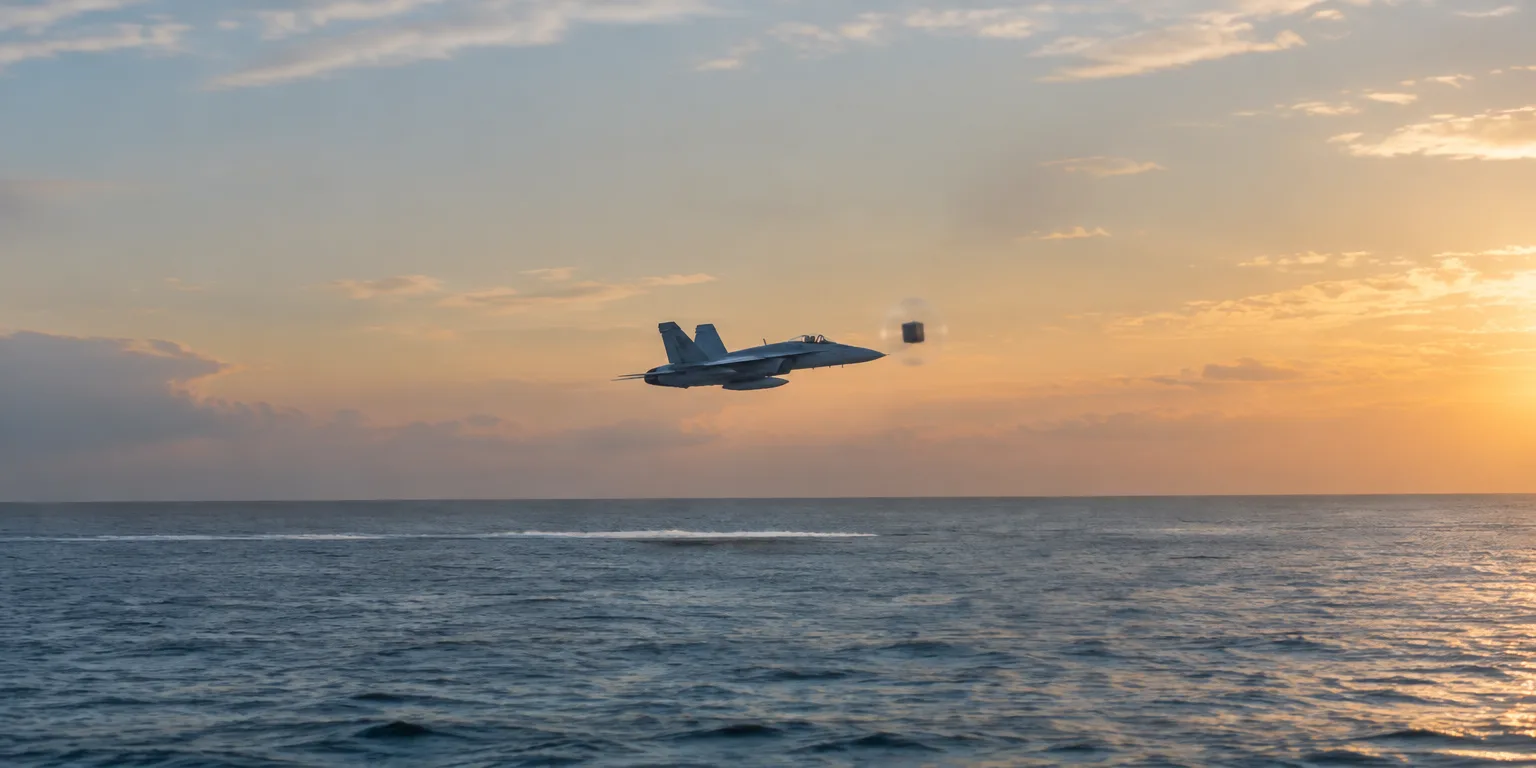
That pattern became the story for his squadron over the next year. Pilots logged unknown contacts nearly every day, sometimes flying alone and sometimes in loose formations. The concern was straightforward and practical: the objects came about 50 feet from their aircraft, close enough that a collision became the worry.
The shift came when an object finally came into view after appearing only as radar glitches. Graves reported seeing a cube, dark gray to black, five to 15 feet across, inside a clear sphere. "That was the turning point," Graves says. "We started treating it as a safety issue."
The objects Graves described showed no exhaust plume, no engine anyone could see, and no wings. Sometimes an object would rotate in place. At other times, it vanished when approached.
On radar and in the air, that behavior challenged what engineers and radar crews thought aircraft could do. An object could sit stationary and then accelerate to 250 to 350 knots, or to 1.1 to 1.2 Mach, without the wings and propulsion pilots expected to see.
For Graves, the point was not one close pass but repetition. Off Virginia Beach, pilots were logging the same round, clear presence again and again, still one moment and supersonic the next.
Questions people ask
What do numbers like 0.0 Mach and 1.2 Mach mean?
Mach is speed measured against the speed of sound. Mach 0.0 means completely still in the air, while Mach 1.0 is the speed of sound, about 760 miles per hour at sea level. Mach 1.1 to 1.2 is 10 to 20 percent faster than sound, speeds fighter jets reach only with powerful engines and a loud sonic boom.
How close is 50 feet for fighter jets?
Very close. Fighter jets on training flights often close at hundreds of miles per hour, so 50 feet can pass in a fraction of a second. At that distance, even a small balloon or drone could damage an engine or canopy, which is why pilots treat any unidentified object that near as a collision risk.
Why would a pilot first think a radar contact was a glitch?
Radar can produce false returns from weather, sea clutter, and software processing, so pilots often treat a single odd blip with caution. In general, an isolated contact may be set aside until there is more to go on.