New York's Underground Grid Is a Mesh, Not a Tree
Each of about 70 underground networks is fed by 8 to 28 separate lines, so power can take another path when one fails.
 Practical Engineering · What's Under Your Feet in New York City?
In most American neighborhoods, your electricity arrives by branch. One transformer might serve several nearby homes, and that transformer connects to one distribution line, and that line runs back to a substation, the facility that steps high voltage power down for local use. It is a one way dead end. There can be a tie to a nearby line that offers backup, but redundancy is not built into the design.
New York City does not work that way. Across the five boroughs, the city operates about 70 separate systems called secondary networks. Each one is supplied not by a single line but by 8 to 28 feeder lines, the high capacity cables that carry power out from an area substation.
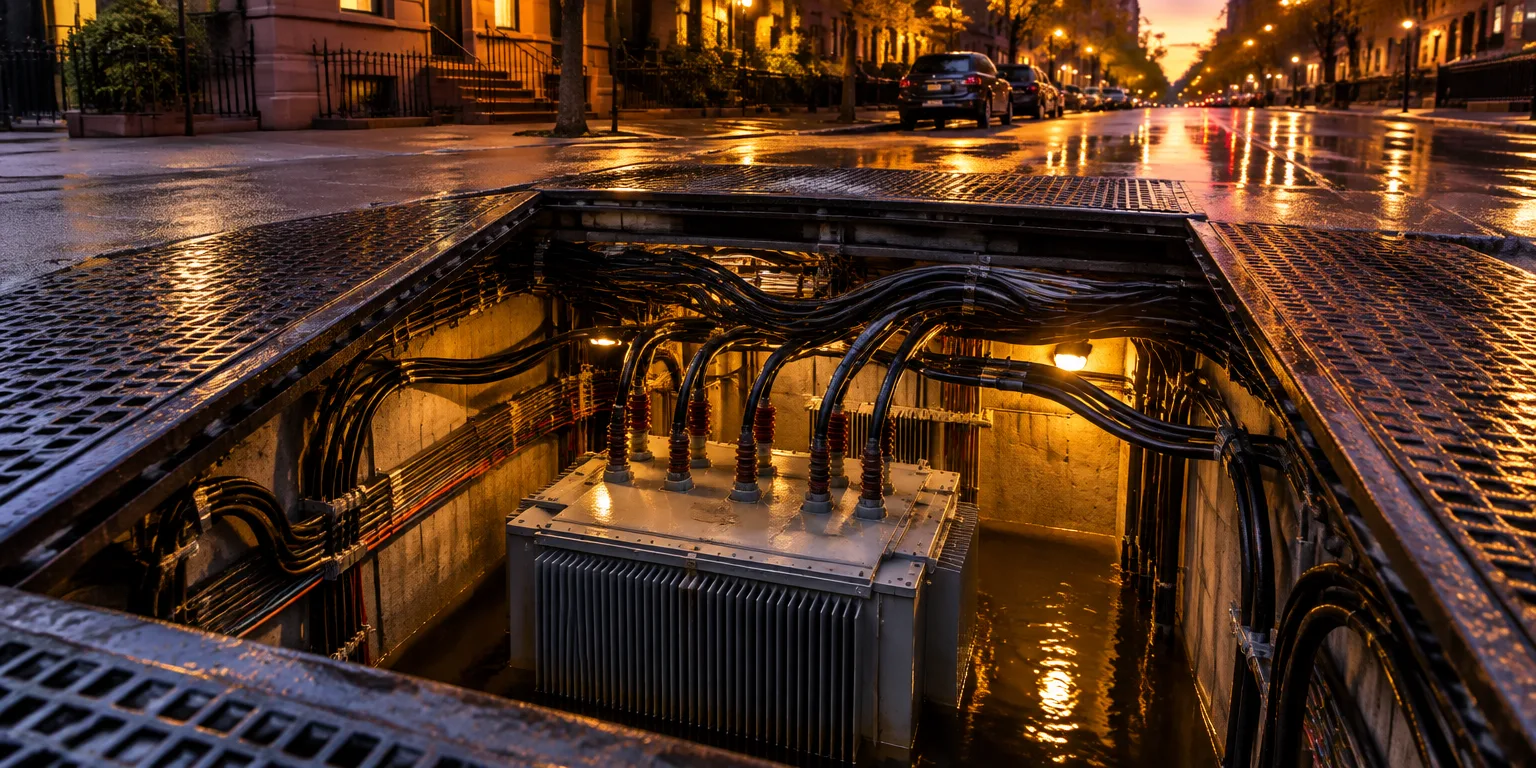
Each feeder connects to its own network transformer, equipment that steps the voltage down again for use in buildings. In New York, those transformers usually sit in concrete vaults below the street. Because the vaults can flood, the transformers must be able to keep running while fully submerged in water.
From those transformers, lower voltage cables spread out to buildings and link together into an actual grid, a mesh of wires with many overlapping paths, rather than a set of separate branches.
If one feeder or transformer fails, electricity can arrive by another route. That redundancy matters in dense areas like Manhattan, where an outage could affect more people than one in the suburbs.
Questions people ask
Why don't all cities use this kind of mesh grid?
Cost and need. A mesh requires many more feeder cables, special transformers, and underground vaults, all of which are expensive to build and maintain. Most suburbs and smaller cities accept occasional outages from a simpler radial system because far fewer customers are affected at once.
What happens when one of the 8 to 28 feeder lines fails?
Customers generally notice nothing. The remaining feeders and the interconnected low voltage mesh pick up the load automatically. Utility crews can then repair the failed cable while the network keeps running, which is the main advantage over a radial branch.
Why do the transformers have to work underwater?
They sit in vaults below street level, where rain, groundwater, and leaking pipes can submerge them. Unlike overhead transformers that stay dry in the air, underground units are sealed and rated to operate while flooded so service continues during storms.