Newton's Physics Still Runs Everyday Life Because We Know Where It Stops
Einstein drew a more accurate map of the universe, but Newton's older one still predicts everyday motion, because physicists are careful about which map to use where.
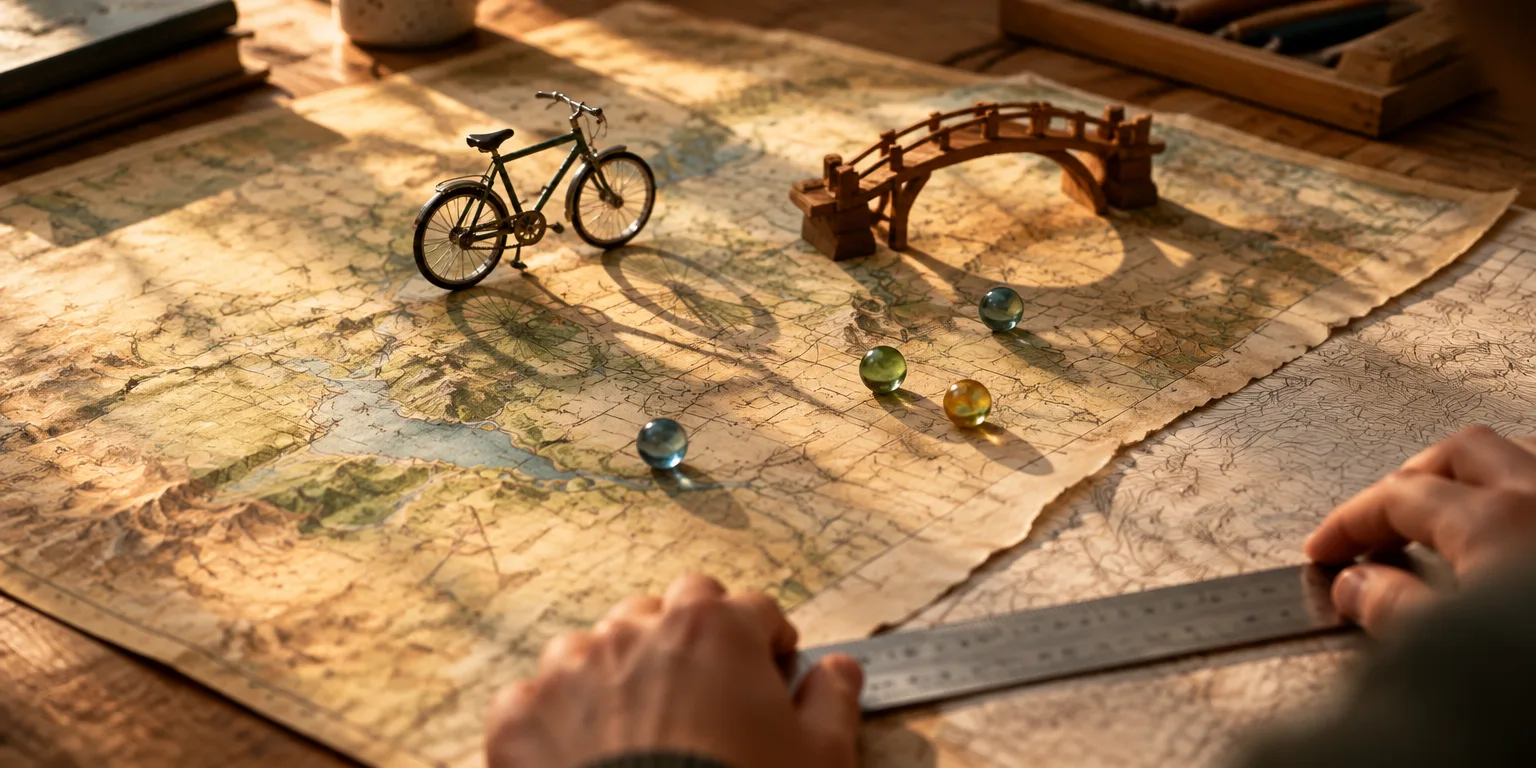
 Farnam Street · The Map Is Not the Territory
Think of a scientific theory as a map and the universe as the territory it describes. A good map simplifies, and it stays useful only while it matches the ground.
For hundreds of years, the map drawn by Isaac Newton, the English mathematician who described gravity and motion, matched very well. It predicted everything from falling objects to the motion of planets.
In 1905, Albert Einstein, the German-born physicist behind relativity, showed that the territory was different from what Newton assumed. At very high speeds, close to the speed of light, time slows and lengths shrink in ways Newton did not predict. His theory of special relativity, which describes space and time at those speeds, gave a more accurate map for those extremes, and later work extended it to very strong gravity.
That did not discard Newton. Newton's equations remain reliable for ordinary speeds and ordinary gravity, the realm of everyday motion, with only tiny errors. Einstein's map takes over where Newton breaks down, near light speed and in very strong gravity, though even Einstein's account is incomplete because it still does not mesh with quantum physics, the science of the very smallest pieces of matter and energy.
The practical result is a division of labor. Physicists spell out where each theory applies, using Newton for everyday motion and Einstein where extreme speed or gravity demands greater accuracy. A still newer theory may someday redraw the map again.
Questions people ask
Where does Newton's map stop working?
It breaks down at speeds close to the speed of light and in very strong gravity, like near black holes or across the whole universe. There, time slows, lengths shrink, and gravity behaves like curved space, effects Einstein's relativity predicts and Newton's does not. For cars, balls, buildings, and even most planetary orbits, the differences are too tiny to matter.
Why can't physicists connect Einstein's physics with quantum physics?
General relativity describes gravity as smooth, continuous curvature of space and time. Quantum physics describes everything else as jittery packets of energy. The math for combining smooth curvature with quantum jitter produces infinities that do not make sense. A theory of quantum gravity, such as string theory or loop quantum gravity, is still unproven.
Do engineers and NASA still use Newton today?
Yes, for almost all everyday engineering and much of spaceflight. Newton's equations are simpler and accurate enough to design bridges, cars, airplanes, and to plot most spacecraft trajectories. Mission planners switch to Einstein's corrections only when extreme precision is needed, as with GPS satellites and Mercury's orbit.