Not Knowing Your Delay Is Worse Than the Delay
Rory Sutherland argues a precise wait time calms passengers more than shaving minutes off the trip.
 Nudge Podcast · #63: Rory Sutherland | Why counter-intuitive thinking wins
Rory Sutherland, the vice chairman of the advertising firm Ogilvy UK, says the best advice of his working life came when British Airways was puzzling over late planes and unhappy passengers. He thought the airline probably had data showing that punctual passengers were happier, and had jumped from that to inferring that punctuality itself drove happiness.
He argued they had mistaken the cause. In his words, "information can solve psychological problems." In Sutherland's view, what makes people miserable when a plane is late may not be the chronological delay but the uncertainty around it.
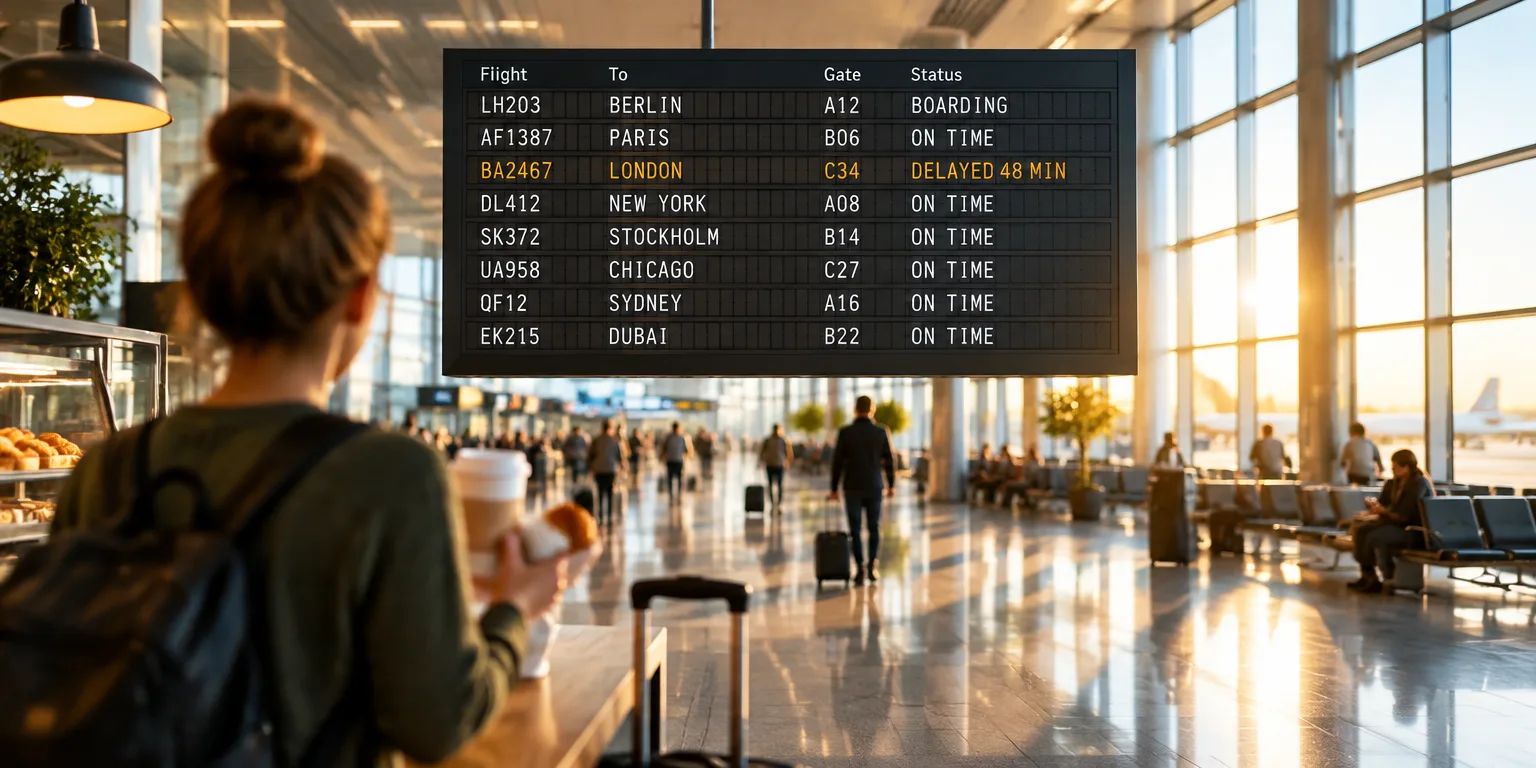
He put it in terms of two departure boards. "BA2467 delayed" leaves a traveler at Gatwick staring at the screen every three minutes, wondering about connections and missed meetings and what to do next. "BA2467 delayed 48 minutes" is a different experience entirely, because the passenger can relax, go get breakfast at the Lebanese restaurant in the North Terminal, and come back.
Sutherland said he lives that way himself. He always allows an hour or two of buffer in a flight, and in a modern airport with WiFi, restaurants, bars, or a lounge, he is unconcerned by delays of less than an hour and a half. During one short delay at Geneva airport, he recalled, he simply went and got his hair cut because there was a barber there.
He believes the same logic applies on the ground. Rail companies, he said, are rewarded or punished on engineering measures like punctuality, which do not match the emotional measures passengers care about. A driver coming on the speaker to explain that the train will be stopped at signals for a few minutes can do more for satisfaction and anxiety than the engineering fixes, he argued.
His example was the dot matrix displays on London Underground platforms. Passengers, he said, are happier waiting 11 minutes when they know the train is coming in 11 minutes than waiting five minutes in anxious uncertainty. Yet funding flows far more easily to a two million pound set of points, the track switches that route trains, than to an information system that improves happiness and repeat use, although the psychological fix may cost a tiny fraction of the engineering one, he argued.
That tradeoff is what he meant when Sutherland wrote in his book, "solving problems using only rationality is like playing golf using only one club."
Questions people ask
Why does not knowing feel worse than waiting?
Yes. Psychologists distinguish the unpleasant event from the uncertainty around it, and uncertainty keeps the brain on alert. A defined wait lets people make a plan, get food, or rebook, which restores a sense of control and lowers stress.
Do airlines and train systems actually tell passengers the length of delays now?
Many now do, at least in part. Airlines, railways, and transit systems commonly post estimated departure times, countdown clocks, and app alerts. The estimates are sometimes imprecise, but even an approximate time reduces the need to keep checking.
If information is so cheap and effective, why is it hard to fund?
Engineering gains are easier to measure and defend. A new set of points produces a clear change in on-time statistics, while happiness, trust, and extra trips are harder to track and credit to one display. Sutherland argues that bias leads agencies to underfund information.