Old trees feed young trees through underground fungi
The oldest trees act as hubs, sending extra sugar to shaded seedlings without being harmed themselves.
 TEDx Talks · Nature's internet: how trees talk to each other in a healthy forest | Suzanne Simard | TEDxSeattle
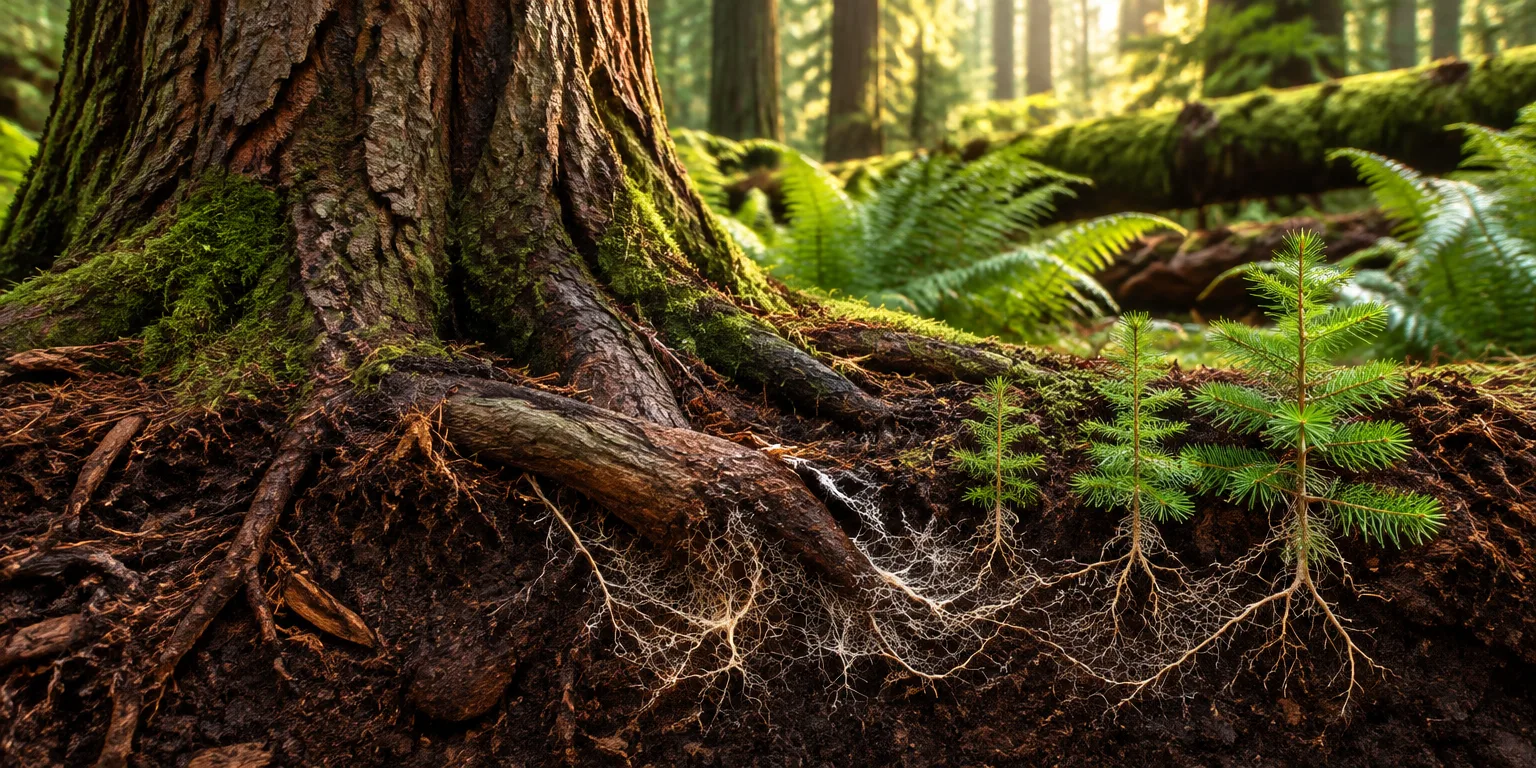
In a healthy forest, the trees are not standing alone. They are wired together underground by fungi, and the oldest trees feed the youngest.
The wiring is called a mycorrhiza, which literally means fungus-root. Forestry scientist Suzanne Simard explains it as a trade. The fungus spreads through the soil, picks up water and nutrients, and brings them back to the tree. In return, the tree gives the fungus carbon-rich sugars made in its leaves through photosynthesis.
That trade becomes a network. In a British laboratory study Simard described, seedlings grown with a mycorrhizal fungus were connected in a web, and carbon moved from one seedling to another.
She later found the same kind of link in a real old-growth forest of Douglas fir, tall evergreen trees native to western North America. Using small differences in DNA to tell fungal individuals apart, her team mapped the connections. In the map, each circle was a Douglas fir tree, with larger, darker circles for bigger, older trees and small, pale circles for seedlings in the shaded understory. The lines between them were the fungal links.
The biggest, oldest trees had the most links. Simard calls them hub trees, and later mother trees, because they nurture seedlings around them. That map showed only two fungal species out of an estimated 100 in that forest, suggesting the full web is far denser.
Food moves through the web where it is needed. By tagging trees with a traceable form of carbon, the researchers watched carbon pass back and forth, in Simard's comparison, like messages through the internet. The carbon flows toward whichever tree is struggling. When a seedling is small, shaded, low on nutrients, or dying, a stronger neighbor sends more carbon, without being harmed itself.
When a young Douglas fir is shaded in the understory, a neighboring birch sends it about 10 percent of its carbon, enough for the fir to one day make seeds. Those transfers improve the survival, growth, and health of young trees.
Questions people ask
What exactly does the fungus get out of this?
A mycorrhizal fungus is a fungus that lives in close partnership with plant roots. Its threadlike filaments greatly expand the root system for absorbing phosphorus, nitrogen, water, and other soil resources, and it receives sugars in return. Most land plants form such partnerships.
How can scientists tell carbon moved from one tree to another?
Researchers feed or expose one plant to carbon dioxide made with a heavier, traceable form of carbon. That distinctive carbon shows up later in neighboring plants connected by fungi, proving movement. Controls without fungal links show much less transfer.
Do trees of different species really share food?
Yes, and that is part of why Simard studied birch and fir together. Different species can be linked by the same fungal individuals when they are compatible with both partners. In the forest research she described, the sunlit birch acted as the strong source and the shaded fir as the receiver.
Does logging break this network?
Clearcutting and replanting single species in neat rows can break or simplify these webs. Young plantations often lack big older hub trees and diverse fungi, so seedlings may get less water, nutrients, and transferred carbon. Retaining older trees and species mixtures is one way foresters try to keep networks intact.