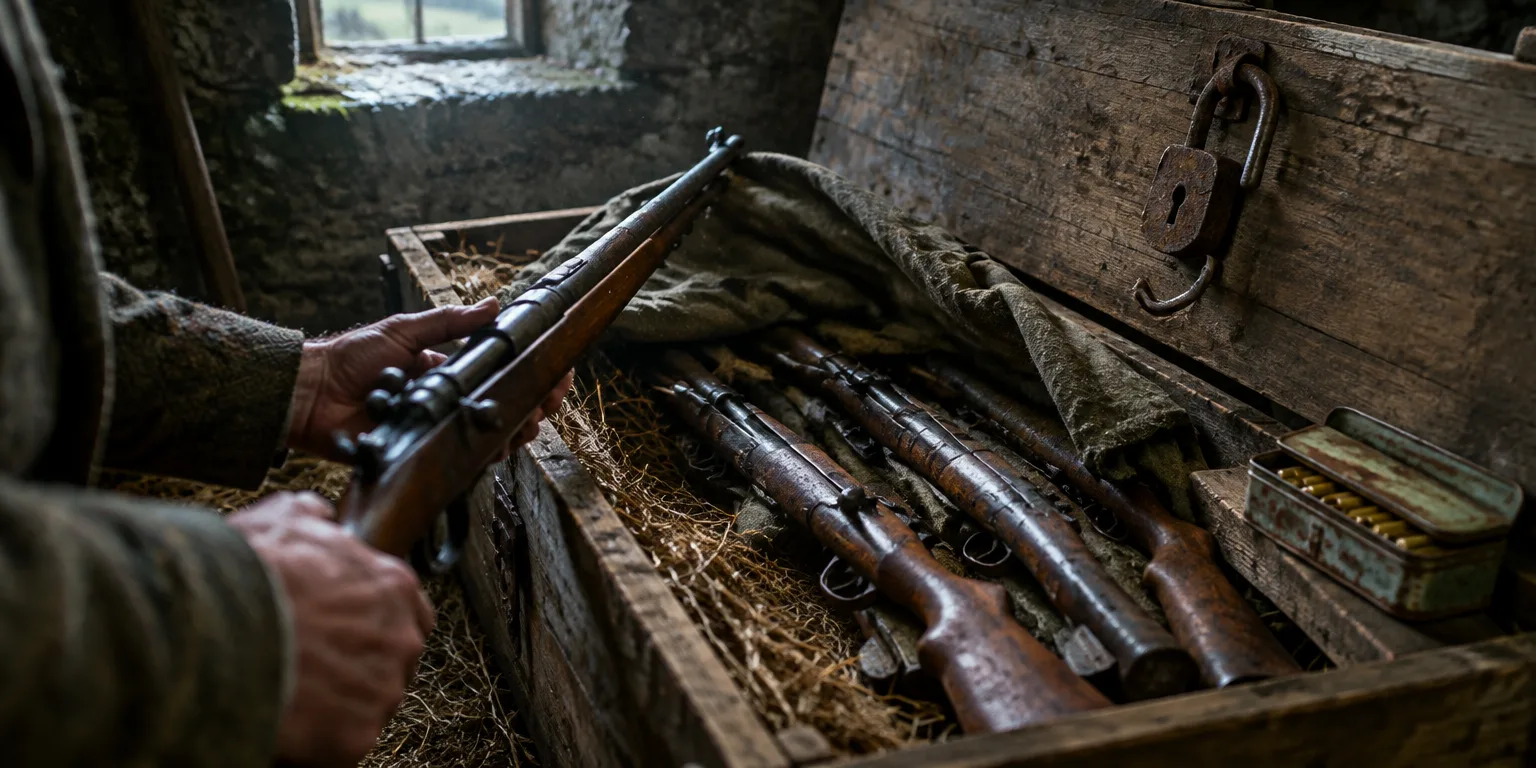
On the eve of the Troubles, the IRA sold many of its rifles to the Free Wales Army
Persuaded to embrace socialism, it was short of weapons when violence returned around 1970.
 The Rest Is History · 697. The Troubles: Murder in Belfast (Part 1)
Only a few years before Northern Ireland exploded into 30 years of killing, the Irish Republican Army, the underground movement committed to ending British rule in the North, had effectively given up on guns.
Its 1956 border guerrilla campaign, called Operation Harvest, had been a complete disaster. Both the Protestant government in Belfast and Eamon de Valera, the leader in Dublin, ordered imprisonment without trial, and the roundup broke the organization.
In 1962 the IRA called off the campaign, dumped weapons, and later sold many of its remaining rifles to the Free Wales Army, a small Welsh nationalist group. The IRA got a new chief of staff from Dublin, Cathal Goulding, who later said, "the notion that the IRA was going to rise up someday and free Ireland and get rid of the British was a ridiculous pipe dream."
Persuaded by Marxist academics and contacts linked to the British Communist Party, Goulding backed a turn to socialist activism and talk of a nonsectarian workers alliance against capitalism and imperialism.
When the IRA returned to violence around 1970, Protestant loyalists, backed by the guns of the armed police reserve known as the B Specials, were probably better armed. The IRA had to scramble for guns that the Free Wales Army would not give back.
Questions people ask
What was Operation Harvest?
Operation Harvest was the IRA's guerrilla campaign from 1956 to 1962, aimed at police stations, customs posts, and infrastructure along the border between Northern Ireland and the Republic of Ireland. It drew little support from Northern Catholics and was shut down by coordinated arrests and internment on both sides of the border.
Who were the Free Wales Army?
It was a tiny militant Welsh nationalist group founded in the 1960s that wanted independence for Wales from Britain. It carried out a few bombings and stunts, never had more than a handful of members, and faded by the early 1970s.
Where did the IRA get guns after giving theirs away?
Mostly from the United States, especially Irish American supporters who raised money and smuggled Armalite rifles, and later from Libya, which supplied large shipments in the 1970s and 1980s. That outside supply transformed the Provisional IRA into a heavily armed group.