Only Hands-On Computing Changes Who Gets to Build
He drew a bunny that moved and made music from paper cards, and concluded only the hands-on version changes who gets to build.
 motivenotes.ai · Against Usefulness
His flight home was delayed, so a venture investor stepped into Mercer Labs, an art and technology museum near the World Trade Center. Inside were 26 projectors and audio that traveled around the gallery while the walls seemed to melt away. The visit transported him and clarified something.
He presents the museum as the opposite of the workshop he had just left. He puts it this way: “Mercer is the consumption version of this future: you stand inside someone else’s computation and watch.”
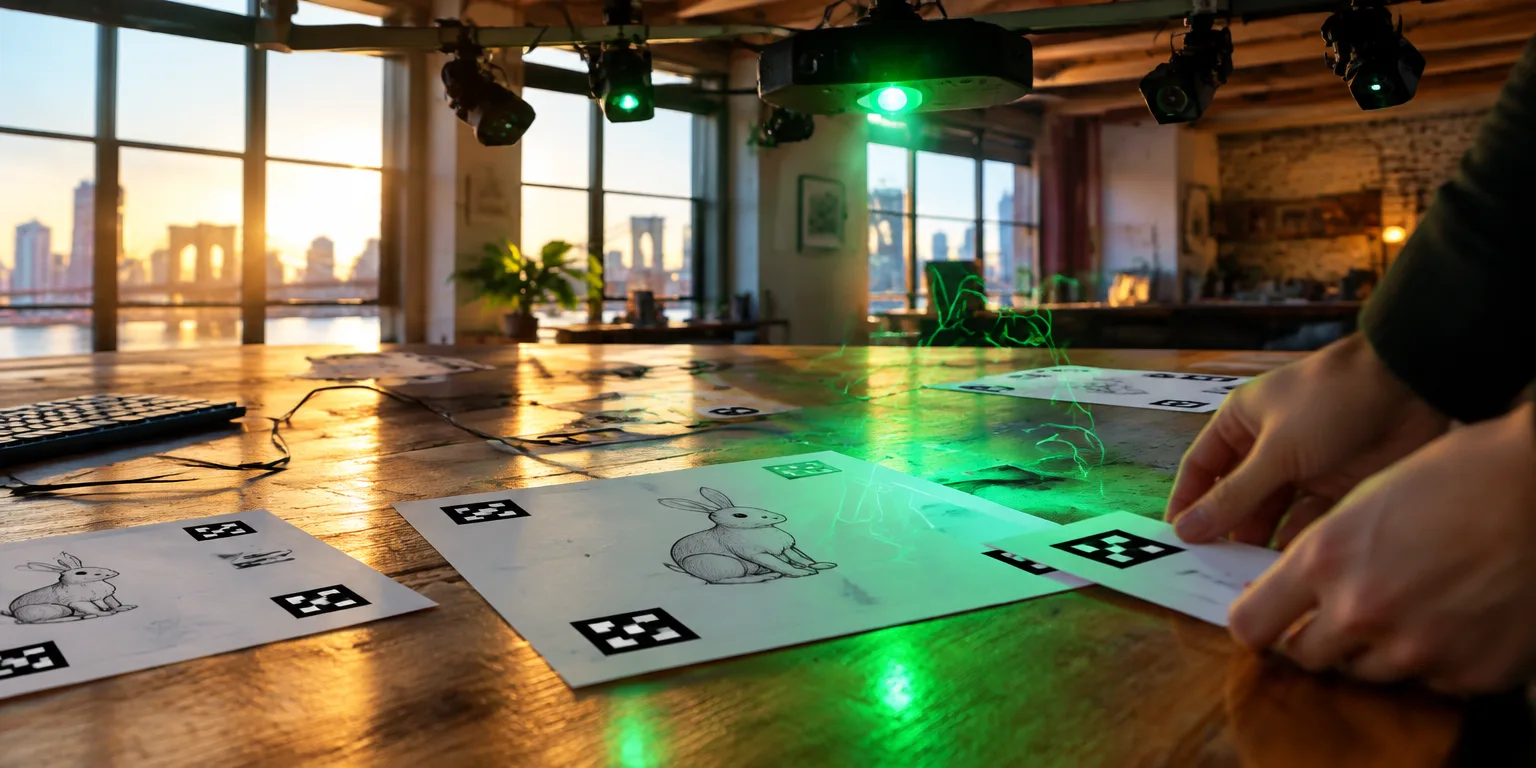
The workshop in Brooklyn held Folk Computer, built by researchers Omar Rizwan and Andrés Cuervo, who had previously worked at Dynamicland, the Oakland lab started by Bret Victor. Overhead cameras keep track of tagged paper sheets that act as programs, and projectors show the results on the tables and walls around them, using locations in the room instead of points on a screen. As he describes it, “The computer is the room.”
Rizwan, one of its makers, handed him a paper program and set it down for the table to run. He attached a keyboard, typed a line of code, saved, and the sheet glowed green. After he detached the keyboard, the program continued to glow where it lay. Nearby, the investor drew a bunny one frame at a time and saw it begin to move. Then he and Rizwan made music by laying down cards between them, each card a track. He heard himself say, “I don’t need the monitor anymore.”
He calls it the most human programming he has ever done, programming with his whole body alongside another person, with, in his words, “almost no distance between the idea and the thing.”
Only the version with the marker changes who gets to build. His phrase for Brooklyn is “you pick up a marker and the room becomes yours.”
Questions people ask
How does a piece of paper run a program?
Overhead cameras read small tags on each sheet, so the system knows which program is which and where it sits on the table. Overhead projectors then display the output right on and around the paper, using real room positions measured in meters rather than screen pixels. Move the paper, draw on it, or place cards beside it, and the program updates.
What is Mercer Labs?
Mercer Labs is a large, ticketed museum of art and technology in lower Manhattan, known for projection mapped rooms and spatial sound that surround visitors. You walk through as an audience member, and artists and technologists control what you see and hear. It is immersive, but you do not change the work by entering it.
Can I try Folk Computer myself?
Yes, by design. Folk Computer is published as an open source project, and strangers have already added programs such as a music sequencer made from physical cards. Setting one up still takes cameras, projectors, and some technical care, so most people start by following the project online or contacting its makers.