OpenAI began with 12 people in an apartment who had no idea what to do
It spent four and a half years with no product, no customers, and no normal way to tell if the research was working.
 David Senra · Sam Altman on Building OpenAI & Betting on the Impossible
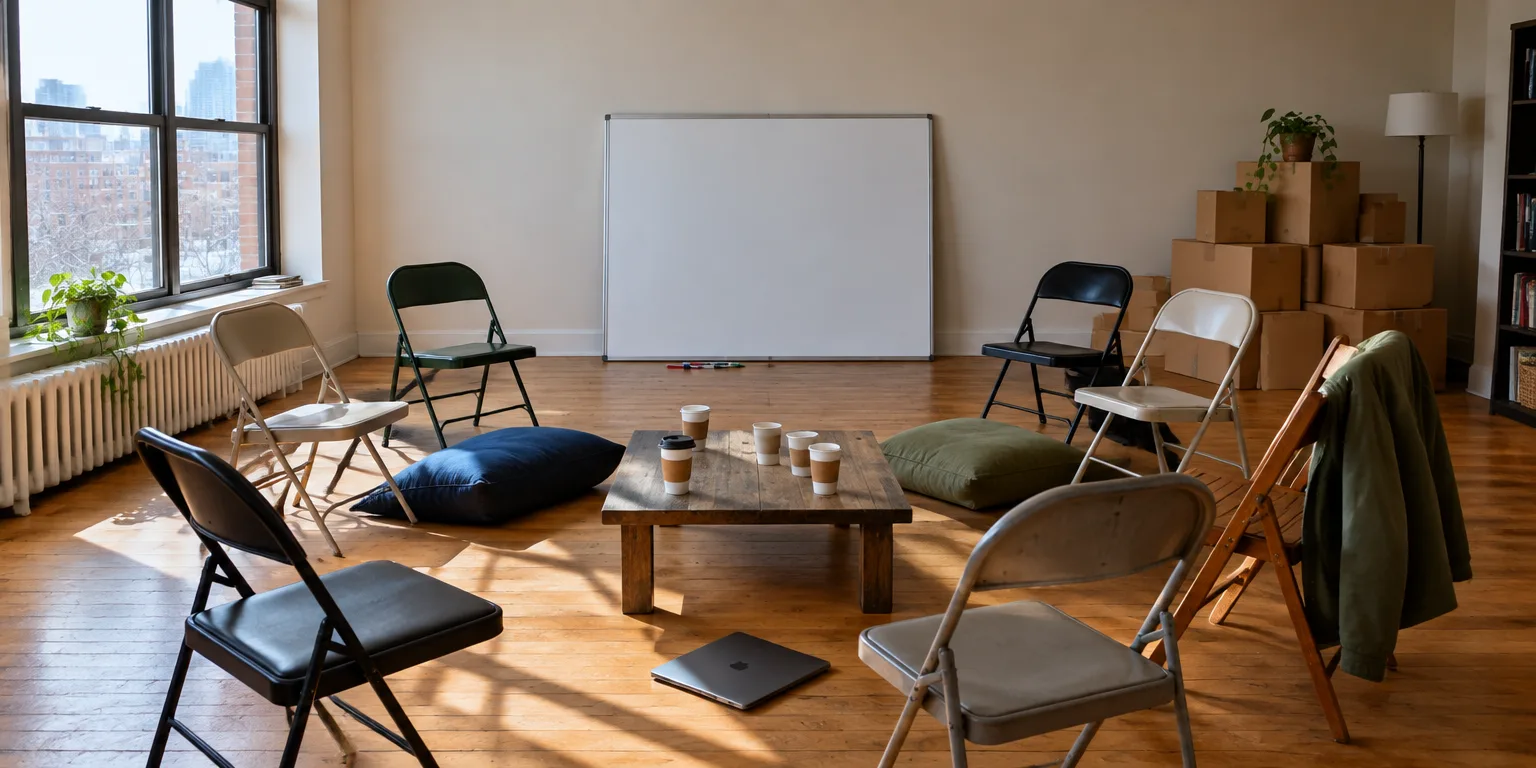
On a Monday morning in early January 2016, about a dozen people walked into Greg Brockman's apartment for the first day of OpenAI. Sam Altman, the entrepreneur who helped start the company, remembers the excitement feeling "like the first day of school."
Then someone said they should get a whiteboard. Someone went to find one, carried it back in, and everyone looked around again.
Nobody knew what to do. There was no product to build and no customer to call, just a stated goal of making artificial general intelligence, machines that can do the work people can do. That confusion is the start of a strange business story, because OpenAI then went four and a half years without releasing a product, the opposite of normal startup advice. About a decade after that morning in the apartment, roughly a billion people were using its work.
Altman calls that morning in the apartment one of his clearest "I have no idea what I'm doing" moments. The energy in the room collapsed, he said, after the whiteboard arrived and the same question hung there: what were they supposed to do now?
What followed was years of improvisation. Altman's dominant memory of those early days is "trying and failing to raise money," with no big profitable business to fund research the way older labs had, like Bell Labs, which was paid for by a telephone monopoly. The team read books about Bell Labs and Xerox PARC, famous research labs of the past, called veterans including computer scientist Alan Kay for advice on how to run a research lab, and tried substitutes for the usual signal from customers.
One substitute worked. While teaching software to beat people at the video game Dota 2, they posted an internal leaderboard that showed which research ideas were performing best, and researchers wanted to climb it. Fake deadlines, Altman said, did not work.
Slowly the group figured out how to pick research ideas and judge whether they were paying off. A paper on finding sentiment without supervision grew into an early version of the language model that would become GPT, and work on scaling laws gave them confidence that bigger models and more computing power would keep improving results.
It is still disorienting to Altman to connect the two ends, a dozen people in an apartment without a whiteboard, and then a product used by a billion people. "None of us have any idea what we're going to do," he remembers thinking that first morning. Then they started stumbling forward anyway.
Questions people ask
Why did OpenAI wait so long to release a product?
It was set up as a research effort to build advanced AI, not as a normal software startup. The team spent years testing basic ideas about language models and how performance improves with scale before it had anything reliable enough to sell or share widely.
What are scaling laws in AI?
They are observed patterns showing that language models tend to get predictably better as they get more parameters, data, and computing power. OpenAI's research on those patterns gave the team confidence to spend heavily on larger training runs. The idea is widely used across the industry today.
What was the Dota 2 project?
OpenAI built software that learned to play the complex team video game Dota 2 and eventually beat top human players. It was a public test of reinforcement learning, where software improves by trial and error. The internal leaderboard from that work helped motivate researchers even before OpenAI had paying customers.