Quantum computers run on waves, not parallel universes
The power comes from controlling how waves line up, the same physics behind music and images.
 Computerphile · Shor's Algorithm for Quantum Computing - Computerphile
Phil, a physicist brought in to explain the quantum half of a famous code-breaking algorithm, started with a complaint. He said he wanted to get away from "this nonsense of we have an infinite number of parallel realities and we just magically magic the answer out of nowhere."
He put the same point more plainly. He argued that "all of quantum mechanics and all of quantum computing we can reduce to exactly that." Quantum computing, he said, is "about adding up waves in just the right way," with interference doing the work.
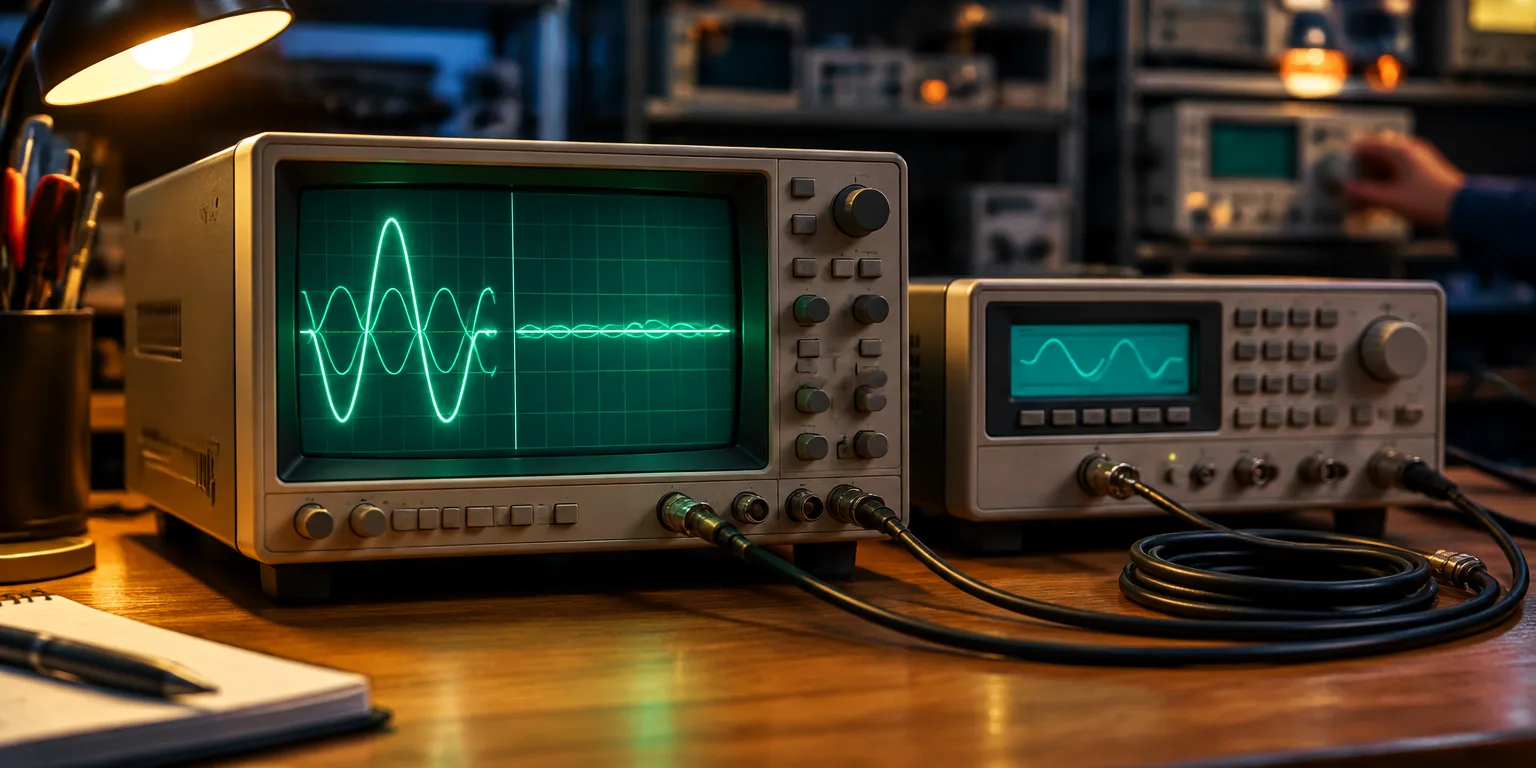
To prove it, he turned to equipment that was not quantum at all. On a signal generator and an oscilloscope, he added two waves together. When their peaks lined up, they reinforced and made a big result. When he shifted the alignment, what physicists call phase, they canceled out. In between was a smooth continuum, not an either-or switch, all controlled by phase.
That, he said, is exactly the mechanism that underpins a quantum computer. There is nothing quantum about interference itself. It is pure classical physics.
So he rejected the familiar coin flip metaphor, that a qubit is amazing and bizarre because it is heads and tails at once. The mixed state of the qubit, with the odds shared between zero and one, is called superposition, he said, meaning waves adding together rather than choosing one outcome. That adding is not bizarre, he said. Waves do that kind of adding everywhere.
Phil said his own voice was a good example. The audience was hearing superposition in action, he said, because the tone of his awful brogue, as he called it, comes from many sound waves adding together. Every musical instrument does the same thing, and every image does too.
He added that a person can keep the books however they like. If someone wants to describe the math as if many worlds exist, that is fine, he said, but they should not mistake the model for what is physically real. There is no empirical evidence that those other worlds exist.
Phil closed by saying everything he had described happened in this universe. No infinite pixies in other universes did the calculations for us, Phil said. "Just this universe is enough. More than enough." Phil added that the brightness of the wave acts as a map, where brighter means more likely to find the particle there.
Questions people ask
If it is just waves, why can't an ordinary computer with sound or light do the same work?
Ordinary waves can interfere, but they do not scale the same way. In a quantum computer, each added qubit doubles the number of wave amplitudes stored in the joint state, so 300 qubits describe more amplitudes than there are atoms in the observable universe. Classical waves would need a physically separate wave for each possibility, which quickly becomes impossible to build.
How do you actually control interference inside a real quantum computer?
In the trapped-ion machines Phil described, each qubit is a single charged atom held in vacuum, with two atomic states serving as zero and one. Researchers use precisely timed microwave pulses to adjust the odds of each state, and then let the states evolve so their phases drift in and out of alignment. That controlled drift is what creates constructive and destructive interference.
What happens when you measure the result?
Measurement gives only one outcome, with odds set by the final wave pattern, so researchers must prepare, run, and measure the same process many times and average the results. In the code-breaking case, the interference is arranged so the desired rhythm, the period that reveals the factors, becomes the most likely outcome. Reading that peak then lets ordinary computers finish the factoring.