Reflected radio waves can swell to as much as double the voltage
When reflections are bad, the peaks can reach up to twice what went in, and a long line gives them room to build.
 Veritasium · The Scariest Chart In Electrical Engineering
Philip H. Smith was a young Bell Labs engineer sending radio signals from New Jersey across the ocean. When he sent power down a long line to his antennas, part of it bounced back. The outgoing and returning waves added in some places and canceled in others, leaving a pattern that stays fixed in place where they overlap. Engineers call it a standing wave. When reflections are bad enough, the peaks can climb to as much as double the voltage that was sent in, enough to burn out a line not rated for it.
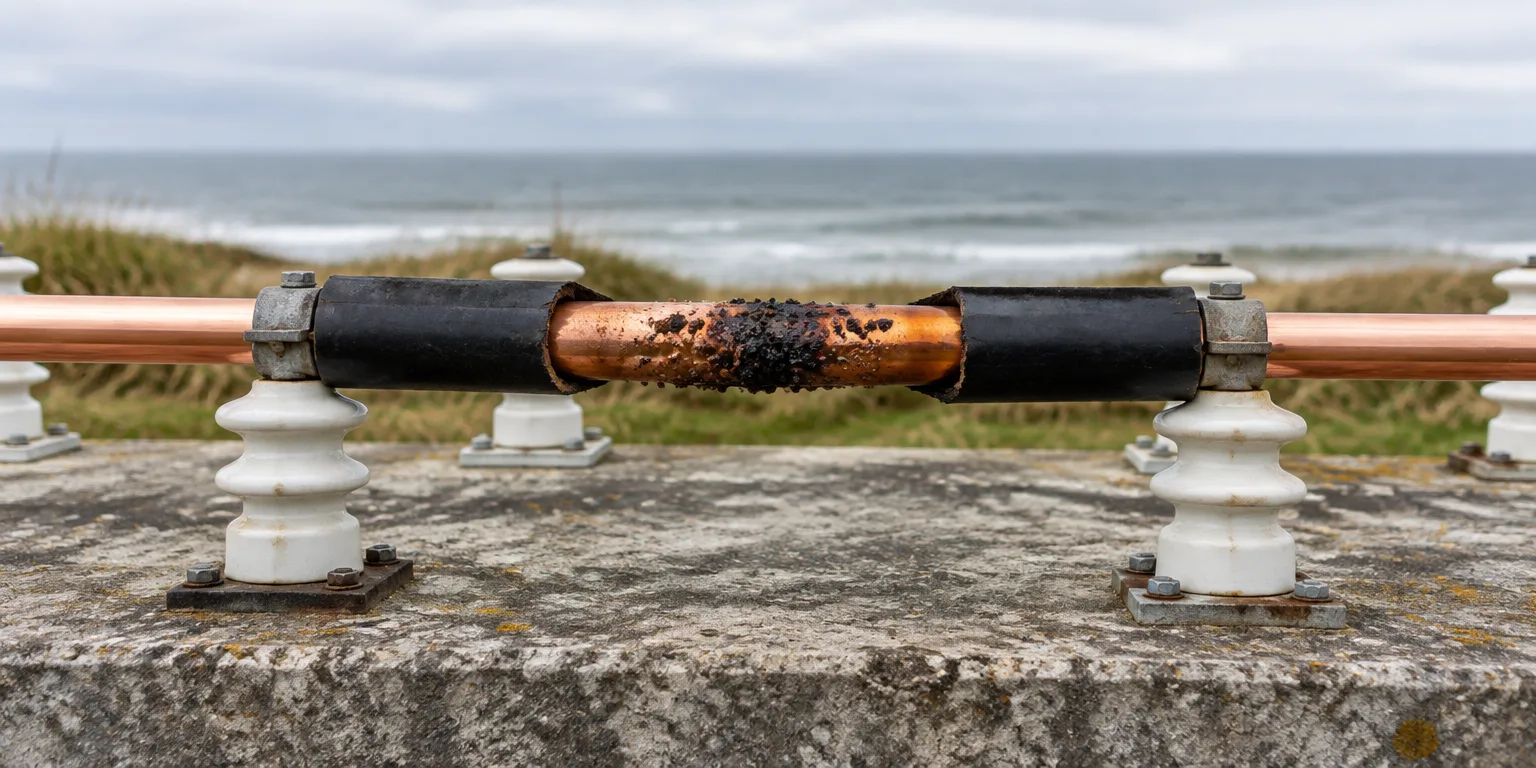
A speaker describing the damaged line says, "There was a huge reflection, and a powerful standing wave did this to the inner conductor of that transmission line."
Household power is safe because its wave dwarfs any wiring in a house: it alternates 50 or 60 times a second, so its wave is about 5,000 to 6,000 kilometers long. A 10-megahertz radio wave has a wavelength of about 30 meters. Smith's line ran more than two kilometers, many times longer than such a wave, which is why reflections were significant. In a scaled model of his setup in an anechoic chamber built to cut interference, the team expected minus 55 decibels but measured minus 59, and that 4-decibel drop means a loss of more than half the power.
Questions people ask
Why up to twice the voltage?
Voltage adds like waves in water. Where crest meets crest you get roughly double the height, and where crest meets trough you get near zero. A standing wave is the stable pattern left when an outgoing wave and its reflection keep overlapping in the same place.
What does a 4-decibel loss mean?
Decibels are logarithmic, so small changes mean large power differences. A drop of 3 decibels means about half the power is gone, so a 4-decibel drop means more than half was lost.
How do engineers stop the reflection?
Engineers match the antenna to the line so little reflects, a process called impedance matching. That can mean adding extra lengths of wire or side branches that cancel the reflection, rather than adding a resistor that would waste power as heat.