Removing a Road Can Make Traffic Move Faster
When every driver rationally picks the fastest-looking shortcut, they clog it, and the whole system slows down.
 Curiosity Chronicle · The Traffic Jam Theory of Success
It sounds backward, but researchers have watched it happen: close a road, and cars start moving faster.
The idea comes from German mathematician Dietrich Braess, who in 1968 built a numerical model of traffic to study how drivers choose routes. He added a shortcut to his pretend road network, expecting trips to get quicker. They got slower.
The reason is not bad driving. It is individually smart driving that adds up badly. When a new shortcut appears, each driver makes the same self-interested calculation: that looks fastest for me. So nearly everyone floods into it.
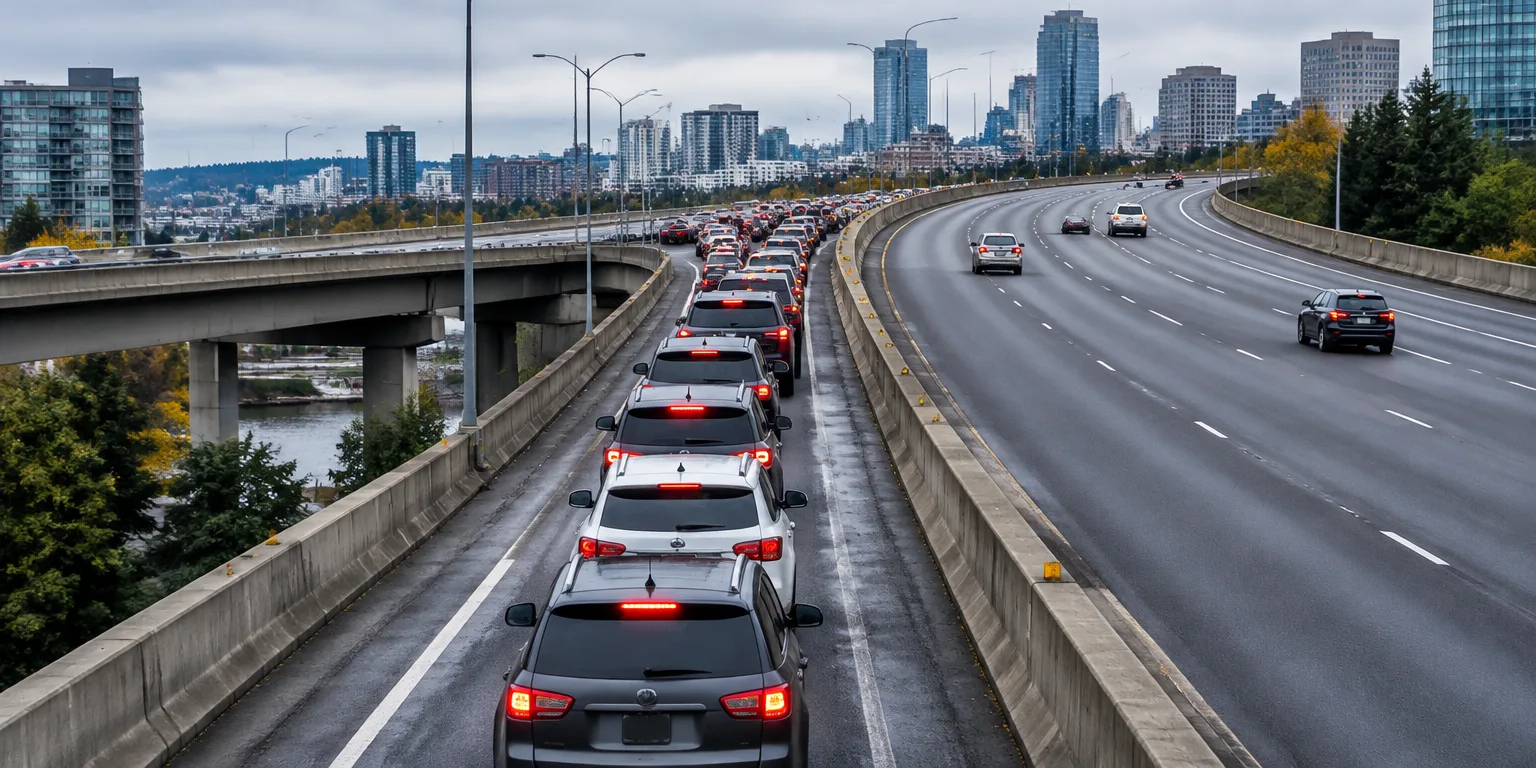
The shortcut then stops being a shortcut. As writer Sahil Bloom puts it, "the fast lane becomes the slow lane." By all trying to optimize at once, drivers clog the one road they all picked, and average travel time ends up worse than before the extra capacity existed.
That is why subtraction can help. Take the tempting shortcut away, and drivers spread back out across the other routes. No single road stays jammed, and the whole system can flow better.
It is not just math. In Seoul, South Korea, taking out an expressway to help restore the area eased traffic nearby.
The lesson is that traffic is collective. What is fastest for one driver, if every driver does it, can be slowest for all of them.
Questions people ask
Why don't drivers just avoid the crowded shortcut?
Each driver picks what looks quickest for them alone, without accounting for the fact that hundreds of others are making the same choice at the same time. The road that looks fastest empty becomes the most crowded once everyone acts on that logic.
Has this happened anywhere besides Seoul?
The account mentions a variety of real-world case studies, with Seoul given as one example. That suggests the pattern is not limited to the model. This story stays with the Seoul example because that is the case detailed in the source.
Does adding a road always make traffic worse?
No. In Braess's model, the slowdown comes when many self-interested drivers with similar trips all choose the same new link. When trips are more varied, or that link does not attract the same crush, added capacity can help. So the paradox describes one possible outcome, not every outcome.