Rivers Branch Because Sharing Big Channels Wastes Less Energy
The most efficient streams steal water from their neighbors until the whole network settles on the cheapest route downhill.
 Quanta Magazine · Why Are Rivers So Mathematical?
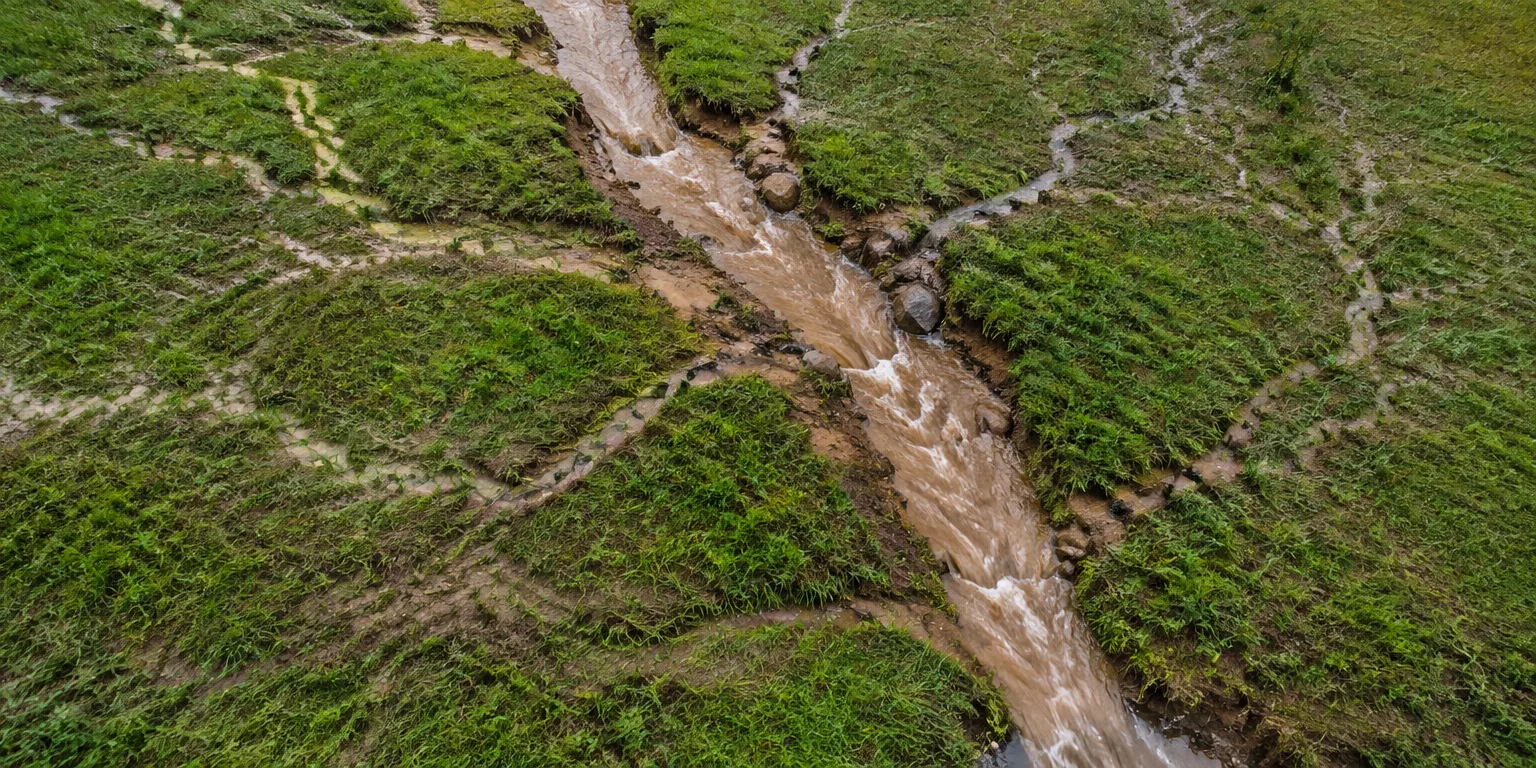
The cheapest way to drain a wet field is to share the plumbing. To see why, imagine a model used by river researchers: rain falls evenly on a square field, and all the water must leave through a single outlet point. Digging a separate straight ditch from every patch of ground to the exit would require a huge amount of channel. It saves effort to let tiny trickles join into larger side streams that feed one big trunk channel.
That sharing is the logic behind branching rivers. When short tributaries share long trunk streams, water may travel a longer path per drop, but the connected system loses less energy to friction, the rubbing of water against bed and banks that slows flow and wears away rock.
Computer tests support the savings. In the early 1990s, Andrea Rinaldo, an Italian hydrologist, and colleagues simulated many possible networks and found that the most energy efficient ones followed a rule seen in real rivers worldwide, called Hack's law, in which a stream's length grows with its drainage area to the 0.6 power. Elongated main streams let more tributaries pile into the same large channels, cutting the total cost of moving water downhill.
The models suggest rivers arrive at that tree shape through erosion. In the 1990s, geomorphologists built landscape evolution models that start with water running downhill over slightly bumpy ground. A tiny dip collects a little more runoff, so it erodes a little faster and gets deeper, so it pulls in still more water.
That feedback turns into theft. A fast growing streambed can reach toward its neighbor and intercept its runoff. The winner extends its course and gains flow, while the loser shrinks or vanishes. Gravity supplies energy to the flowing water. Friction dissipates that energy. In these simulations, layouts that force water along wasteful routes erode rapidly and change, while layouts that route water more effectively are more stable and persist. Over thousands of years in the models, the network moves toward that lower friction form and keeps adjusting it, although researchers say many questions remain.
Questions people ask
What does friction actually do in a river?
In these models, friction is the way flowing water loses energy as it drags against the bed and banks. That loss is also what wears rock away, so friction both dissipates energy and drives erosion.
Can part of a river change within a person's lifetime?
Yes. Floods can shift a channel, cut off a bend, or move gravel and sand in days. Those are local changes, much smaller than the reorganization of a whole network, which the models show unfolding over thousands of years.
What is a drainage area?
It is the area of land whose rainfall flows into a particular stream. Every upstream trickle counts toward the stream below it, so drainage area grows larger as one moves downstream toward the outlet.