Rivers Grow Long Faster Than Their Basins Grow Big
Stream length grows as basin area to the 0.6, not the expected square root, so big basins end up long and thin.
 Quanta Magazine · Why Are Rivers So Mathematical?
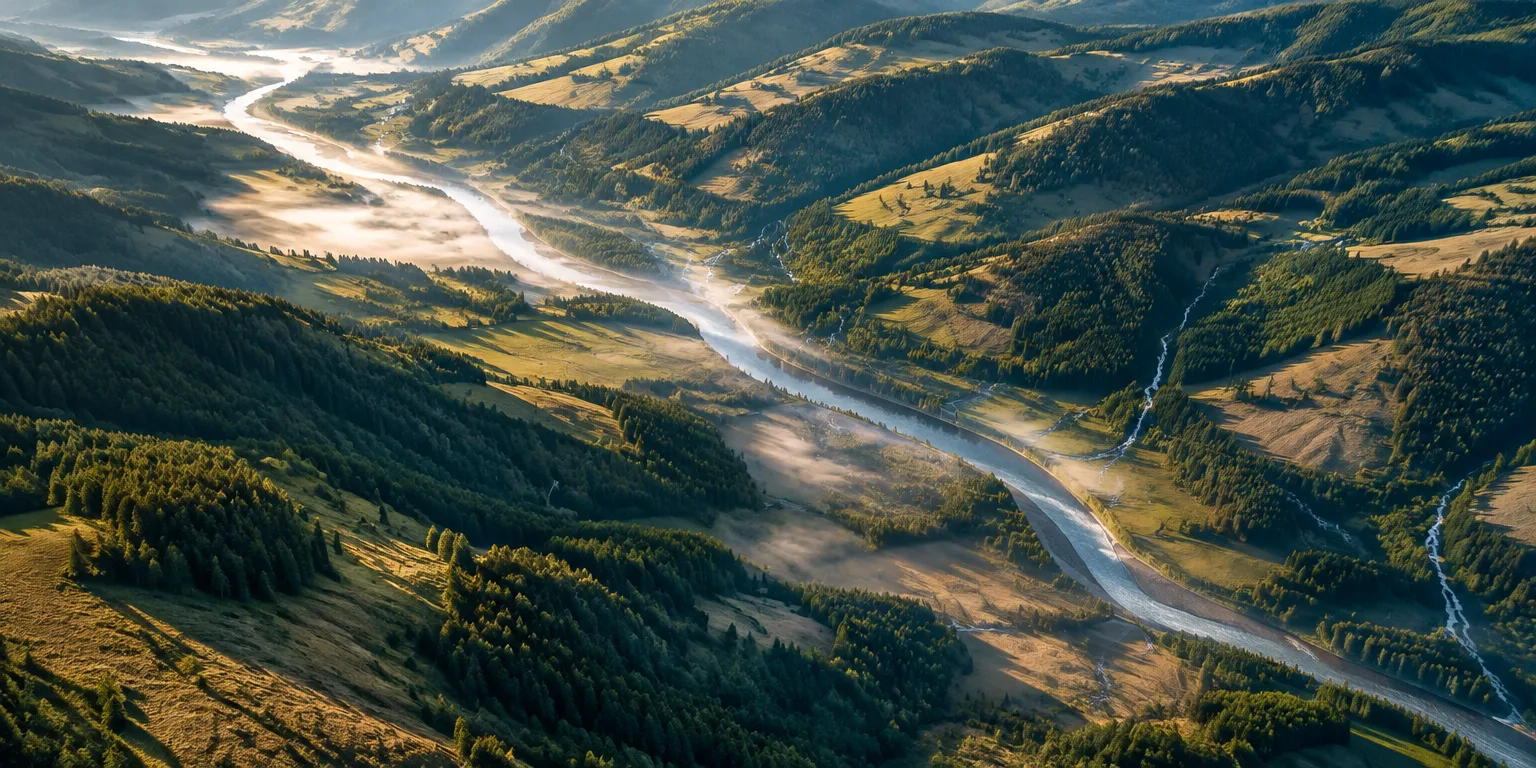
Satellite data show rivers around the world share a strange math rule, with a bit of variation around it. A stream's length grows as its basin size to the power 0.6, where the basin is the land area that drains into it.
The pattern was first spotted by John Hack, a scientist with the Geological Survey, who measured streams and basins in Virginia and Maryland. “The general regularity of the relation is nevertheless remarkable,” Hack wrote. “Stream lengths tend to increase proportionally to the 0.6 power of the drainage area, regardless of the geological or structural characteristics of the area.” Later data showed the rule has held worldwide.
The surprise is that the number is not 0.5. On an idealized square patch of land drained by a stream as long as one side, length would equal the square root of area. Small and large basins would then have the same proportions.
Instead, length grows faster than area, so large basins are longer and thinner than small ones. “Hack’s law is still the big question,” said Hansjörg Seybold, who studies mountain landscapes at Austria’s Academy of Sciences. Daniel Rothman, a geophysicist at the Massachusetts Institute of Technology, described the outcome this way: “small basins are short and squat, and large basins are long and thin.”
Questions people ask
How do scientists measure a river's length and drainage area?
Today they mostly use satellite elevation maps and digital river networks. Software traces downhill flow to outline each basin and measures the longest channel from headwaters to outlet. Field surveys and stream gauges help check the maps in complicated terrain.
Do leaf veins or blood vessels follow Hack's law too?
They branch in a similar treelike way, but they do not follow Hack's law exactly. Each system has its own constraints, such as leaf shape, heartbeat pressure, or road cost. Rivers are unusual because such different landscapes converge on the same 0.6 power.
Why would a big basin be long and thin rather than round?
No one knows for sure, which is why researchers still call it the big question. What is clear from the measurements is the pattern itself: length grows faster than area, so big basins stretch longer and thinner than small ones.