Roman Harbor Concrete Gets Stronger After 2,000 Years Underwater
Salt water seeps in, dissolves lime, and triggers crystal growth that tightens the concrete instead of rotting it.
 Medieval Wisdom · Why Roman CONCRETE Lasts 2000 Years While Ours Dies in 50
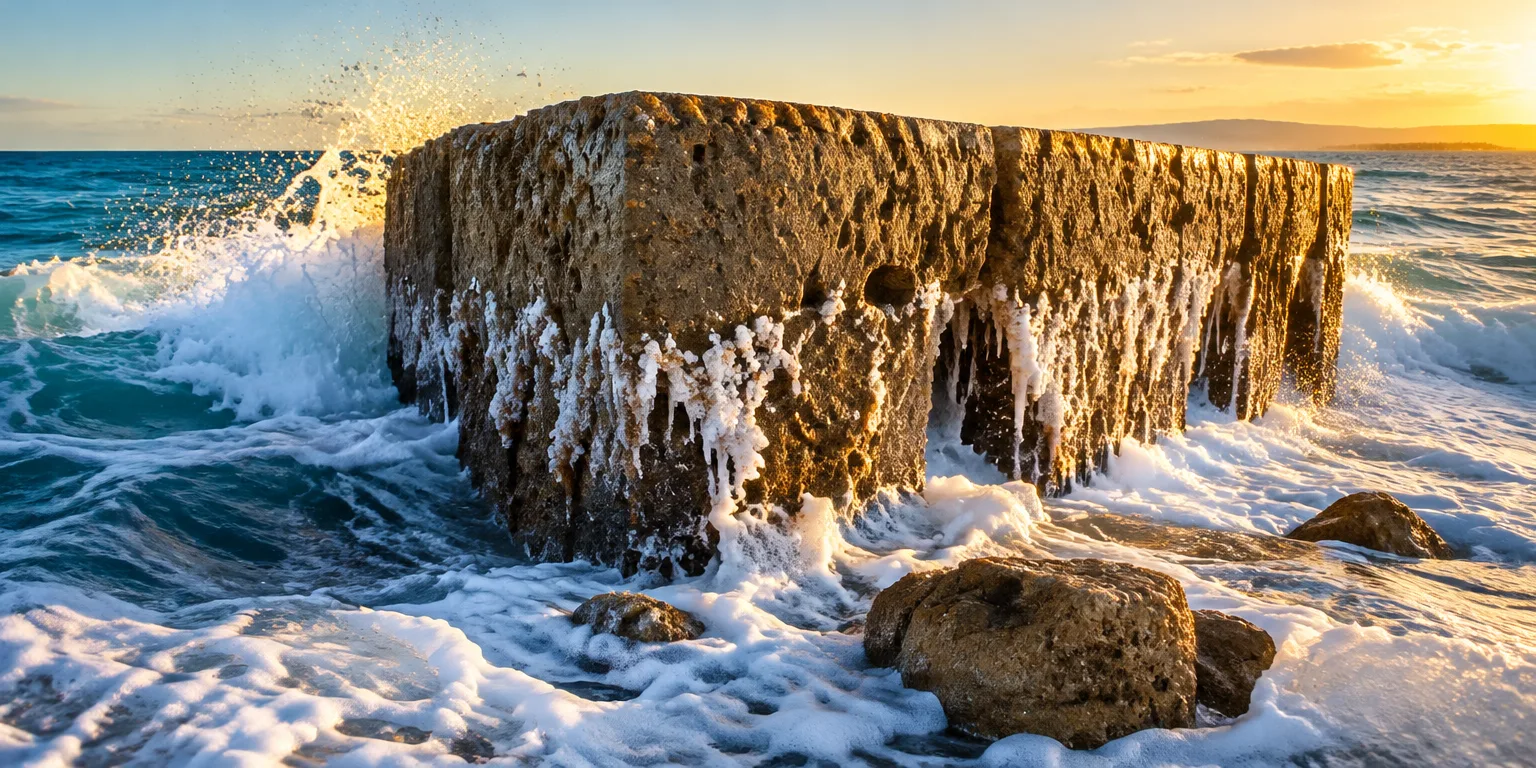
Off an ancient harbor, huge Roman concrete piers were built directly into the rough sea. After 2,000 years under seawater, parts of them are still intact.
That alone would be remarkable. Modern concrete in seawater often starts to break down in 20 to 30 years, as salt and water work their way inside. The Roman material did the opposite. It came out stronger.
Seawater is the reason. Roman concrete is porous, so seawater seeps in. As it moves through, it dissolves lime contained in the concrete.
That dissolved lime then reacts with volcanic ash, another core ingredient of the Roman mix. The reaction produces a rare mineral, called aluminum tobermorite, in the form of microscopic plates and crystals.
Those crystals do more than plug holes. They interlock and bind the material together, filling pores and strengthening the bonds inside the concrete, rather than just hardening.
The striking part is the timeline. Researchers at the University of Utah found that these crystals keep growing for thousands of years. Each assault by seawater dissolves a little more lime, forms a little more crystal, and leaves the structure more resilient.
Modern concrete is designed to keep water out. Once salt water gets in, the damage compounds. Roman harbor concrete lets the sea in, so the longer the ocean pounds it, the stronger it becomes.
Questions people ask
Did Roman concrete last only underwater?
No. The Pantheon in Rome, a 142-foot dome with no steel reinforcement, has also survived for about 2,000 years on dry land. The harbor piers are the clearest example of seawater helping, but Roman concrete was unusually durable in many settings.
What exactly is aluminum tobermorite?
It is a rare, hard mineral that forms when dissolved lime reacts with volcanic ash. In Roman concrete it grows as thin, interlocking plates that fill pores and strengthen bonds in the material.
Why don't builders just copy the Roman recipe today?
The chemistry is only part of the difference. Roman harbor concrete used lime and volcanic ash that can form strengthening crystals, and it contained no steel to rust. Modern concrete typically relies on steel reinforcement, and when salt water reaches that steel it rusts and breaks the concrete apart.