Rosalind Franklin Saw a Helix Clue in Photo 49 and Finished Other Work First
Her notes flagged a possible spiral in DNA's natural form, but she stayed on the dry form while Maurice Wilkins showed her B-form photos to James Watson.
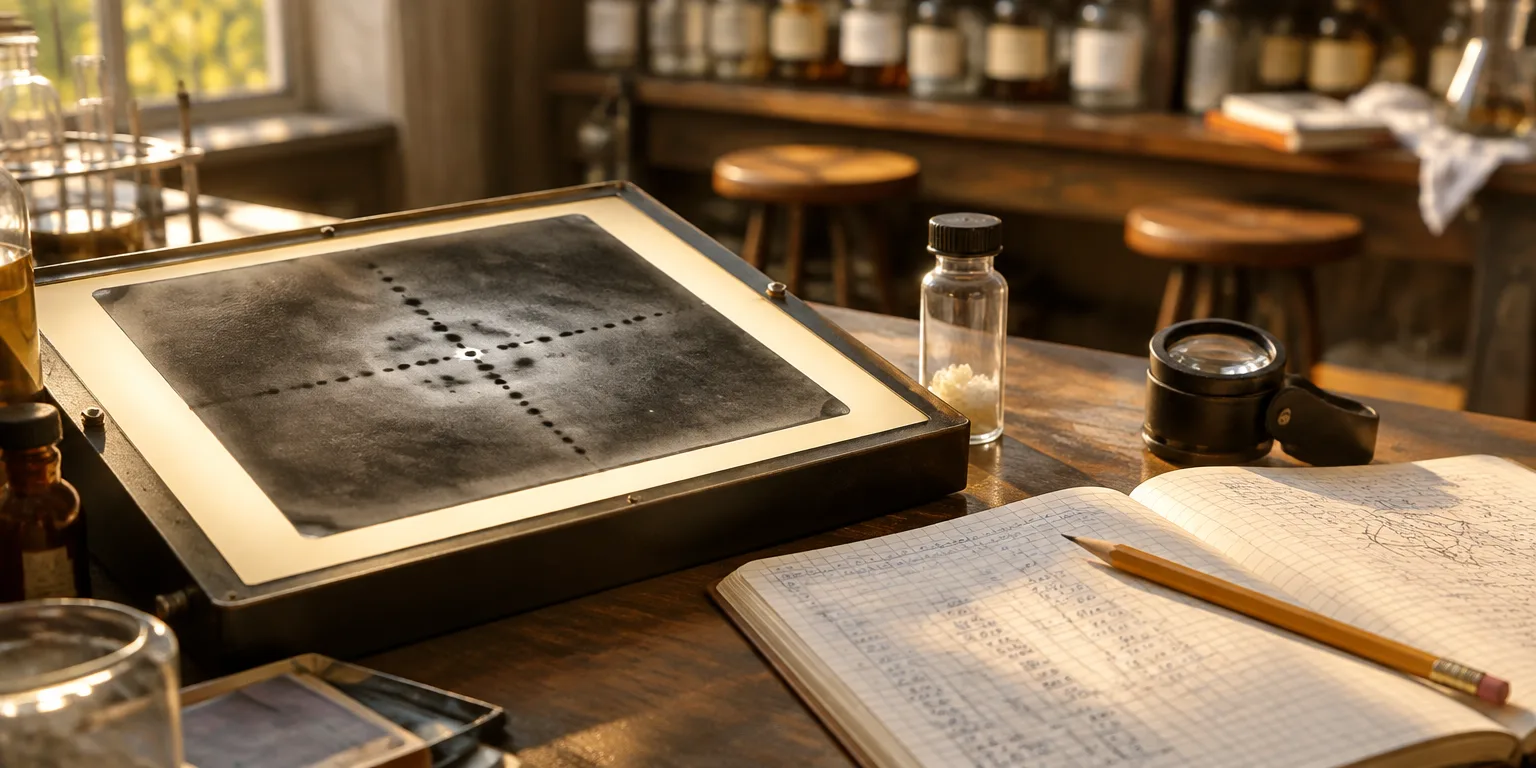
In May 1952, Rosalind Franklin looked at an X-ray image of DNA called Photo 49 and started work the same day on another exposure of the same sample. She wanted a sharper, more refined version, what would become famous as Photo 51.
Her notebooks show what she saw in that first image. In notes on Photo 49, she flagged a possible spiral shape and rich structural information.
In her thinking, the two pictures had different jobs. Photo 49 was the experimental image that revealed exciting new data, and Photo 51 was the showcase print meant to carry those findings with maximum clarity and sharpness.
That distinction matters because it shows she understood the clue. Her research plan, written in February 1952 at King's College London, was to untangle two forms of DNA, then known as A and B, and she chose to characterize A first.
The B form, shown in Photos 49 and 51, was the double helix found in nature. The A form is the shape DNA takes when dried out in the laboratory, and in pictures it looked richer in data, so Franklin set out to fully describe A before turning to B.
While she did that painstaking work, her King's colleague Maurice Wilkins showed her B-form photographs to James Watson, a young American scientist working at Cambridge with Francis Crick. Watson, Crick, and Wilkins then built a detailed model of the double helix.
The three men shared the Nobel Prize for that work less than a decade later. Franklin had died of ovarian cancer in 1958, which made her ineligible for the prize and left her insights to come to light only much later.
The account comes from Alistair Sponsel, a historian of science at the Science History Institute in Philadelphia, and Brian Sutton, a molecular biophysicist at King's College London. Working from a newly acquired archive of Franklin and graduate student Raymond Gosling, plus King's records, they trace why she did not rush Photo 51 into print.
Questions people ask
What was a DNA photograph in 1952?
X-ray crystallography bounces X-rays off a crystal of molecules and records how they scatter. The resulting pattern of spots and crosses does not look like a molecule, but scientists can work backward from the geometry to infer the shape, much like deducing an object from its shadow.
Why did the dry form look more promising?
In living cells DNA is usually in the B form, surrounded by water. The A form appears when DNA is dehydrated, and the molecules pack more compactly and orderly. That order can give sharper spots on an X-ray film, which is why Franklin judged it richer in information.
Could Franklin have shared the Nobel if she had lived?
Nobel Prizes are not awarded posthumously, except when a winner dies after the announcement. If Franklin had lived until the 1962 prize, the committee could have considered her, but it limits a prize to three people at most, so her inclusion would have raised difficult questions about whom to include.