Rosalind Franklin saw DNA's spiral before Watson and Crick did
Her notes on an earlier, blurry image show she grasped the spiral and held out for a better picture.
 Global News Podcast · Trump strikes deal with Putin to buy Russian diesel
The instant James Watson saw the picture, he later said, his mouth fell open.
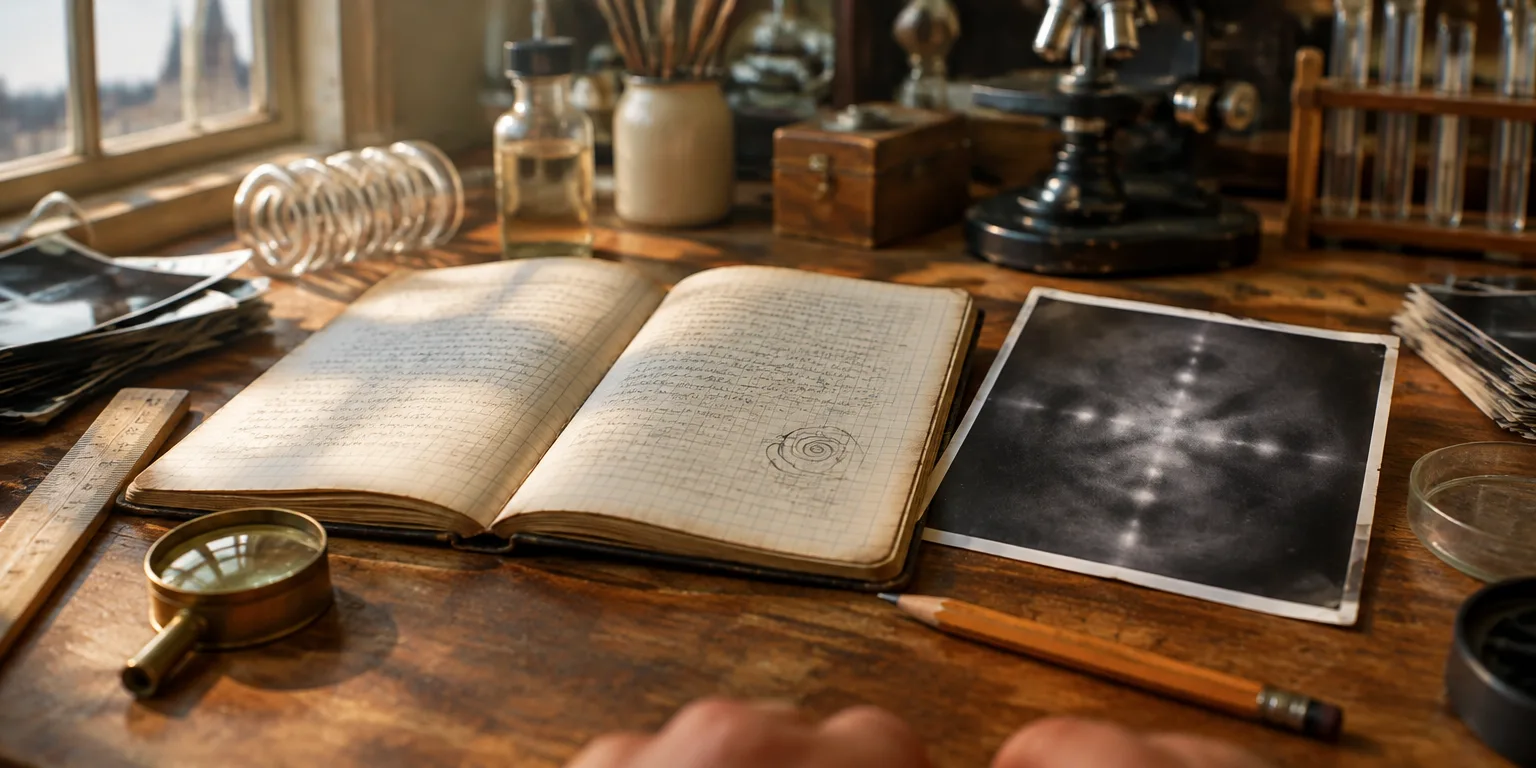
Watson was looking at an X-ray image called Photo 51. It showed a blurry cross of spots, the shadow of a molecule too small for any microscope to see. To Watson, it meant that DNA, the molecule that carries inherited instructions, had to be shaped like a twisted ladder.
The image had come from the X-ray research of Rosalind Franklin, the scientist whose work produced both Photo 51 and an earlier, less sharp image. It was shown to Watson and Francis Crick without her consent. The two men went on to build the famous model of the double helix and to win a Nobel Prize. Watson later said Franklin had not understood her own picture and had missed its meaning.
A new examination of her laboratory notebooks points the other way. Two researchers dug into the notebooks, the instruments, and the camera work behind the pictures, instead of relying on Watson's telling. They found that Franklin had written notes on the earlier image, Photo 49, showing that she had already recognized the spiral shape.
Photo 49 was misaligned and a little blurry, and Franklin wrote notes on it while she worked toward a sharper picture. She did not feel she had to take notes on Photo 51, said Betty Smocovitis, a historian who discussed the finding, because laboratory notebooks are private and are not publications.
Smocovitis said Franklin did see the helix and "wanted to perfect the image." The earlier picture, Smocovitis said, "did not meet her standards for publication" and for giving the most information. She could have made the case with Photo 49, but it was not good enough.
The widely accepted account came from Watson's version, Smocovitis said. In his telling, Franklin did not see it and did not grasp what mattered. Many writers and historians followed him, she said, without closely exploring Franklin's notebooks and practices.
Smocovitis said she shows her classes a film version of the DNA story in which the line, "She didn't see it," appears just as the music shifts. That moment paints Franklin as someone who missed the clue entirely. The notes on Photo 49 show that is not true.
Questions people ask
Who was Rosalind Franklin?
Franklin was a British chemist and expert in X-ray crystallography, a method that uses X-rays to reveal the arrangement of atoms in crystals. She ran the DNA work at King's College London in the early 1950s and later did important work on viruses. She died of ovarian cancer in 1958 at age 37, four years before the Nobel Prize for DNA was awarded.
Why didn't Franklin share the Nobel Prize?
The prizes for the structure of DNA went in 1962 to Watson, Crick, and Maurice Wilkins, Franklin's colleague. Nobel Prizes are not awarded after death, so Franklin could not have shared it. Historians now argue she deserved full credit alongside them for the discovery.
Why would a scientist wait instead of publishing right away?
She was cautious because a blurry or tilted image could support more than one shape, and she wanted measurements precise enough to rule out alternatives. Scientists usually wait until evidence meets the standard for publication, especially for a claim as large as the structure of DNA. In this case, waiting allowed others to publish first using her unpublished image.