Scots Tested a Haunting by Seeing if Bones Bled
After a stonemason's wife found bones and fresh blood, officials lined up former residents to touch them and watch for a sign.
 After Dark: Myths, Misdeeds & the Paranormal · Scotland's Worst Poltergeist
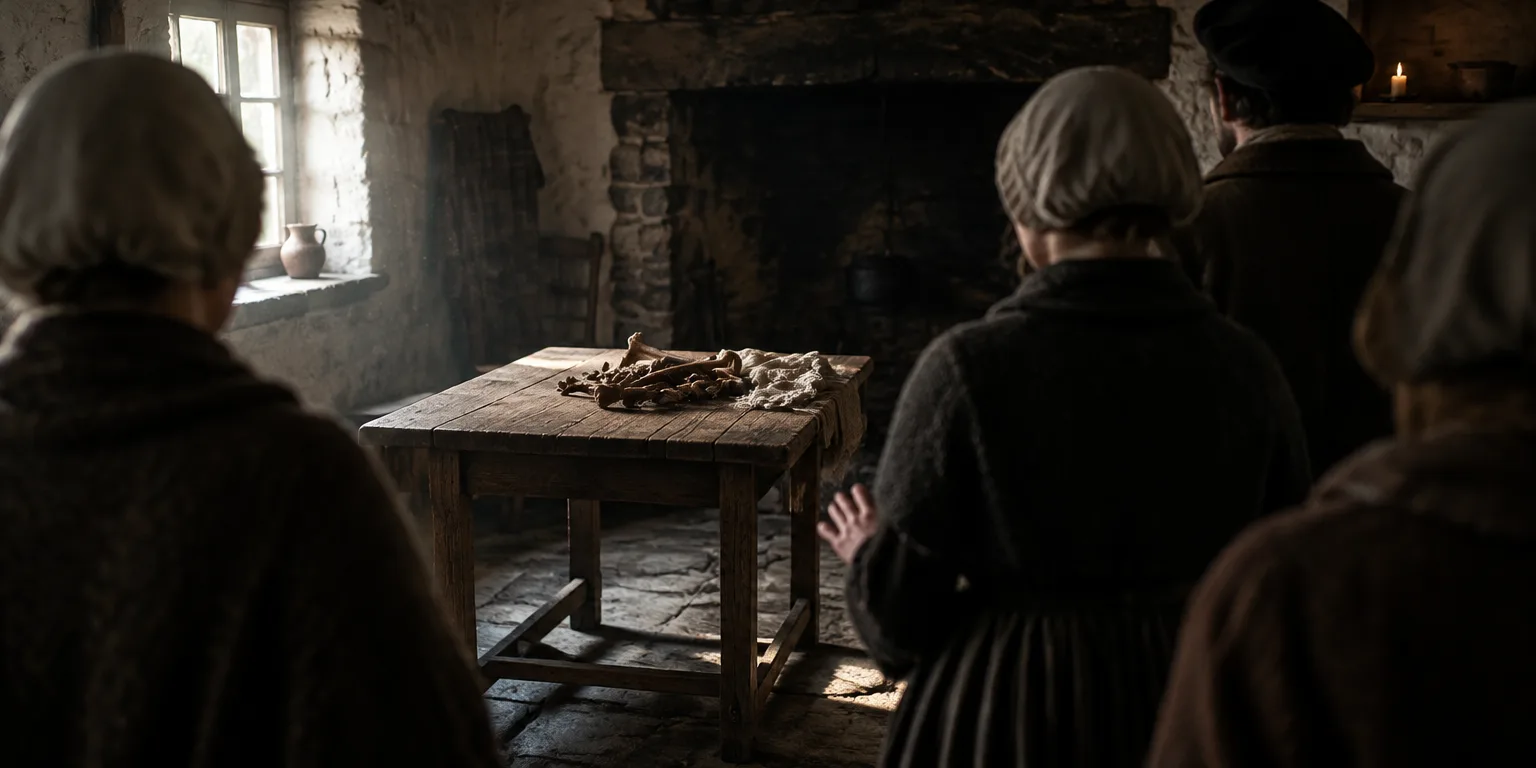
When Andrew Mackie's wife uncovered a buried cache at home, she found a handful of bones with bits of tissue and what looked like fresh blood.
She was understandably alarmed, and she carried the find to the local authorities. Her family, headed by Mackie, a stonemason in Scotland, was already reporting stones thrown at them, sudden fires, and cattle strangely tethered and tormented.
That next step was a normal way at the time to test a strange claim, by having respected local people come along to attest to what happened. According to historian Martha McGill, Scots relied on such communal testimony to prove or demonstrate that something strange was happening.
An earlier lead had already failed. An earlier household that had occupied the house had reported repeated misfortunes and felt under a curse. The son said an old witch had blamed a tooth buried under the hearth, which had to be uncovered and destroyed to lift the curse.
Later occupants dug up something shaped like a tooth beneath the hearth and smashed it. The disturbances continued, so investigators set witchcraft aside and considered murder.
Perhaps, they reasoned, someone had killed and hidden a victim in the house, and the victim's ghost was tormenting the new household. To check, they turned to an old belief called cruentation, the belief that a corpse could bleed when its killer came near.
Officials invited everyone who had lived in the house over the previous twenty years or so to handle the remains and watch for blood. Cruentation was understood as a sign from God, who would expose a hidden killing through blood.
Nothing happened. No fresh bleeding appeared, and the murder explanation was dropped as another dead end.
Alexander Telfair, the local minister who recorded the case and gathered sworn statements from neighbors, returned to his main conclusion. The trouble at Ringcroft, he wrote, was the work of the Devil.
Questions people ask
Did people really believe a body would bleed near its murderer?
Yes. The belief, known as cruentation, held that a corpse would bleed in the presence of its murderer through divine intervention. It appeared in legal and popular writing in Europe for centuries, and was sometimes staged as a public test when murder was suspected.
Why did a minister carefully document a poltergeist?
Telfair said he published the Ringcroft account to refute atheism. Ministers and writers at the time collected sworn testimony and physical details to argue that spirits were real, and that the Devil could torment households with God's permission.
How did the Ringcroft haunting end?
According to Telfair's pamphlet, the disturbances began in February and ended on May 1. The Mackies temporarily left the house while neighbors moved in, then later returned. What became of the family afterward is not recorded.