Small Gifts From 120,000 Readers Paid for the Statue of Liberty's Pedestal
He promised to print the name of anyone who gave even a penny, and more than 120,000 people answered.
 Founders · Joseph Pulitzer: The Inventor of Mass Media
France had covered the cost of the statue, while Americans were expected to fund the base it would stand on in New York. By the time Joseph Pulitzer got involved, fundraising had essentially died out and the project was still short by more than $100,000.
Pulitzer, the new owner of the New York World, knew about long odds. The reluctant owner was railroad baron Jay Gould, who said, "I never cared anything about the paper," and, "The World had an anemic circulation of 15,000 and was losing money every week." It had never earned a profit in the four years Gould owned it. Pulitzer still went nearly $500,000 into debt to buy it, only a few years after he had risked nearly everything he had on a failing paper in St. Louis.
This is the story of how Pulitzer used that shaky paper to pull off an early version of mass crowdfunding, asking thousands of ordinary readers for small gifts, and made the paper itself a success in the process. He believed a newspaper should make enemies constantly, saying, "The most valuable and most successful paper will generally be that which has the most enemies." He was also skilled at pairing the two halves of this campaign: the campaign drew attention, and that attention raised circulation.
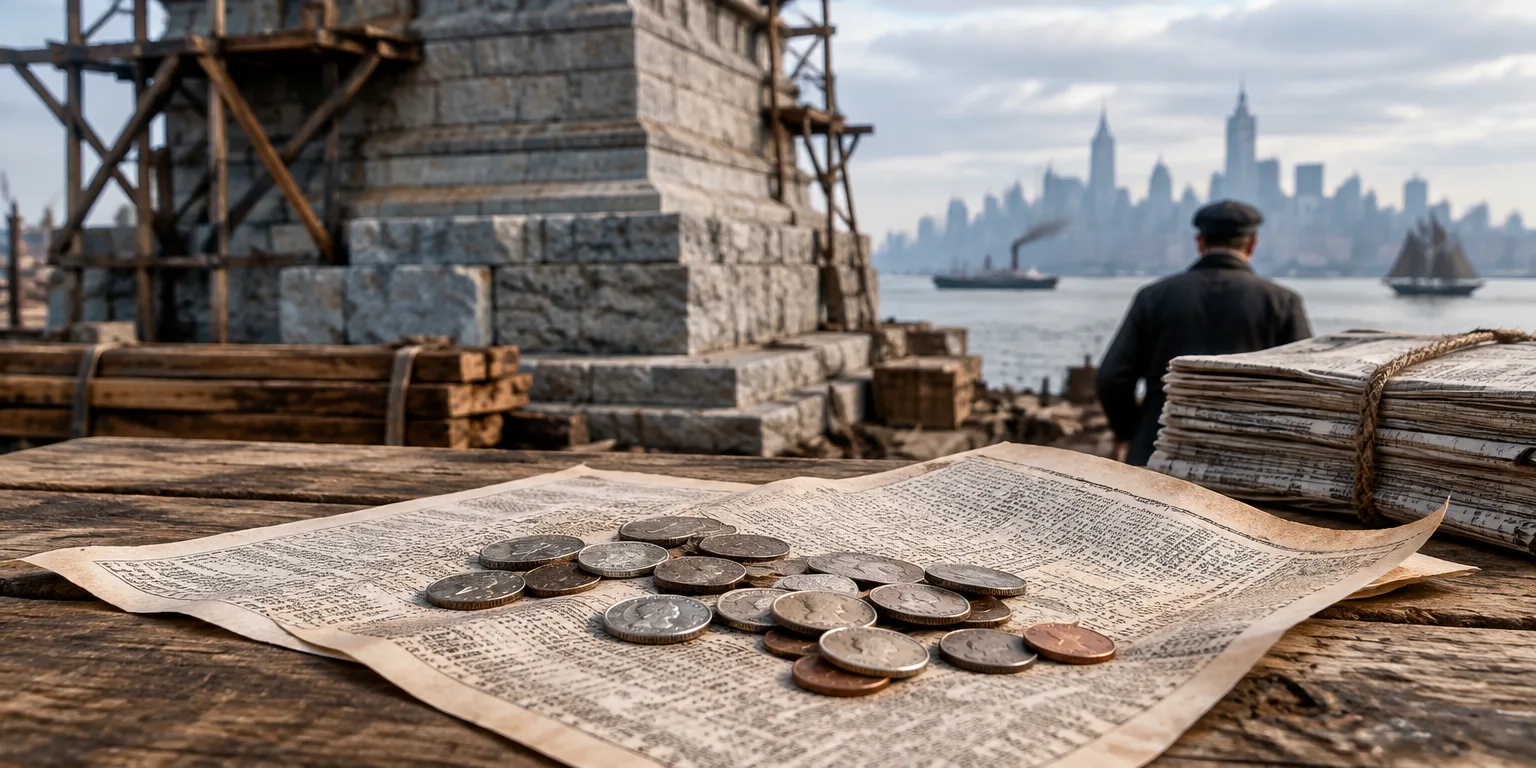
He launched a nationwide campaign through the World and made a simple promise to readers. It did not matter if a person gave a penny or two pennies. He would print the name of every single person who donated in his newspaper. That promise meant even the smallest gift bought a moment in a big city daily.
The response was enormous. More than 120,000 people sent money. In less than five months, Pulitzer raised all the money required to build the pedestal.
As a biographer of Pulitzer wrote, "The public service also turned out to be good for business. The World's circulation soared." A paper that had been in the red every week was now on its way to becoming a national leader, built one printed name at a time.
Questions people ask
Did France really pay for the Statue of Liberty?
Yes. France paid for the statue, which was a gift to mark American independence and friendship between the two countries, while Americans were expected to fund the pedestal and the site. When that fundraising stalled, the whole gift looked like it might fail.
How much was $100,000 worth at the time?
About $100,000 in the 1880s would be roughly $3 million today. Most of Pulitzer's donors gave very small sums, often a dime, a nickel, or pennies, which is why reaching more than 120,000 people mattered so much.
Did the campaign actually save the newspaper?
It worked. The World grew from about 15,000 readers under Jay Gould to hundreds of thousands within a few years, becoming one of the most widely read papers in the country. The pedestal campaign proved Pulitzer's formula that a crusade for ordinary readers could also sell newspapers.