Some Diving Insects Breathe Underwater by Wearing Air
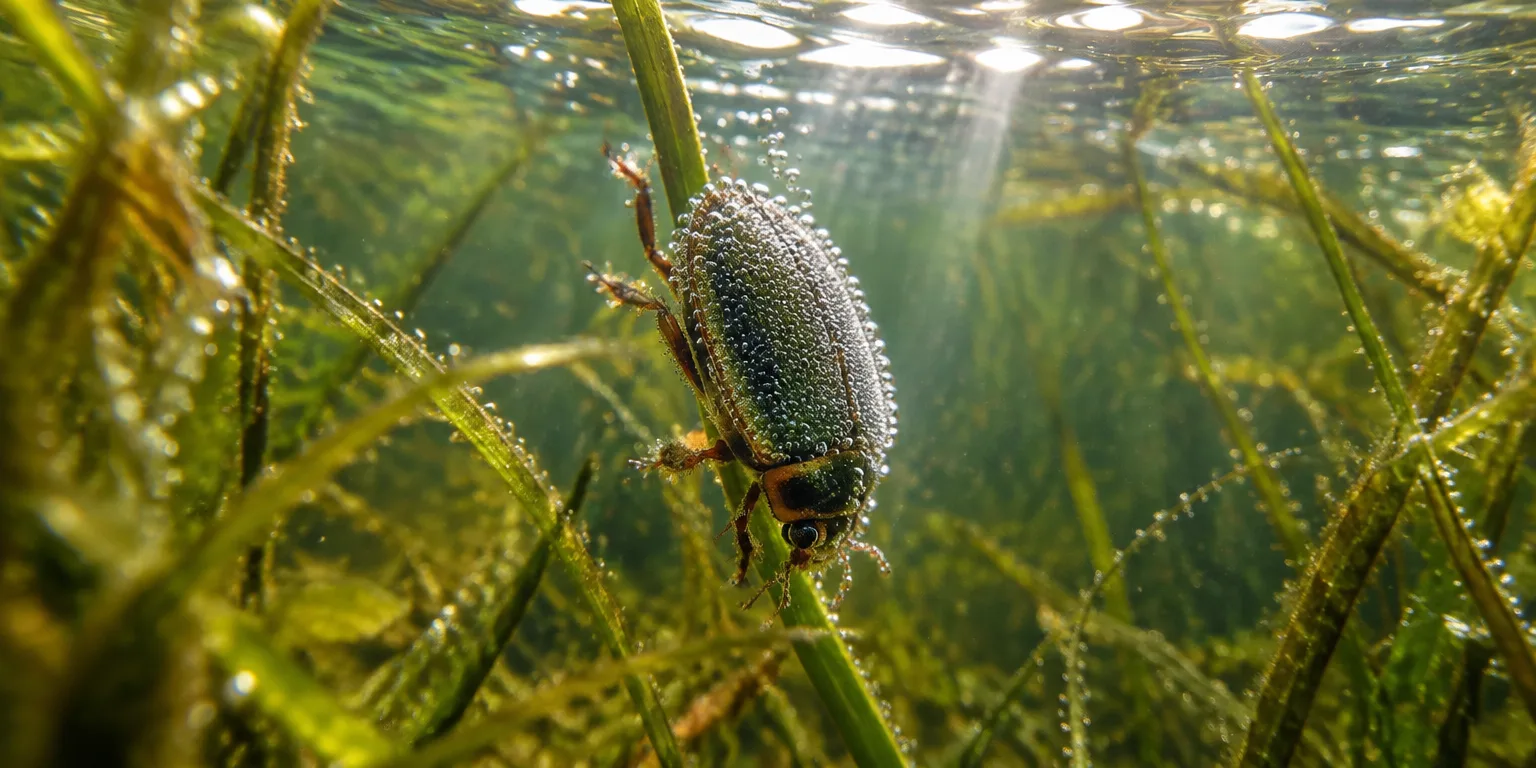
Water that feels harmless to people grabs small insects like glue, so evolution gave some divers fur so dense it holds air in place.
 Kurzgesagt – In a Nutshell · What Happens If We Throw an Elephant From a Skyscraper? Life & Size 1
For an insect, falling from a great height is barely an event. Drowning in a droplet can be the real danger.
The problem is surface tension. Water molecules pull toward one another, in a clinging effect known as cohesion, and that pull creates a kind of invisible skin on the surface of water. People are big enough that they tear right through it without noticing. At insect size, that skin is brutally strong. Touch water and it grabs you like glue, wraps around you, and will not let go.
So insects evolved to stay dry. Their hard outer shell, the exoskeleton, is coated in a thin layer of wax, much like the wax on a car. Water cannot get a good grip on wax, so it beads and slides rather than soaking in.
Then there is hair. Many insects are covered in tiny hairs that hold droplets away from the body and make them easier to shake off. Some diving species take this much further, with a short, extremely dense fur coat that repels water. Some have more than a million hairs per square millimeter, a kind of water-proofing perfected long before people learned to engineer at that scale.
That fur is what makes underwater breathing possible. When one of these insects dives, air gets caught in the thicket of hairs and stays there as a silvery coat. Water cannot push in and flood the coat because the gaps between the hairs are too small for its surface skin to break through.
That trapped coat then works like a lung worn on the outside of the body. As the insect uses up the oxygen inside the bubble, fresh oxygen moves in from the surrounding water, while the waste gas, carbon dioxide, moves out into the water. The exchange happens on its own, through diffusion, the natural drift of gases from where there is more to where there is less.
It is the same physics that lets pond skaters, those slender insects that dent but never break the surface of a pond, walk on water. For a small enough animal, the skin of water can be a floor to stand on, or a wall that holds a breathable bubble in place.
Questions people ask
How does fresh oxygen get into the bubble without any pumping?
Through diffusion, the passive movement of molecules from higher to lower concentration. As the insect breathes, oxygen in the bubble falls below the level dissolved in the surrounding water, so more oxygen drifts in, while carbon dioxide builds up in the bubble and drifts out.
Do all insects breathe underwater this way?
No. The wax coating and water-shedding hairs are widespread, but the dense underwater air coat is a specialty. Many insects simply avoid getting wet, while a smaller group of aquatic beetles, bugs, and spiders use some version of a trapped-air store to extend their dives.
What is a pond skater?
They are slender, long-legged insects commonly seen gliding across ponds and slow streams. Their feet are covered in tiny water-repelling hairs that dent the surface without breaking through it, so surface tension supports their weight.