Some Minutes Last 61 Seconds Because Earth Cannot Keep Time
Our planet speeds up and slows down as it spins, so timekeepers insert a second labeled 60 to keep clocks lined up with Earth.
 Computerphile · The Problem with Time & Timezones - Computerphile
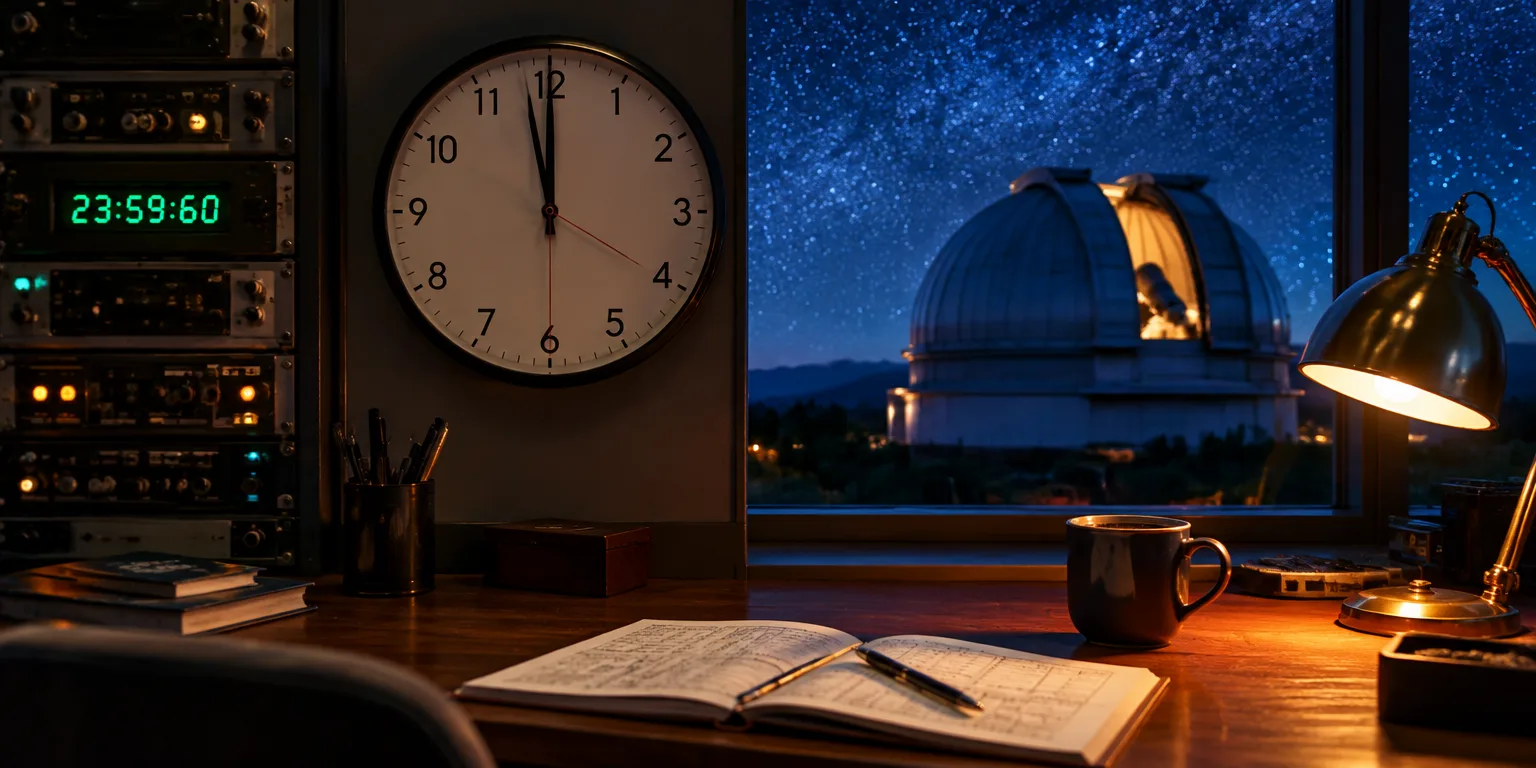
On certain nights, midnight does not arrive on time. The clock ticks toward the end of the day, counts 58, counts 59, and then displays an impossible 60 before the date changes. That minute holds 61 seconds.
The reason is that Earth is a poor timekeeper. The planet spins unevenly, turning a little faster at some times and a little slower at others, nudged by shifting plates and changing magnetic fields. So the day set by sunrise and sunset slowly drifts away from the day ticked off by steady clocks.
To bring them back together, international timekeepers decide whether the world needs a leap second. The everyday civil system includes that extra tick, which is why it can show a 60. Computers expect every minute to hold 60 seconds, so the extra tick causes trouble. Depending on the design, a machine may fall a second behind world time or be forced to count the same second twice.
Astronomers also keep a separate scale that leaves leap seconds out entirely. They must watch the sky and aim telescopes, and stars follow the actual turning of the planet rather than our corrected clocks. That star-watching scale has therefore drifted ever farther from the time on phones and laptops.
The strange second labeled 60 is the compromise. Because the planet will not spin evenly, human time has to wobble with it.
Questions people ask
How often does a 61-second minute happen?
Since 1972, 27 leap seconds have been added, with the most recent on New Year's Eve 2016. They are announced only about six months in advance, when measurements show atomic time and Earth rotation have drifted by more than about nine-tenths of a second.
Why do astronomers need time without leap seconds?
Telescopes track objects that rise and set with Earth's actual rotation, not with adjusted civil time. If astronomers used leap seconds, the calculated positions of stars would be off, so they use a smooth, continuous scale and accept that it drifts from wall-clock time.
Are leap seconds going away?
Yes, in the past. Systems that assumed every minute had 60 seconds have frozen, logged events out of order, or shown the same second twice. That is why international metrologists voted in 2022 to stop adding leap seconds by 2035, and let the two kinds of time drift a bit more instead.