Spiders spin steel-beating silk at room temperature using crystals and coils
Inside a narrowing duct, changing chemistry and a final hard pull turn watery protein soup into hard blocks joined by elastic coils.
 Veritasium · Is spider web really stronger than steel?
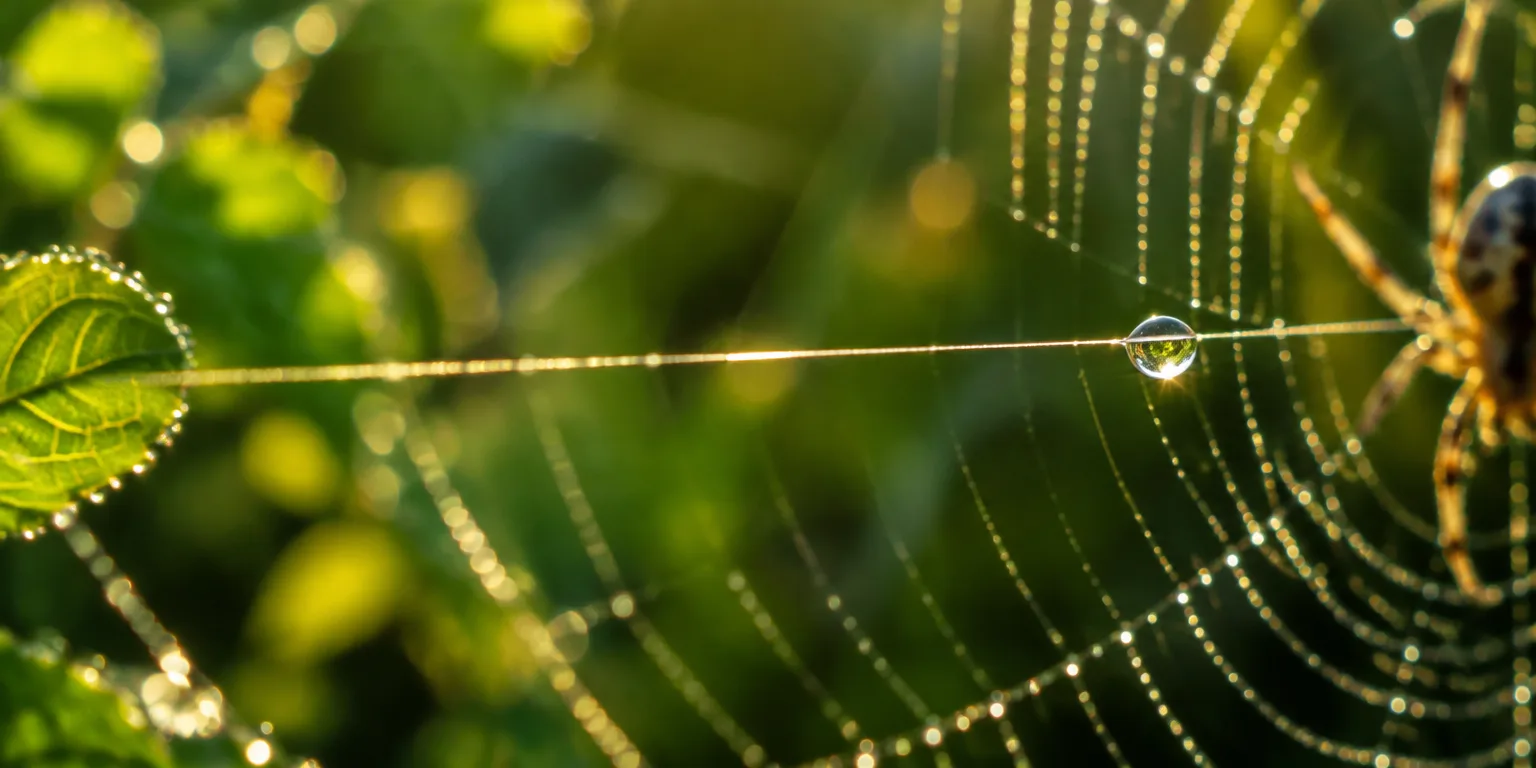
A garden spider makes a fiber that, pound for pound, pulls stronger than steel and absorbs more punishment than Kevlar without heat or harsh chemicals. It does the work at room temperature, inside its own body, using the same basic protein building blocks found in human hair and skin.
The trick is not the ingredients but how they are arranged. Inside the finished thread are two kinds of protein packing. In some patches, the proteins line up neatly and lock together into rigid blocks called nanocrystals. In other patches, they stay loose and tangled in stretchy coils called amorphous regions. Pull the thread and the coils stretch and soak up energy, while the hard blocks spread the load across many connections. Together they let the silk stretch far and still resist a hard pull.
The construction starts in a region of the silk gland called the tail. Cells there release long proteins called spidroins into a watery fluid. Each protein has a long repeating middle between an N-terminal tip and a C-terminal tip. In that tail region, the ends known as C-terminal pair up and loosely link neighbors, while the N-terminal tips largely remain unpaired.
Next the proteins move into a storage sac, where they are packed at very high concentration. They do not clump because the chemistry is carefully tuned. A precise mix of salts plus tuned pH gives the N-terminal tips the same negative electrical charge, so they push apart. Crowded in water, the proteins then rearrange by preference: the water-loving ends face outward and the water-avoiding middles tuck inward. They gather into tiny balls, called micelles, which cluster into larger droplets.
Then comes the spinning. The droplets enter a long duct that narrows as it curves toward the exit. As the fluid squeezes forward, layers near the wall drag and layers in the middle move faster, and that sliding, called shear, stretches the droplets. Water is drawn out and the fluid turns more acidic. The extra acid neutralizes the repelling charges, so the N-terminal ends pair up and join into long chains.
At the final narrowing, the spider pulls the fluid through a tiny opening. The sudden stretch lines the chains side by side. Some sections fold into zigzags and fasten together with many weak hydrogen bonds, weak attractions between molecules that hold the layers together, stacking into the hard nanocrystals. Other sections stay disordered and become the elastic coils.
Researchers are still working out precisely how the proteins come together inside the spinning duct. That gap in knowledge makes the process difficult to copy in the laboratory.
Questions people ask
Why does making fiber at room temperature matter so much?
Most high-performance fibers need high heat and strong solvents, which cost energy and create chemical waste. A spider uses water, salts, and small shifts in acidity instead. If factories could do the same, they could save energy and avoid toxic processing.
What is the difference between strength and toughness?
Strength is how much pull a material can withstand before breaking. Toughness is how much energy it can absorb before breaking, which depends on both strength and stretch. Spider silk is remarkable because it is fairly strong and very stretchy, so it absorbs more energy than stiffer fibers.
Why can't scientists just make the same proteins and get the same silk?
Companies have made spider silk proteins in bacteria, yeast, plants, and even goat milk, but the result was powder, gel, or dissolved protein, not strong thread. The spider's pulling, drying, and acidifying process controls how those proteins fold and lock together. Without that precise processing, the proteins do not form the right mix of crystals and coils.