A Quick One-Leg Check Shows How Steady You Are
One in four people over 65 will experience a fall, but Castel says steadiness can improve in one to two months.
 Andrew Huberman · How to Improve Your Memory & Cognitive Function at Any Age | Dr. Alan Castel
Alan Castel, a UCLA professor who studies memory and aging, likes to break up his talks after 30 or 40 minutes by asking the audience to stand up. He says people should not be sitting for so long.
His larger point is that people worry a great deal about dementia and Alzheimer's disease, but he thinks balance matters even more. He says most people are not aware of how steady they are.
One in four people over age 65 will experience a fall, he says. Such a fall can break a hip or collarbone, often after getting up at night and tripping over a carpet or rug, and he says time in bed recovering without walking is when, as he puts it, the hippocampus shrinks.
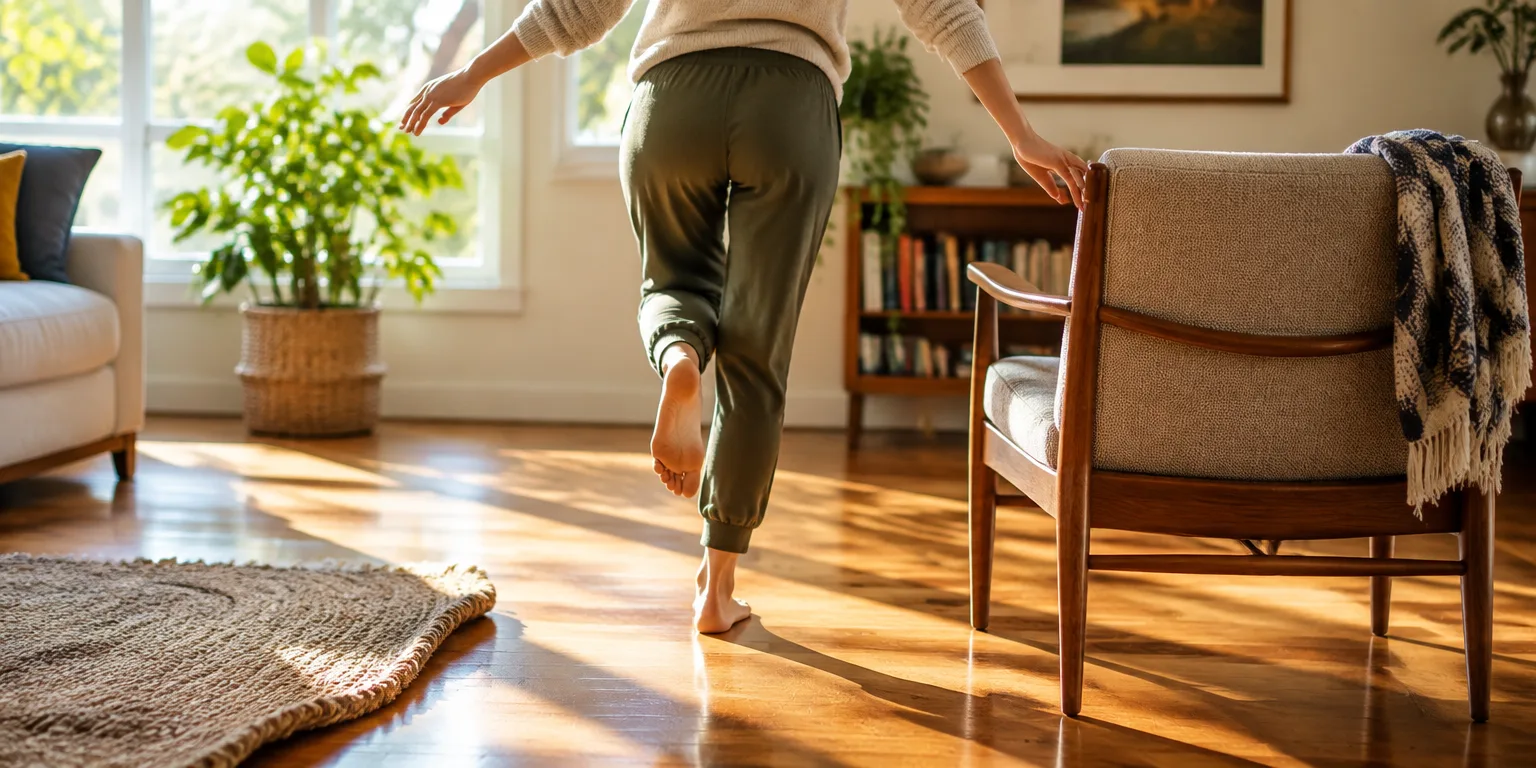
In his talks, he describes a simple check he uses: standing on a single foot for 10 seconds or more. He says most people do pretty well, but he asks them to keep something sturdy within reach because steadiness changes considerably with age.
With younger audiences, he sometimes adds a second round with eyes closed, a version he says he usually skips with older groups. Even younger people start to tip, which surprises them, and he compares the wobble to a roadside sobriety test because people get many balance cues from vision.
He links that steadiness to vision, the inner ear, and the cerebellum, a primitive coordination center in the brain. He says people assume their balance is fine because they have not fallen, when they could be closer to a fall than they realize.
He says balance is very trainable. Standing on one foot, or practicing yoga or tai chi, can make steadiness much better in one to two months, he says, adding that he has tried it himself and noticed changes.
Questions people ask
Why would a fall affect memory?
Castel ties it to recovery. He says a person who is in bed recovering from a fall is not walking, and in that situation, as he puts it, the hippocampus shrinks. The point is that the layoff itself is part of why a fall can be so costly.
Why does closing the eyes make balancing so much harder?
People rely heavily on visual cues to stay upright, Castel says, along with signals from the inner ear. When the eyes close, the brain loses that visual anchoring and must depend on the remaining systems. That is why even younger people tip in his demonstration.
What does the cerebellum do for balance?
The cerebellum is a small, older structure at the back of the brain that helps coordinate movement and posture. It integrates signals about head position, vision, and body placement to make quick corrections. Castel describes it as a primitive part of the brain involved in much of balance.