Sweden tells builders how safe a wall must be, not how to build it
Certified factories can repeat an approved process instead of stopping for inspections on every house, a change that helped make a 20-story wooden tower possible.
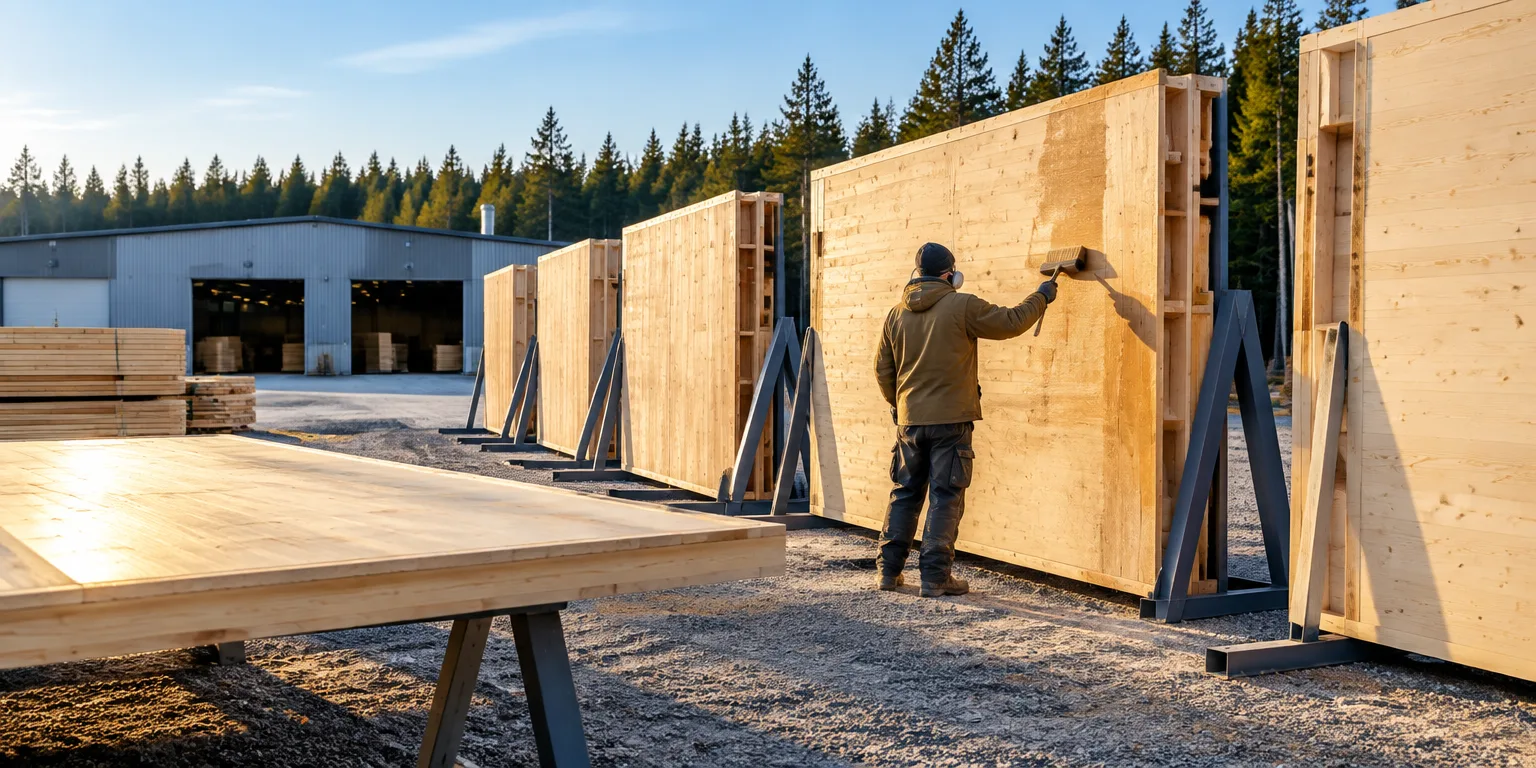
Inside the Lindbäcks housing factory in northern Sweden, painting and staining happen out in the open air. In an American modular factory, that same wet work usually happens inside a nearly finished module, which slows the line. The difference comes down to what the building rule controls.
American codes are prescriptive, meaning they prescribe the exact recipe for safety. For fire resistance, they dictate how thick the drywall must be, how many sheets to hang and how they must be fastened. Swedish codes are performance based, meaning they set a target and let builders find a way to hit it. A Swedish rule might simply require a wall to hold back fire for two hours, and leave it to engineers and manufacturers to devise a solution.
With only the finished result to satisfy, a Swedish factory has freedom in how it orders the work. Lindbäcks can finish wall panels while they are still open to the air, rather than waiting to paint inside a closed box. Once that method is shown to meet the national target, the whole factory process can win approval to keep repeating, which rewards new solutions and creates less waste.
Inspection works differently, too. In America, every home project requires its own permit, and construction repeatedly pauses while inspectors come to look. That stop-and-go rhythm annoys almost everyone apart from lenders, who collect interest on the financing while projects wait. In Sweden, builders do more work up front to show their method is sound, but then they can keep building.
Stefan Lindbäck, who leads the family-owned builder, told visitors that building quality homes will never be cheap and that the savings from factory building may not show up right away.
The payoff stands about 90 minutes by bus from the company's northern plant, in a small city to the south. There rises Sara Kulturhus, a twenty-floor complex that pairs public arts venues with a hotel above, built from mass timber, or thick engineered wood, with 205 identical rooms. Before Sweden adopted its performance code in 1995, timber structures could rise only two floors; then within a short period, engineers could build as high as they could show to be safe.
Questions people ask
If a Swedish factory is certified, does nobody ever inspect the buildings?
The buildings are still checked, but the check moves upstream. Instead of stopping work at each site for visual inspections, regulators review engineering calculations, test results, and factory quality controls before production, then audit that the factory follows its certified process.
Why does painting in the open air make factory building faster?
Paint, stain, and sealants release fumes and need dry, ventilated space to cure. Inside a nearly finished box, workers must wait for one wet trade to finish and ventilate before the next step can proceed. Doing the finish work on open wall panels lets several panels move forward at once and avoids trapping moisture inside the module.
Is a 20-story wooden building a fire risk?
Mass timber behaves differently from a stick-built house because thick wood chars on the outside at a slow, predictable rate, which insulates the structural core. Designers add layers, encapsulation, sprinklers, and compartment walls so the structure can meet the same two-hour fire-resistance targets required of steel and concrete. In tests and real fires, properly detailed mass timber holds its strength long enough for evacuation and firefighting.