Taiwan hid its wartime leaders and most of its jets inside mountains
Concrete forts would be bombed before landing craft arrive, so the island put its commanders and jets under rock and made its runways extra hard to close.
 Wendover Productions · How Taiwan is Preparing to Get Invaded
Taiwan has decided not to fight for its survival on the beach.
Concrete forts on the sand look reassuring, but Taiwan's thinking is that they would almost certainly be destroyed by air strikes before the first Chinese landing craft arrived. Stopping an enemy at the water would be the best outcome, but the island refuses to let its survival hinge on it. Instead, it puts its most important people and planes where they are hardest to kill.
That starts beneath a forested peak on the north side of Taipei. Inside lies Heng Shan Command Center, built to house the president while leading a war, supposedly linked by tunnel with headquarters of the Ministry of National Defense, with other entrances around the mountain apparently existing. Very little is publicly known about it, except that it is said to withstand atomic explosions and electromagnetic pulses, bursts of energy that can knock out electronics and power, and little else has been disclosed. A rare interior image made public shows Tsai Ing-wen, the former president of Taiwan, receiving a briefing.
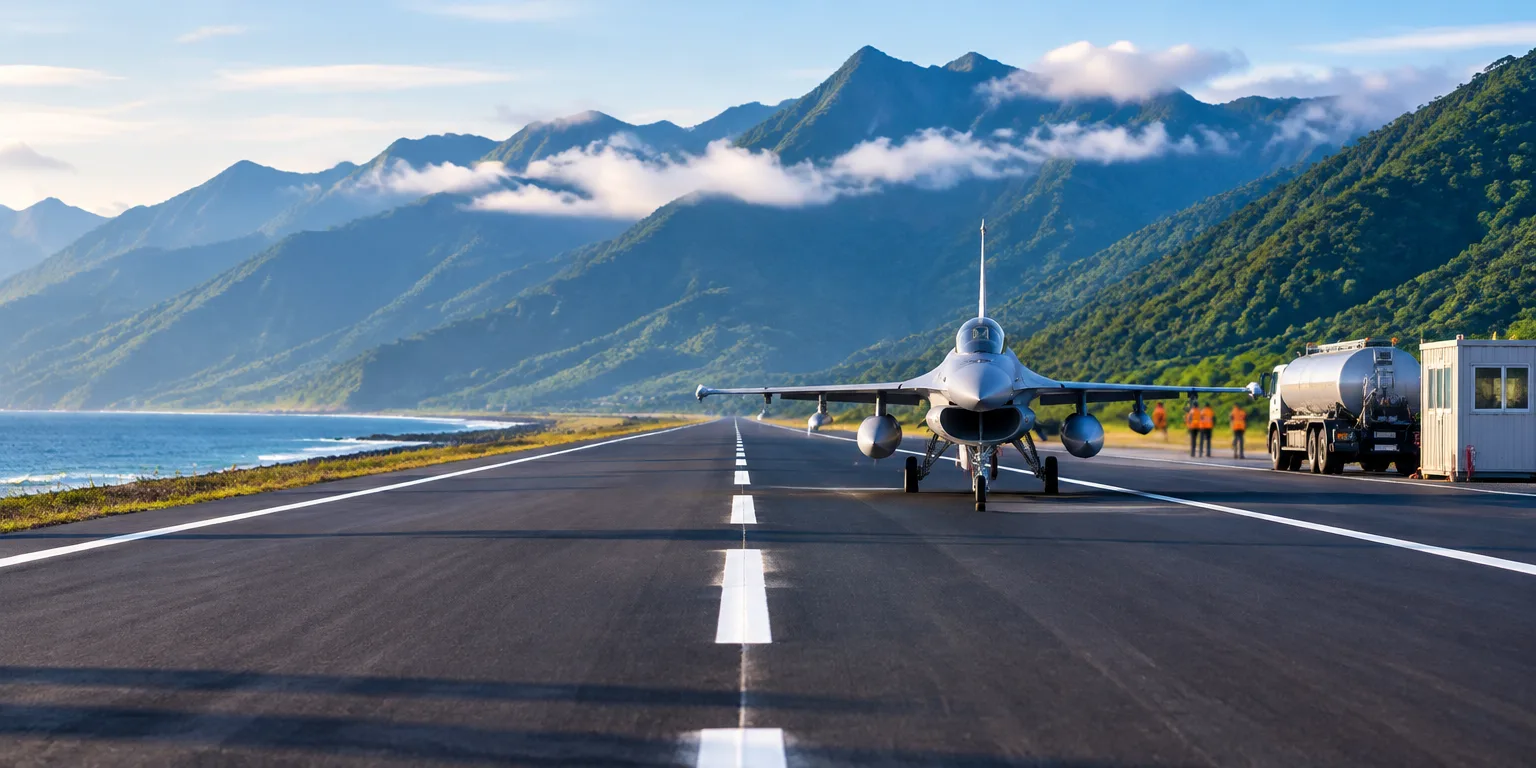
The same thinking protects Taiwan's air force. Its most resilient base, Jiashan, sits near the city of Hualien on the thinly populated east coast, as far from a western invasion as possible and shielded by peaks nearly 13,000 feet high. Its power is underground: a hangar complex tunneled into the rock and believed to hold 200 fighter jets, about two thirds of Taiwan's entire fleet and more planes than all but about a dozen air forces own.
Safe jets still need a usable runway, and modern long range missiles can now hit one precisely. Taiwan's answer is to make runways harder to close. At Jiashan and other bases, strips were widened to 200 feet, three times the width a fighter needs to take off and land, so a crater is less likely to block every path. Crews constantly practice repairs and can reportedly fill a crater in two and a half hours.
Taiwan's backup is its highways. Across Taiwan, selected road sections are built wider than normal, paved with stronger asphalt, left free of overhead wires, and fitted with center barriers that can be removed. Within 24 to 48 hours, a road becomes a temporary airbase.
The point is time. Taiwan cannot match China's military head on, so it is built to keep its leadership alive and its jets flying long enough for help, above all from the United States, Japan, South Korea, the Philippines, and Australia, to arrive.
Questions people ask
How does an ordinary highway handle a fighter jet?
A highway airstrip needs a long straight section with no bridges, overpasses, or lights overhead. Taiwan builds chosen stretches extra wide and thick, then in wartime closes the road, removes the center dividers, parks fuel trucks and mobile control equipment nearby, and uses the road as a runway.
What makes a mountain bunker able to survive a nuclear blast?
It generally means deep underground construction, thick reinforced concrete, blast doors, shock absorbers, filtered air, backup power, and shielding against radiation and electrical surges. No bunker is truly proof against a direct hit, but distance, rock, and redundant systems make it far more likely that the people and communications inside keep working.
Why put the safest airbase on the opposite side of the island from China?
An invader coming across the strait from mainland China would land on the west, so the east offers natural distance plus a wall of high mountains that ground forces must cross. Aircraft based in the east can also fly out over the Pacific, which gives them more routes to scramble, train, and potentially be resupplied than bases trapped near the landing zone.