Tanis was full of Ramesses II's stone, but his capital was 30 kilometers away
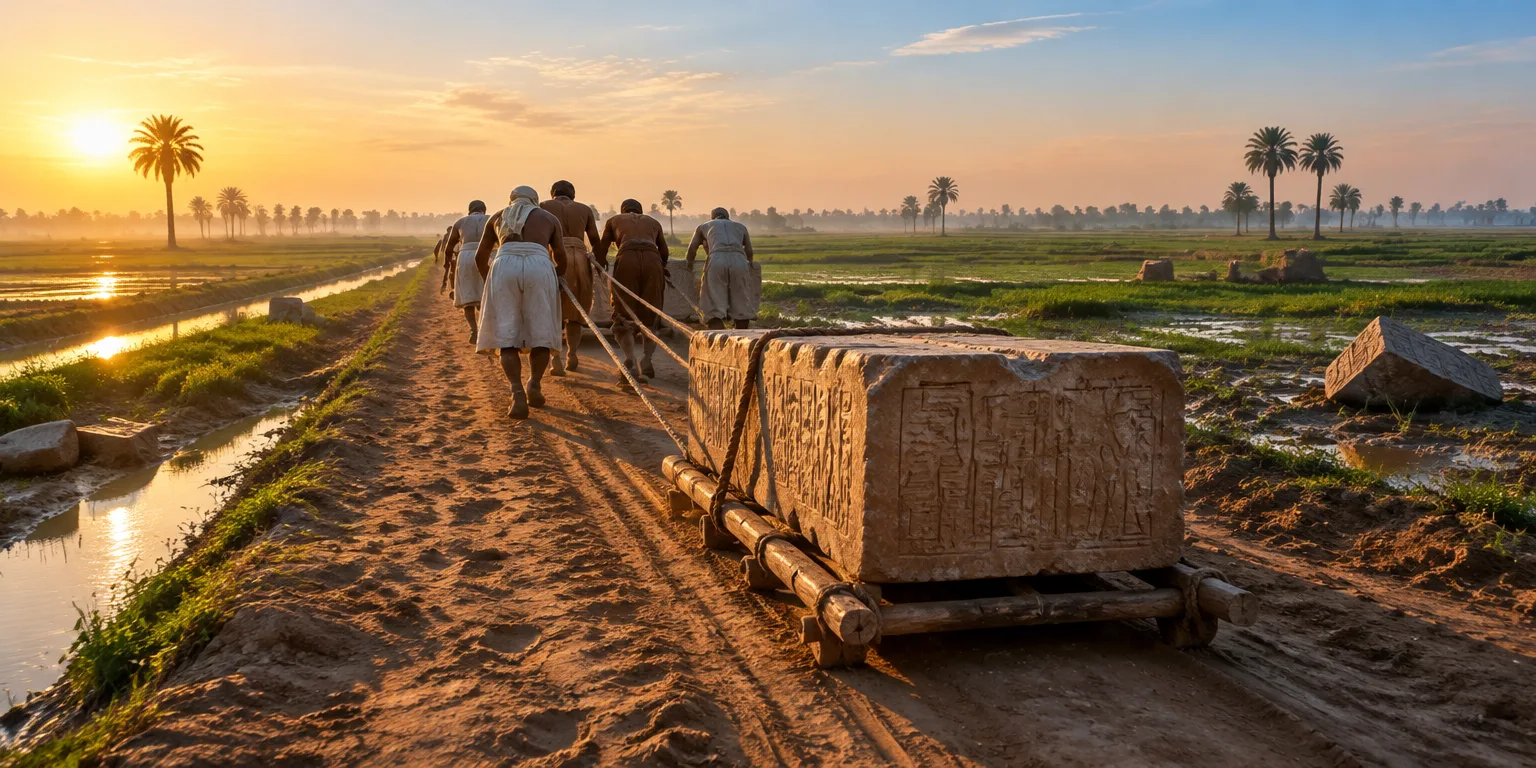
When its river dried up, workers hauled temple stone 30 kilometers north rather than quarry fresh rock.
 The Ancients · Egypt's Lost Cities
In 1939, French archaeologist Pierre Montet cut into the flat mud of the Nile Delta at Tanis and struck a royal cemetery. Out of the earth came statues and tall temple walls etched with ancient picture writing, and then gold masks and elaborate coffins belonging to kings from Egypt's 21st and 22nd ruling lines.
The discovery confirmed that Tanis had been a royal capital, and a major trading center well before Alexandria rose. But it also deepened a mistake that had already lasted for decades, because so much of the temple stone lying around Tanis bore the name of an earlier pharaoh, Ramesses II.
Egyptologists had long hunted for Ramesses II's famous capital, called Per-Ramesses, or Pi-Ramesses, meaning the House of Ramesses. Since Tanis was full of his stone, scholars concluded that Tanis must be that city, perhaps under a later name. The site had been noted by Napoleon's expedition, dug by Auguste Mariette in the mid-19th century and by Flinders Petrie in 1883 and 1884, and then worked by a long line of French directors, and each campaign uncovered more stone stamped with his name.
The turn came in the 1970s near the village of Kantir, about 30 kilometers away. There was only a small scatter of monumental stone at the surface, set in ordinary farmland. But a survey that left the ground untouched revealed that under the fields, invisible to anyone walking across them, lay a very substantial ancient city. That city, not Tanis, was Pi-Ramesses.
The reason, says Egyptologist Chris Naunton, was water. Pi-Ramesses had been built deliberately on a Nile branch that led north and east toward Egypt's holdings in what is now the Middle East. In the late New Kingdom that channel dried up, and the city became unviable. The nearest usable branch was about 30 kilometers to the north, the branch named for Tanis.
Naunton imagines the thinking this way. Rather than build a new temple from newly quarried stone, the reasoning went: it is only 30 kilometers, so why not just move the stone. So, in his reconstruction, workers hauled stone from Ramesses II's temples the whole distance to Tanis, which is why his capital seemed to be where it was not.
A few years ago, satellite images and other surveys that leave the ground untouched revealed the outlines of buildings at Tanis that have yet to be excavated. Some news reports treated that as a fresh discovery, but archaeologists have known where Tanis was for two centuries. The city remains useful for the opposite reason, as a lesson in how a lost city can be found in the wrong place.
Questions people ask
Who was Ramesses II?
Ramesses II ruled Egypt for 66 years in the 13th century B.C., and made his name by building on a huge scale, from rock temples in the south to a new capital in the Delta. His reign is often treated as the peak of pharaonic power, which is why finding his capital mattered so much.
Why move old temples instead of building new ones?
Cutting, shaping, and hauling large blocks is slow and expensive, even when the quarry is close. If decorated blocks were already cut and only 30 kilometers away, floating or dragging them to the new site reused both material and labor, and carried the prestige of the older king with them.
What does Tanis have to do with Indiana Jones?
In the film, Tanis is the buried place where the Ark of the Covenant is hidden. Real Tanis is a Delta capital of the 21st and 22nd dynasties, found with intact royal tombs in 1939, and has no connection to the Ark story.