The Air in Hotels, Planes, and Classrooms Is Heavy With Other People's Breath
Stale indoor air can reach 2,500 parts per million, and research links levels above 1,500 to serious cognitive effects.
 The Rich Roll Podcast · This Breathing Technique Will TRANSFORM Your Health In DAYS
Fresh outdoor air holds about 422 parts per million of carbon dioxide, a tiny share of each breath. James Nestor, the author of "Breath," reports much higher readings indoors, including "1900 parts per million the whole way through" on one flight.
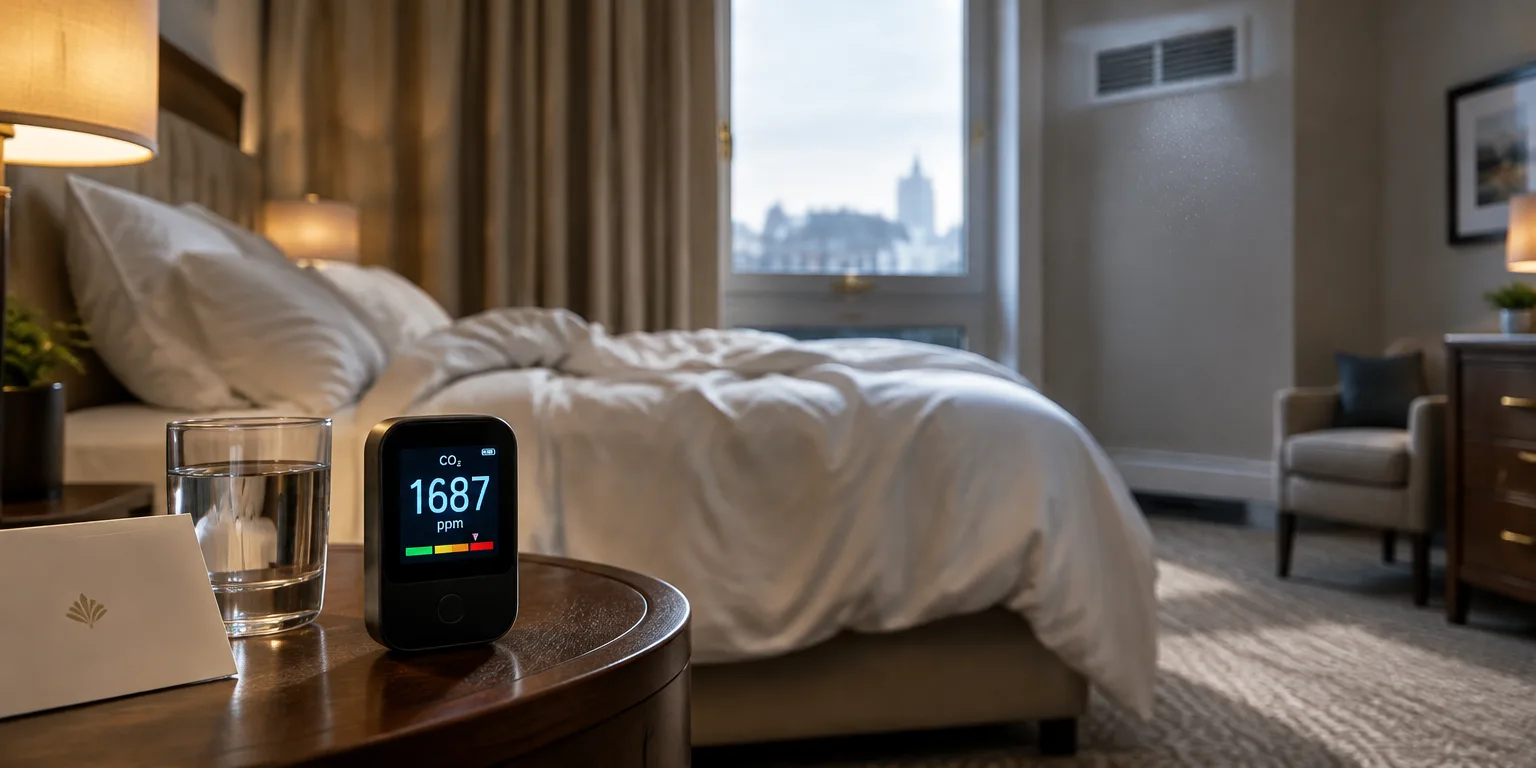
Nestor spent three years carrying a small carbon dioxide monitor onto flights, into hotels, schools, and restaurants. Even in very nice hotels, he said, about one in every 25 breaths was someone else's exhalation, potentially loaded with viruses, bacteria, and other gunk. In a crowded subway car at 5,000 parts per million, about one in 10 breaths is someone else's.
Nestor thinks hotels do this mainly to save money. Windows are glued shut because, as Nestor put it, "it is so much more economical to recycle air that's already been heated or cooled down" than to heat or cool fresh air from outside. The same stale air gets recycled over and over, which is one reason travelers wake up with a headache even when they did not drink.
The body notices the difference. Anything north of 1,500 parts per million has been linked to serious cognitive effects, including lower test scores, anxiety, and higher blood pressure in some people. Nestor cites a Harvard study that found test scores 50 percent lower above 1,500 parts per million. Many schools with monitors reported 2,000 to 2,500 all day, for eight hours, asking kids to perform while their bodies were pushed into a stressed response.
A physiologist told him the source of the carbon dioxide matters. Carbon dioxide made inside your own body is controlled, and, as the physiologist told Nestor, "your body knows how to handle that." Carbon dioxide breathed in from a stuffy room is, in the physiologist's words, "an acute exterior stress on you." To keep blood acidity in its narrow working range, in the physiologist's words, "your body will do whatever it can," including pulling minerals from bone, and that emergency balancing act creates stress.
On occasion, Nestor said, a brief hit is fine. But spending hours in a high reading environment is potentially one reason for feeling stressed and anxious. Nestor's own yardstick is simple: around 500 is great, anything up to 1,000 is very good, and the lower the better.
Questions people ask
What does parts per million actually mean?
Parts per million means how many molecules out of every million air molecules are carbon dioxide. Outdoor air is about 422, so 2,000 parts per million is roughly five times as concentrated. Monitors report it because it rises when many people share a closed room.
Will an air purifier fix high CO2?
No. Most portable purifiers trap particles such as dust, pollen, and some germs, but they do not remove carbon dioxide. Only fresh air lowers carbon dioxide, through an open window, a door, or a ventilation system that brings in outside air.
If I train myself to tolerate more CO2, will stuffy rooms stop bothering me?
No, according to the physiologist Nestor consulted. Carbon dioxide you produce during exercise or breath holding is controlled inside your body. Carbon dioxide you inhale from a stuffy room is a sudden outside load on blood chemistry, and the body treats it as stress.
What can I do if my office or classroom reads high?
Look for ways to add fresh air first, by cracking a window, propping a door, or asking building staff about ventilation settings. A portable carbon dioxide monitor, which Nestor bought in several brands for comparison, can show whether the change worked, with readings near outdoor levels as the goal.