The Army said it found a flying saucer, then took it back the next day
A rancher found foil and sticks, the Army called it a saucer, and then called it a weather balloon.
 en.wikipedia.org · Roswell incident
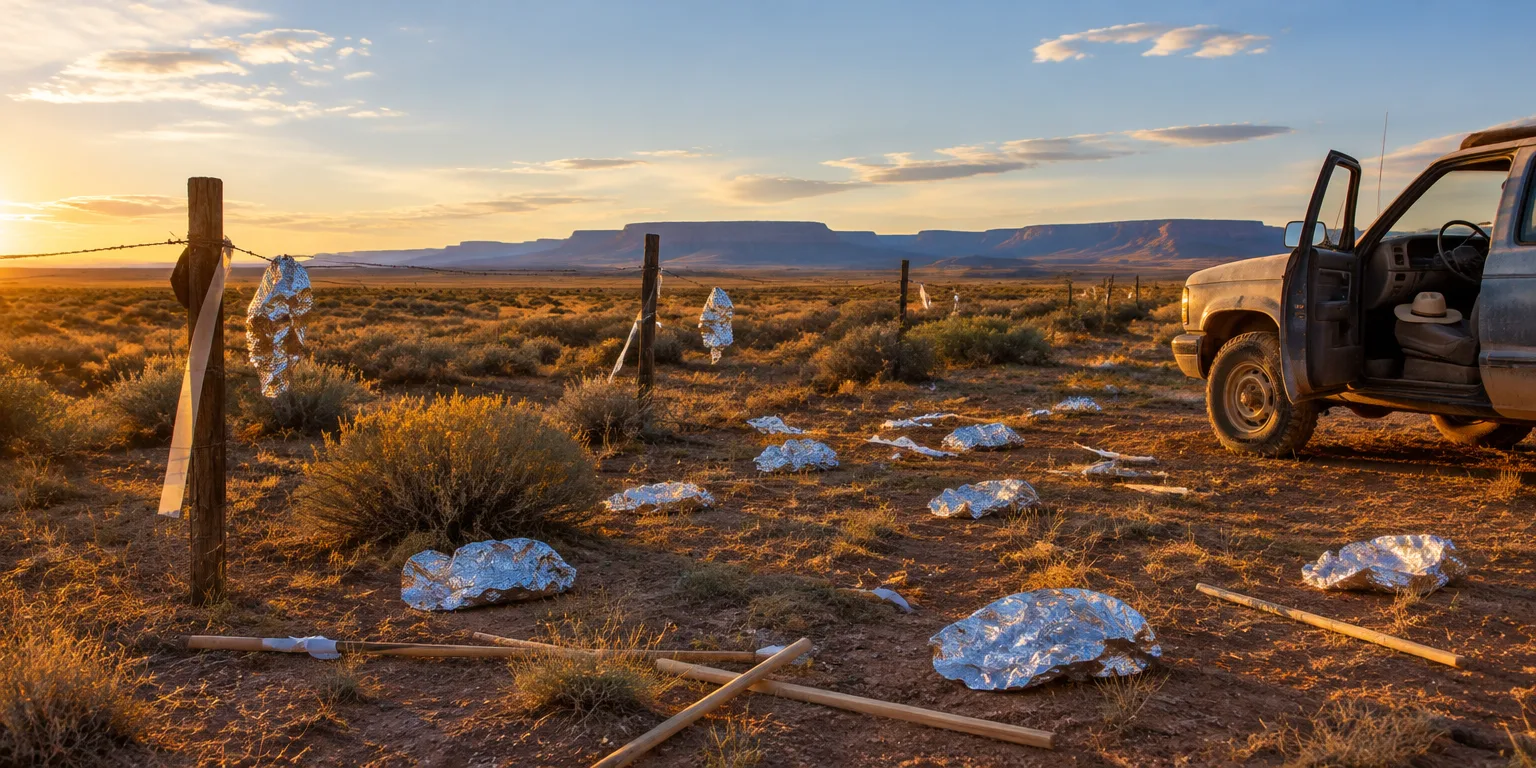
On July 6, 1947, rancher Mac Brazel drove into Roswell, New Mexico, and told Sheriff George Wilcox about wreckage scattered across his ranch near Corona. Brazel had no phone or radio on the ranch, and he had found the debris without knowing that the country was looking for exactly that kind of find.
The country was in the middle of the first flying saucer scare. After pilot Kenneth Arnold reported objects performing maneuvers beyond any known aircraft, more than 800 similar sightings followed. Newspapers speculated about Soviet weapons, and about $3,000 was offered for physical proof of a saucer. During a July 5 trip to Corona, his uncle Hollis Wilson floated the idea that the wreckage might be a flying disk.
That tip reached Roswell Army Air Field, home of the 509th Bomb Group, then the only military unit capable of delivering nuclear weapons. The base sent Maj. Jesse Marcel, an intelligence officer, and Capt. Sheridan Cavitt back to the ranch to gather the material. Base commander Col. William Blanchard notified his superior, Eighth Air Force commander Roger M. Ramey.
On July 8, the base announced it had something extraordinary. Public information officer Walter Haut put out a statement saying the Army had recovered a flying disc. Flight engineer Robert Porter helped load the cargo onto a plane bound for Fort Worth, Texas. It was material he was "told was a flying saucer," and Porter later described the load as light and compact, saying it arrived in paper wrapping and could have fit in an automobile trunk.
Radio station director George Walsh broadcast the news over station KSWS and passed it to the Associated Press, and his phone lines collapsed under calls from around the world. Haut's announcement said "the intelligence office of the 509th Bomb group of the Eighth Air Force, Roswell Army Air Field, was fortunate enough to gain possession of a disc through the cooperation of one of the local ranchers and the sheriff's office of Chaves County." Walsh later recalled, "All afternoon, I tried to call Sheriff Wilcox for more information, but could never get through to him. Media people called me from all over the world."
The next day, the story changed. At a press conference, Ramey, his chief of staff Col. DuBose, and base weather officer Newton said the material was pieces of a weather balloon. Newton said comparable radar targets were in service at roughly 80 weather stations nationwide. The Roswell Daily Record noted that the wreckage held neither an engine nor metal pieces. Brazel, who went back later alongside family members to pick up additional debris, did not agree. "I am sure that what I found was not any weather observation balloon," he told the paper.
After that, national interest faded. Later, the Air Force gave the fuller answer, describing the weather balloon story as "an attempt to deflect attention from the top secret Mogul project." According to the Air Force's later account, the debris came from that classified balloon program.
Questions people ask
What was the 509th Bomb Group?
It was the bomber unit based at Roswell Army Air Field. In 1947 it was the only American unit trained and equipped to drop atomic bombs. That is why a statement from its intelligence office was taken so seriously around the world.
Why did the base announce a flying disc in the first place?
Officers at Roswell did not know about the classified balloon program, which was run from elsewhere. When strange looking debris arrived, the intelligence office appears to have mistaken it for something exotic. The correction came the next day from senior officers in Fort Worth.
What was Project Mogul?
It was a secret Cold War program that flew high altitude balloons carrying listening equipment. The goal was to detect sound waves from Soviet nuclear tests. The balloons used foil, rubber, tape, and wooden beams, which explains the strange looking wreckage.