The Best Lab Diamond Is Flawed on Purpose
One swapped atom and one empty space give a pink diamond the power to feel tiny shifts in magnetism, electricity, and heat.
 The Wall Street Journal · The Complex Tech Behind Growing Diamonds in Minutes | WSJ Tech Behind
The perfect diamond is a dead end. The valuable one is flawed on purpose.
A diamond is carbon atoms bound together so tightly that diamonds do not typically conduct electricity. For companies like Element Six, lab diamonds on their own have not yet grown into a giant business. Getting there depends on producing many stones that each carry an exact imperfection.
They do it through doping, a process that introduces defects into the crystal. Defects can dramatically change how a diamond looks and behaves, and researchers have many ways to tweak the crystal.
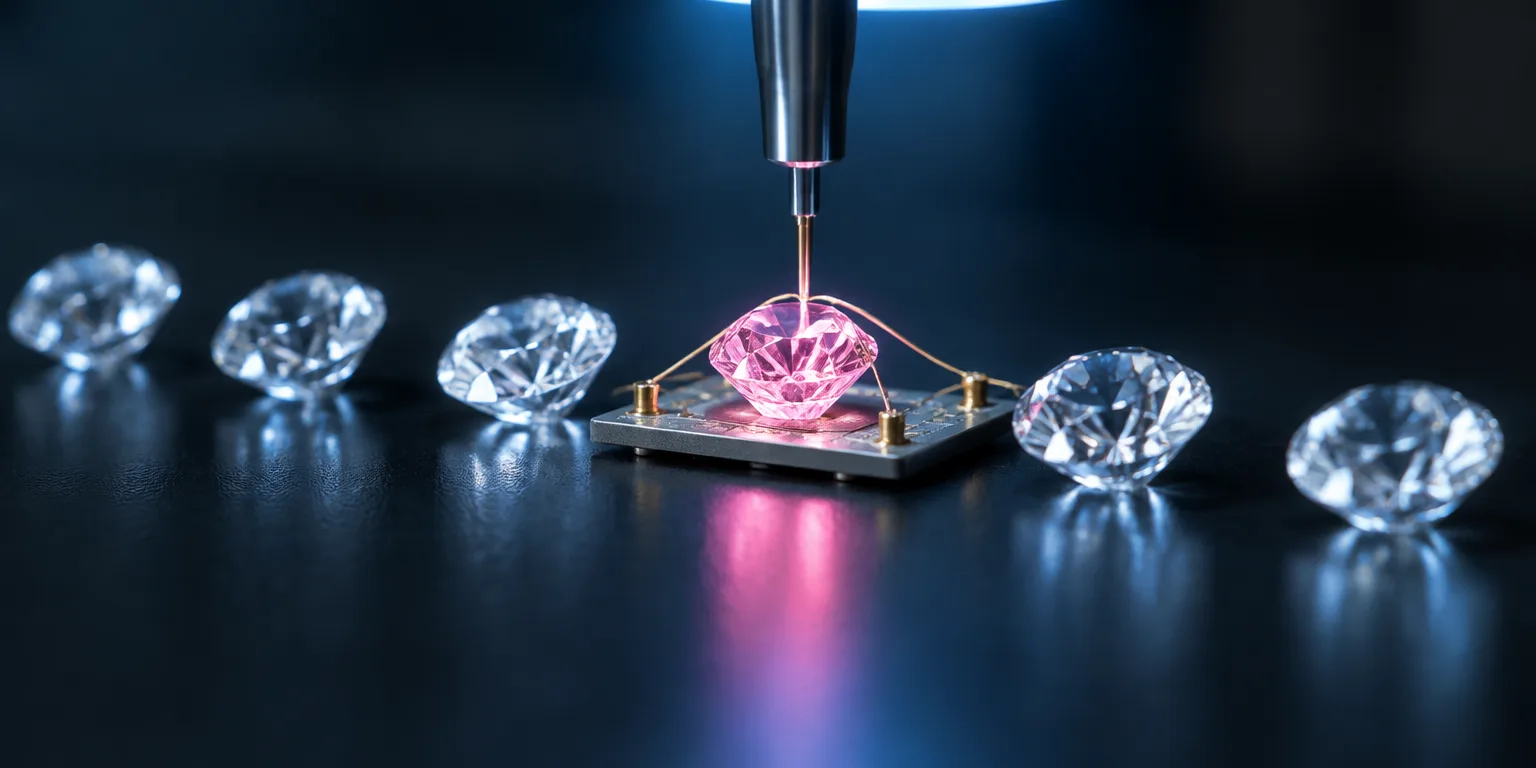
For example, one lab-made stone looks pink owing to a particular imperfection. A nitrogen atom takes the place of a carbon, with a vacant spot beside it in the crystal framework. That tiny break, one swapped atom plus one missing atom, turns the stone pink.
That same break carries quantum behavior that reacts strongly to slight shifts around the stone. That responsiveness is what makes these pink diamonds with what scientists call a nitrogen-vacancy defect well placed to serve as detectors.
In practice, the defect can pick up very small shifts in magnetic fields, electric fields, and temperature. That ability makes it helpful across quantum measurement, computing, and related tools.
Questions people ask
What would a diamond quantum sensor actually be used for?
Mainly to measure things too faint for ordinary sensors. Nitrogen-vacancy sensors can map tiny magnetic fields from brain activity or heart activity, spot hidden mineral deposits or submarines by their magnetic signatures, and serve as precise thermometers or compasses that work without GPS.
If the diamond is flawed, is it weaker or less valuable?
No. The flaw is atomic, not a crack, so the crystal stays hard and durable. In gemstones a flaw lowers the price, but in lab diamonds grown for technology, the precisely engineered defect is what creates the value.
Do natural diamonds have these defects too?
Yes, nature makes them by accident when nitrogen gets trapped during formation deep underground. Lab growers have an advantage because they can control the number and placement of nitrogen-vacancy defects, making many identical sensors instead of hunting for lucky stones.