The classic explanation for why wings lift is wrong
Air particles have no appointment to keep at the back of the wing, and upside down flight suggests the curve is only half the story.
 The Rest Is Science · The Fluid Dynamics of Fountain Pens
Even the people who fly planes argue about why they stay up. Michael Stevens, talking with Hannah Fry, recalled asking three pilots in the cockpit over the Atlantic how wings work. The pilots fell into a massive argument, and none of them could agree.
The textbook story they were arguing about goes like this. A wing is curved on top and flat on the bottom, shaped a little like a teardrop. Two neighboring bits of air are split apart when the wing slices through them. One goes the long way over the curve, the other goes straight underneath, with the pair rejoining behind the wing.
Because the top bit traveled farther in the same time, the story says, it must have gone faster, and faster air has lower pressure. The lower pressure above then pulls the wing up. That is the part usually credited to Bernoulli, the idea that fast air means low pressure.
The problem is that the two bits of air made no promise to meet again. As Michael Stevens put it, "there is no rule that says that these two particles have to meet up at the back." As Fry put it, halfway across the wing, why would the top particle think it has to go faster: "It doesn't care."
There is a second giveaway. If lift came only from the curve, airplanes could not fly upside down. Yet they do. That points to the second idea, credited to Newton, the idea that pushing air downward creates an upward push in return. Tip the wing slightly nose up, and incoming air is deflected downward. The reaction pushes the wing upward. That tilt is called the angle of attack, and an upside down plane can stay up if it holds the right one.
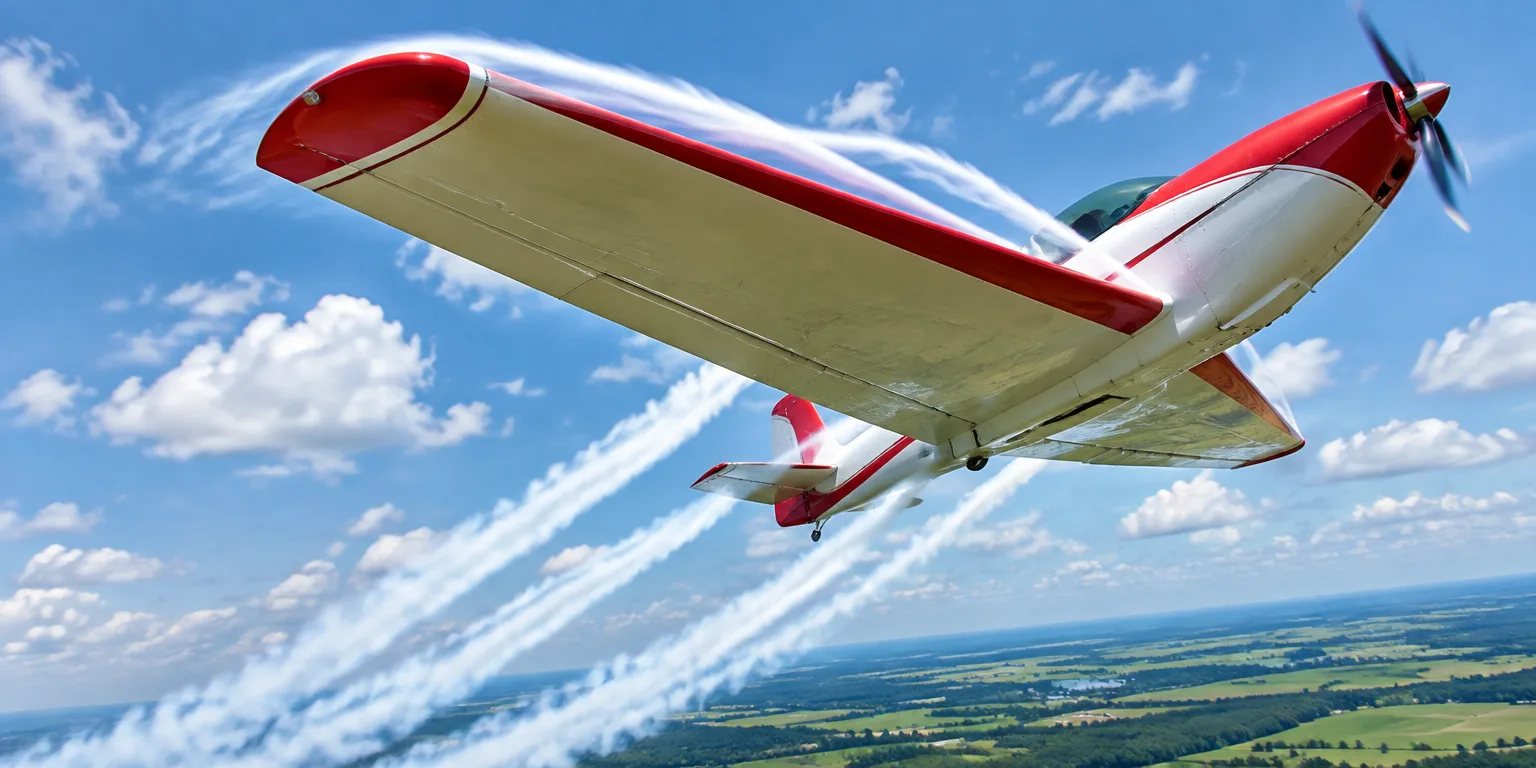
Neither idea works alone. Fry recalled the pilots describing watching a trail from another plane out the window, which rose and passed over the wing well before reaching it, not only at the moment it was struck and shoved down. Fry's ultimate conclusion, after noting how much debate there has been, is that both effects happen together. The curved shape changes the pressure, and the angled wing sends air downward, and lift is the result of both at once.
Questions people ask
Can planes really fly upside down?
Yes, with the right airplane and the right tilt. Aerobatic planes and fighter jets do it routinely by holding an angle of attack that still deflects air downward, so the upward reaction continues even though the wing is inverted. Airliners are not built for sustained inverted flight.
What is angle of attack?
It is the tilt of the wing relative to the oncoming air. Increase the tilt a little and you deflect more air downward, making more lift, up to a point. Tilt too far and the smooth flow breaks apart, the wing stalls, and lift collapses.
Why does faster air mean lower pressure?
It is a reliable rule of thumb for smooth, steady flow: where air speeds up, pressure falls. Pilots and engineers use it to design and trim wings, even though speed alone does not explain why the air speeds up. That fuller pattern comes from the shape, the tilt, and the way air moves as a continuous fluid.