The Deep Sea Runs on Falling Poop and the Occasional Dead Whale
The leftovers get picked over on the way down, until a carcass lands like a seafood tower.
 Ologies with Alie Ward · Deep Sea Microbiology (UNSEEN OCEAN CRITTERS) with Peter Girguis
Many animals and microbes in the deep sea live on leftovers raining down from above, because sunlight never reaches those depths.
Peter Girguis, a deep sea microbiologist who studies life around hydrothermal vents, calls that rain marine snow. It is fish poop, and more poop, plus mucus, shed scales, and bits of dead plants and animals. On camera it looks beautiful, like a field of stars drifting past. Then, as Girguis puts it, "I'm looking at a toilet." One fish's waste becomes another animal's meal on the way down.
He explains the trip down as a wedding buffet line. Animals near the surface get there first and take the shrimp and lobster, the freshest and richest food. Animals in the middle get the tenderloin. By the time the flakes have sunk 1,000 or 2,000 meters, much of the good nutrition has been picked over, leaving the deep dwellers with chicken fingers and kale.
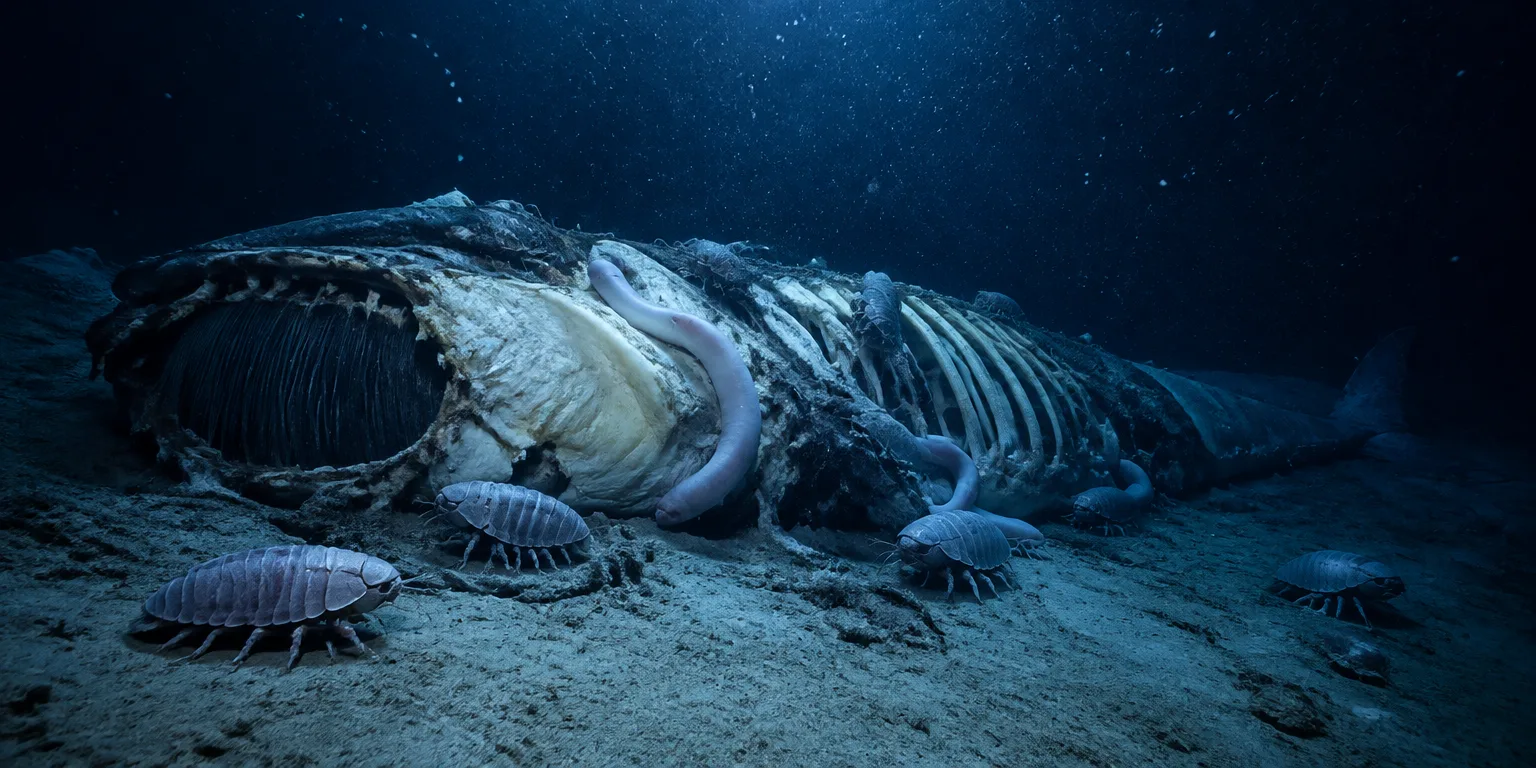
That is why a dead whale matters so much. When a whale, tuna, or even a great white shark dies, it often sinks fairly quickly to the bottom like a seafood tower arriving "at the end of the buffet," as Girguis puts it. Scavengers emerge from the darkness and tear it apart. Giant isopods, armored crustaceans related to pill bugs that can grow as large as a person's head, walk in to feed. So do hagfish, eel-like animals that burrow into carcasses to chew on flesh. A single carcass can feed them for decades.
The same hunger shapes plans to fight climate change. Some proposals call for growing algae and burying it in the deep ocean to lock away carbon. Girguis says "the verdict is still out on how well that will work," because microbes eat whatever food they find. That raises the open question of how much buried material microbes would eat and pump back out as carbon dioxide.
Questions people ask
What is a giant isopod?
They are large crustaceans related to the small pill bugs found under logs on land. In the cold, food poor deep sea, they grow much larger, sometimes more than a foot long, and can survive long fasts between big meals like whale falls.
What is a hagfish?
Hagfish are jawless, eel-like animals that live on the seafloor. They produce prodigious slime to deter predators, and feed by burrowing into dead fish and whales and rasping off flesh with a toothed tongue.
Why is a whale fall so different from marine snow?
The small particles sink slowly, days to weeks to reach the deep seafloor, and bacteria and animals strip out most of the energy along the way. Large carcasses are heavy, sink fast, and arrive with blubber, bone, and muscle largely intact, so they deliver a rare concentrated feast.