The Fastest Way to Power AI Still Burns Natural Gas
Builders keep choosing gas because futures prices make it look cheap, while storage is set to fall below historical levels.
 Invest Like the Best with Patrick O'Shaughnessy · The 2028 Natural Gas Crisis No One Sees Coming
For data centers that need power fast, almost every option energy analyst Matt Browning counted still burns natural gas.
After studying nearly all active wells and the wider pipeline, processing, and gathering network, his team found capacity to add about 20 billion cubic feet per day of production, a measure of daily gas flow. His model shows that new supply is matched by planned exports of liquefied natural gas, gas chilled to liquid for shipment overseas, scheduled to rise from about 15 to as much as 35 billion cubic feet per day for year-end 2030, even without AI compute.
The added demand from computing is about 5 billion cubic feet per day in his base case. That counts only projects with at least a 50 percent probability, usually with some approvals, a buyer that has signed a contract to purchase the power, and a plan to connect to the grid.
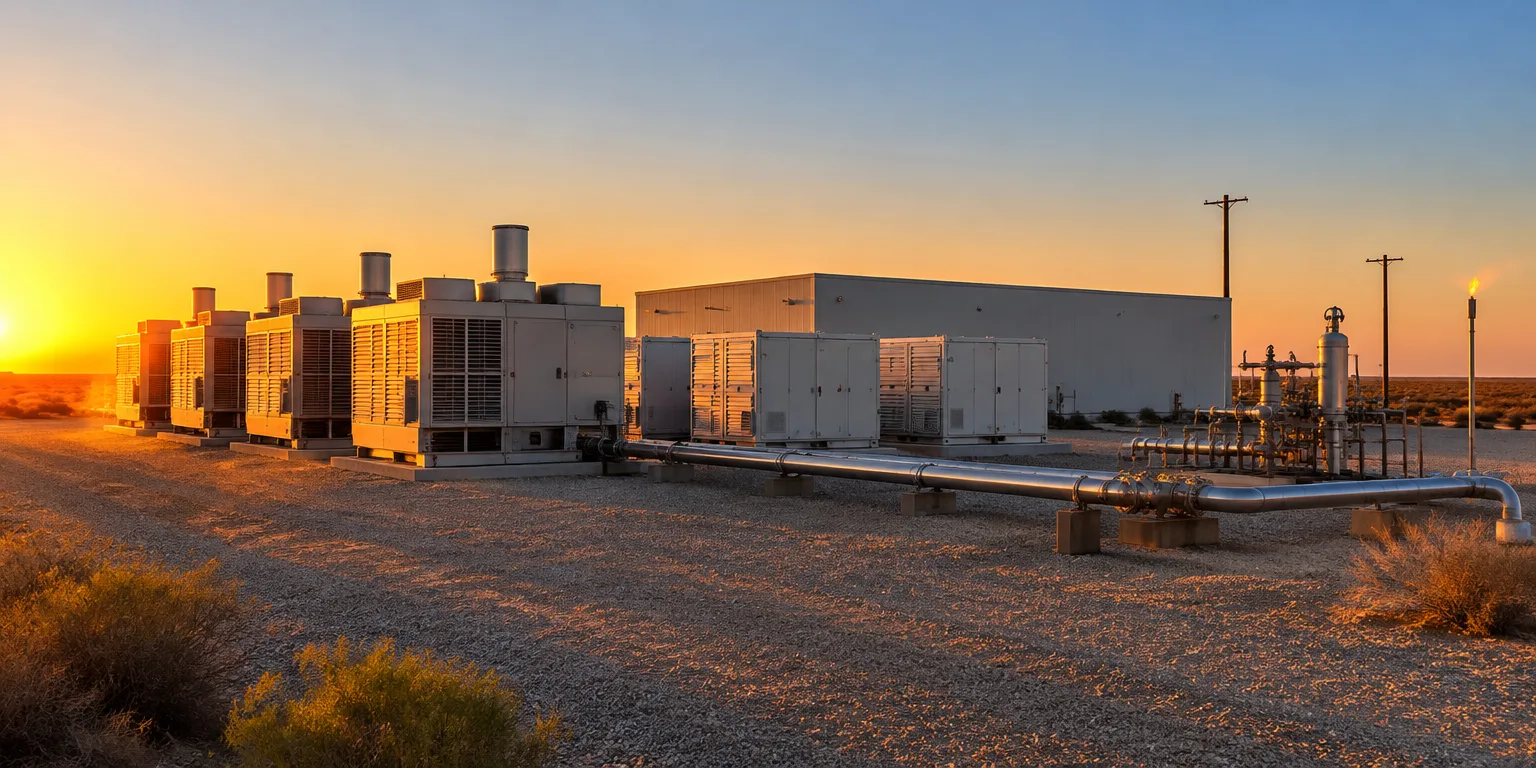
Browning ties that list to the industry focus on time to power, meaning how fast a plant can start delivering electricity. It runs from large, efficient gas plants that use waste heat to make extra power down through distributed machines, including fuel cells, Caterpillar engines and solar turbines, and local field level generators built behind the meter, meaning on the data center property rather than waiting on the utility grid.
A generator in the Permian Basin, a large oil and gas region in West Texas and southeastern New Mexico, that avoids grid delay does not avoid gas demand. Browning said such local generation is happening and already modeled, and gas burned there would not make it into downstream pipelines.
Builders keep choosing gas because on paper it still looks cheap. A standard tool called the levelized cost of energy, which combines construction cost and fuel cost over a plant life, uses a gas futures curve that stays mostly flat into the mid-2030s.
That curve makes gas look like an attractively low cost fuel for the largest cloud and AI companies committing to long term power.
Known battery deployments are also included in the model, but Browning describes a disruptive battery advance as hard to handicap. He said the vast majority of economic deployment today is lithium ion batteries, which have a fairly fast discharge cycle, while sodium and other technologies are not yet commercial.
If those demands arrive on schedule, Browning expects working gas in storage to break materially below historical levels by the middle of 2028, and below all known historical evidence by 2029. He says the resulting shortfall could keep growing and push prices very high, and says at 8 or 10 dollars per thousand cubic feet, some spot export cargos could shut off.
Questions people ask
What does behind the meter mean?
It means equipment on the customer's side of the electricity meter, usually on site. For a data center, that often means gas generators or fuel cells installed at the facility so it can get power without waiting for new utility lines.
What is the levelized cost of energy?
It is a calculation that combines building a plant and fueling it over its life to compare power sources. Builders using today's relatively flat gas futures curve get a low fuel estimate, so gas plants look attractive for long term deals.
Could batteries replace that gas?
Browning includes known battery deployments in his model of the generating system. He says most economic deployment today is lithium ion, which has a fairly fast discharge cycle, while sodium and other technologies are not yet commercial. He says a technology change that structurally changes gas use is hard to handicap.