The Ground Beneath Epic's Campus Stores Summer Heat for Winter
Water piped hundreds of feet down takes on the ground's steady temperature, and extra summer warmth is saved in the rock for winter.
 Inside Climate News · One of the World’s Largest Geothermal Networks Is Buried Beneath a Corporate Campus in Rural Wisconsin
The system doesn't make heat so much as store it.
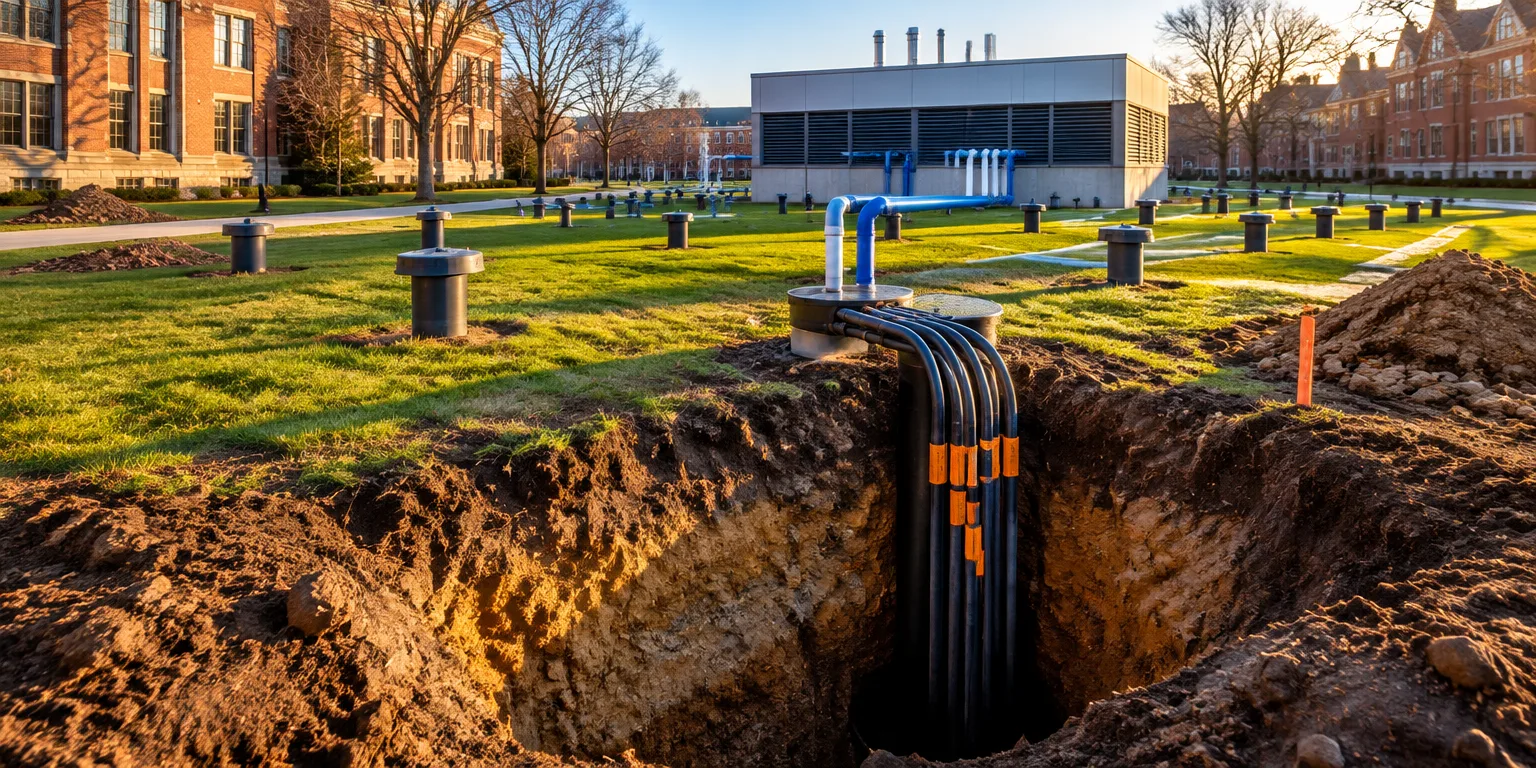
Beneath Epic's campus, boreholes running 300 to 800 feet deep reach ground that stays near 50 degrees Fahrenheit year-round.
Water piped down through the bores takes on the temperature of the surrounding rock and soil. Cold water comes up warmer, and warm water comes up cooler.
Back above ground, efficient electric heat pumps in central plants further heat or cool the water to supply the hot water and cold water that heat and cool the buildings.
Heat is stored in summer and used in winter. In summer, the system pulls excess heat from buildings and stores it underground. In winter, that stored heat flows back into the buildings. The thousands of boreholes work together as a thermal battery.
“They harvest energy from that battery in the heating season and then in the cooling season, they’re recharging the battery by putting heat back into the subsurface,” said James Tinjum, an associate professor of civil and environmental engineering at the University of Wisconsin-Madison.
That seasonal saving adds efficiency. Heat taken out of the buildings in summer helps warm them in winter.
Questions people ask
What does a heat pump actually do?
A heat pump moves heat rather than making it by burning fuel. In winter it pulls warmth from the mild underground water and concentrates it for indoor heating, and in summer it reverses to dump indoor heat underground. Because moving heat takes less electricity than creating it, the system uses much less energy.
Does the system use up groundwater?
No. The water stays sealed inside plastic pipes in a closed loop and never touches groundwater or rock directly. It only exchanges temperature with the earth through the pipe walls, then returns to the surface to be heated or cooled further.
Why can this work in Wisconsin, not just in volcanic places?
Ordinary geothermal power needs high-temperature resources near the surface, found in certain regions, mostly volcanic areas. Heating and cooling systems work in many more places because they rely on shallow ground's mild, year-round temperature of around 50 degrees, plus heat pumps to finish the job.