The Moon Could Fall for a Year and Still Never Hit Earth
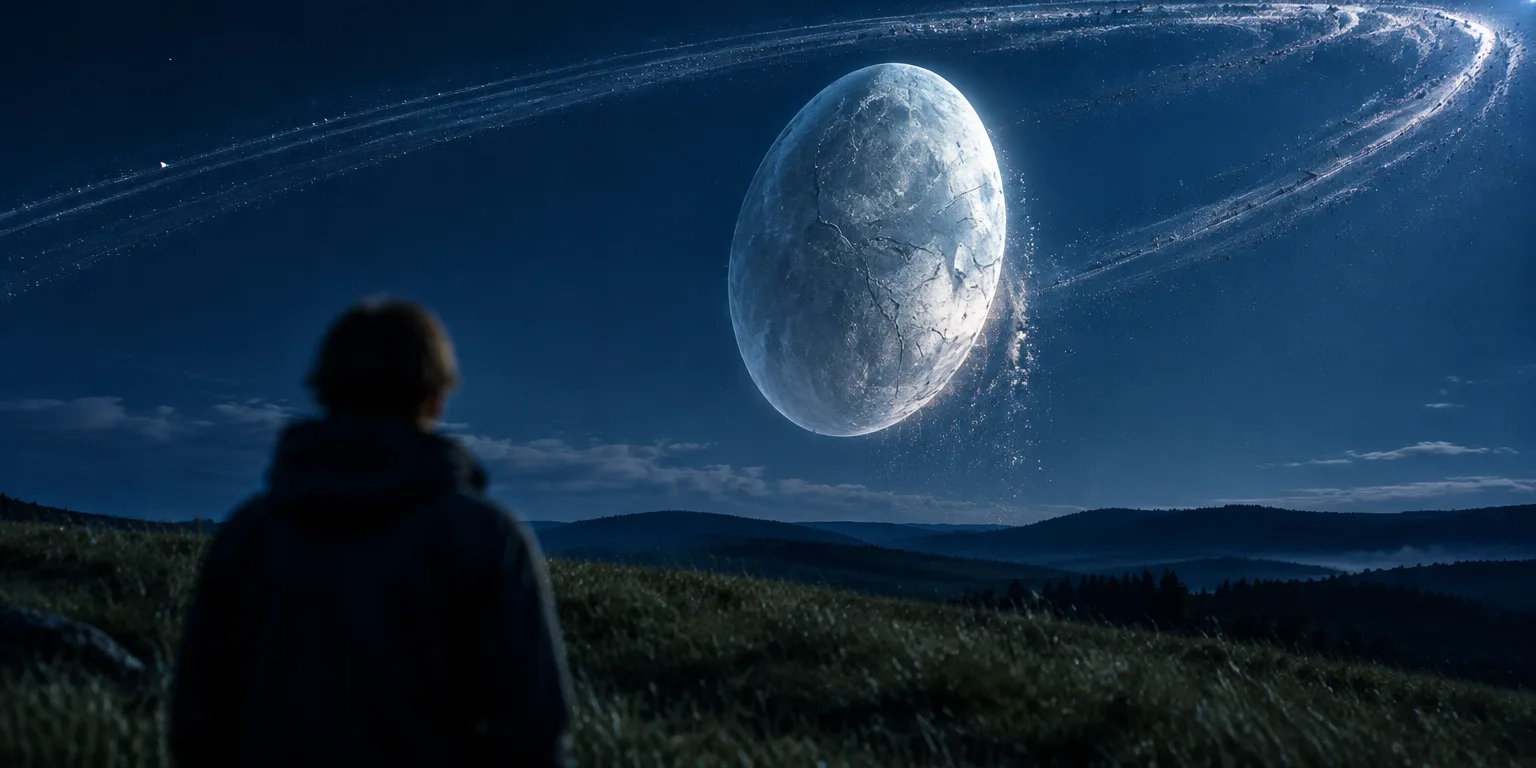
Earth would stretch the Moon into an egg, shake it with quakes, and then tear it apart into rubble.
 Kurzgesagt – In a Nutshell · What Happens if the Moon Crashes into Earth?
Forget a giant explosion in the sky. If the Moon started falling toward Earth, it would never reach the ground.
Even if the Moon ended up hovering right over your head, you would stay firmly planted. Our planet's grip at its surface is roughly sixfold the Moon's tug, so Earth wins every gravitational tug of war.
What would lose is the Moon itself. Gravity gets weaker with distance, so Earth's pull on the Moon's near side is stronger than on its far side. As the Moon sinks closer, that difference grows and starts to stretch the Moon forward toward Earth, like dough pulled into the shape of an egg.
Rock does not like to be stretched. As the Moon's interior bends and reshapes, it triggers deep moonquakes. At first the deformity is barely noticeable, but within months the bulge grows to hundreds of kilometers.
Then comes the breaking point, called the Roche limit. That is the distance at which our planet's tug on its companion overpowers the cohesion keeping the Moon whole. Loose rock and dust up there begin dropping Earthward.
By the time the dying Moon crosses within about 10,000 kilometers, it disintegrates entirely into rubble. The rubble forms a ring around Earth, much like Saturn's rings. Survivors would see tremendous arches spanning the sky, glowing brighter than every full moon ever seen, with meteor showers of Moon dust.
The crash never happens, and with no Moon left to pull on the oceans, the tides end and the seas withdraw from flooded land one last time. The disaster does not end. The calm may be short lived, as falling dust could heat the atmosphere, or shadows from the rings combined with volcanic aerosols could block sunlight and start runaway cooling that freezes much of Earth's surface.
Questions people ask
What exactly is the Roche limit?
It is the distance at which a planet's tidal forces overcome the gravity holding a moon together. Inside that boundary, loose material is pulled off the moon, and a solid moon can break apart. For the Moon and Earth, the breakup zone lies well above Earth's surface, which is why the Moon would become rings rather than strike us.
Would Earth's new rings look like Saturn's?
For a while they would be even more dramatic, forming vast arches of rock across the sky. Scientists who model such events expect bright bands of dust and rubble that reflect sunlight. Over very long times, much of that material would rain down as meteors or clump back into small moons.
Why isn't the Moon being shredded right now?
Because it is far away, about 384,000 kilometers on average, where the difference in Earth's pull from one side of the Moon to the other is tiny. Tidal stretching still happens, but it is far too weak to deform rock by hundreds of kilometers. Only a Moon brought close in would feel a fatal stretch.