The Moon Stays Up Because It Keeps Falling and Missing Earth
It circles Earth every 27 days at 3,600 kilometers an hour, and only losing speed could bring it down.
 Kurzgesagt – In a Nutshell · What Happens if the Moon Crashes into Earth?
The Moon looks as if it is hanging in the sky, held up by something pushing against Earth's gravity. There is no such push. The trick, instead, is sideways motion.
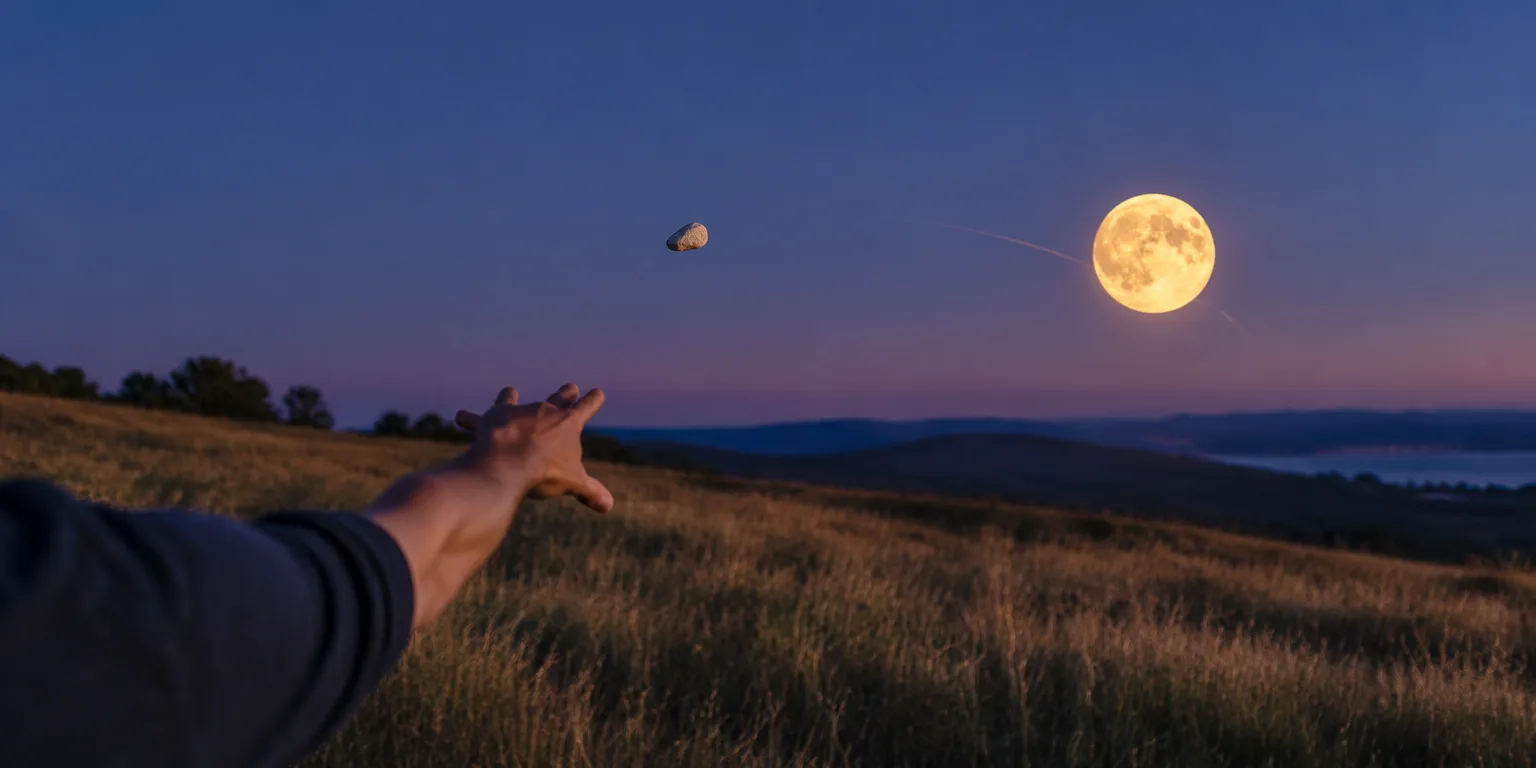
Think of throwing a ball. It arcs and hits the ground, but in a sense it is making a tiny orbit. If you could hurl that ball much faster, with no air to slow it, its path would curve around the entire planet and return to where you stand, circling forever.
That is what the Moon is doing. It is falling toward Earth under gravity, but moving sideways so fast that it keeps missing the ground and falling around the planet instead. There is no air up there to brake it, so the fall never ends.
The scale is hard to picture, but the numbers help. The Moon circles Earth every 27 days at 3,600 kilometers an hour. That speed is what keeps its fall bent into a loop rather than a plunge.
To change an orbit, you must change speed. Even setting off billions of rocket motors all over its surface would barely budge it. To imagine the Moon falling, you would have to slow it dramatically; one thought experiment has it spiral in over a year. Speed is what keeps the Moon up, and losing speed is what would bring it down.
Questions people ask
Do satellites stay up the same way?
Yes, in the same way. A satellite is also falling toward Earth while moving sideways fast enough to keep missing it. Go slower than orbital speed and it sinks back down, go faster and its path widens.
What if the Moon went faster instead of slower?
If the Moon moved faster, its orbit would widen. Given enough extra speed, it could escape Earth altogether and orbit the sun on its own. Speed sets the shape of the path.
Will air or friction slow the Moon naturally?
Practically no. Space around the Moon is nearly a vacuum, so there is almost no drag. The Moon is actually drifting very slowly outward, about 3.8 centimeters per year, as tides transfer energy from Earth's spin.