The Moon Stretches the Ocean by Pulling One Side Harder
Normally the uneven pull lifts the sea by half a meter, but a closer Moon would make the same force shake solid rock.
 Kurzgesagt – In a Nutshell · What Happens if the Moon Crashes into Earth?
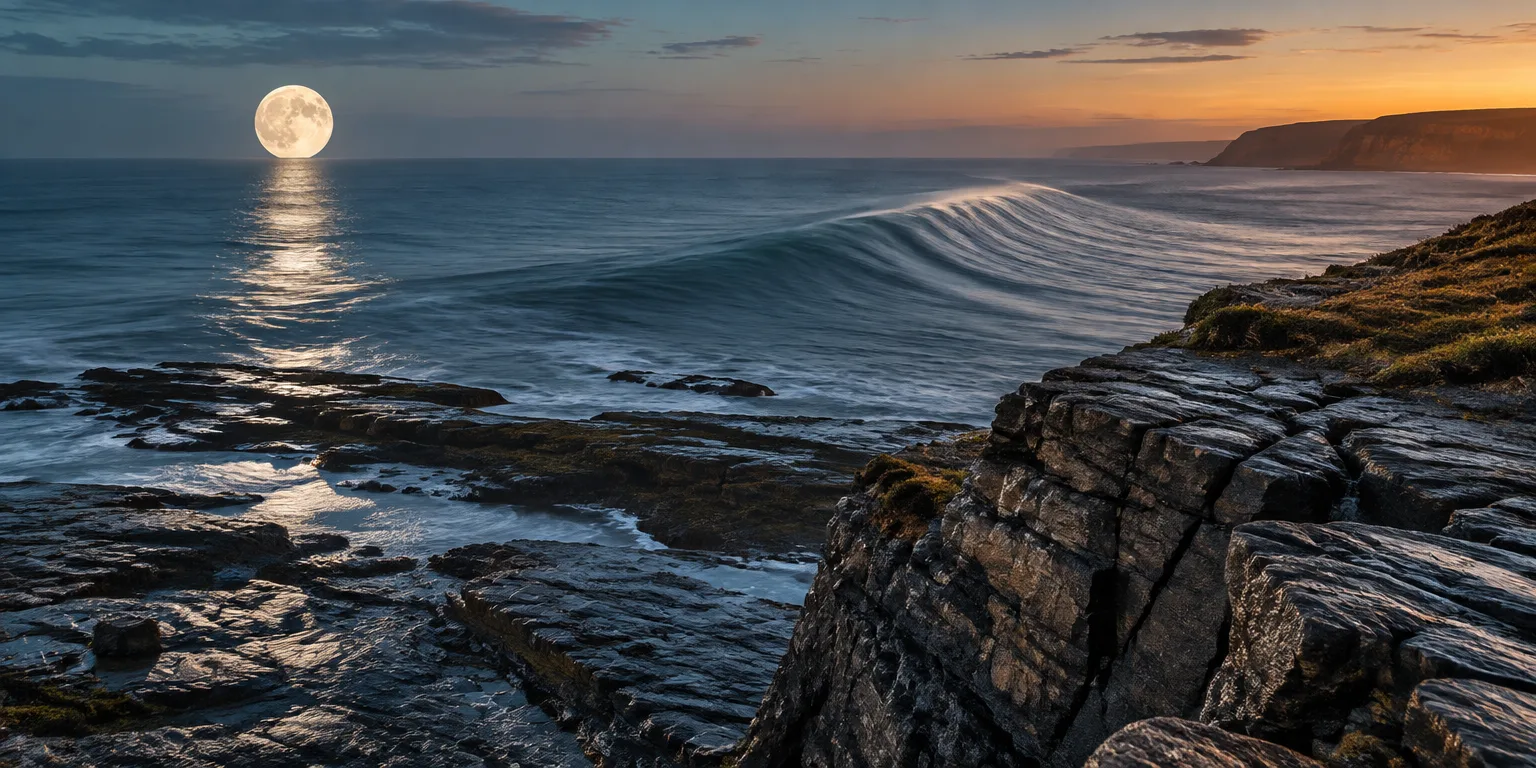
The ocean does not rise because the Moon lifts it like a magnet. It rises because the Moon does not pull evenly.
Gravity gets weaker with distance, so the side of Earth facing the Moon feels a slightly stronger pull than the far side. The oceans swell where the Moon is overhead and pinch inward along the flanks where it is not. As the planet spins each day below the Moon, that uneven pull makes sea level climb and drop roughly half a meter two times daily.
Bring the Moon closer and the same uneven pull gets stronger. The daily bulge grows taller, until flowing water can no longer absorb the squeezing. The seas average just 3 kilometers deep, and once the sloshing reaches that scale, Earth itself starts to feel the squeeze.
Then the tide becomes less a tide of water than a tide of rock. The Moon squeezes the planet from above while the weight of tons of water sloshes on and off the tectonic plates, the giant slabs that carry the continents and seafloors. The combined strain accumulates deep inside and starts setting off larger and larger quakes.
The direction of the tide can change, too. If the Moon moves close enough to orbit Earth faster than the planet rotates, the tides slow down and then reverse direction, sweeping the other way around the planet and bringing still more earthquakes and volcanism.
That is the ordinary tide writ large: not a lifting from above, but a stretching from one side to the other.
Questions people ask
Why are there two high tides each day instead of one?
There are two because Earth turns through two bulges. One bulge faces the Moon where its pull is strongest, and another forms on the opposite side where the weaker pull and Earth's motion leave water piled up. A coastal spot passes through both bulges during each daily rotation.
Does the Sun cause tides, too?
The Sun does raise tides on Earth, and at new and full moons the solar and lunar tides line up to make extra high spring tides. The Moon dominates because tide raising depends on the difference in gravity across Earth, which falls off faster with distance, favoring the closer Moon despite the Sun's much larger total pull.
What is a tectonic plate?
They are the giant, slowly moving slabs that make up Earth's outer shell and carry the continents and ocean floors. Their edges grind, collide, and pull apart, so when extra weight and squeezing stress them, faults slip and earthquakes grow larger and more frequent.