The most advanced chips are printed with tiny star-hot explosions of tin
Tin shines at exactly the right wavelength, and a triple laser hit plus a hurricane of hydrogen turns each droplet into usable light without wrecking the mirrors.
 Veritasium · The World's Most Important Machine
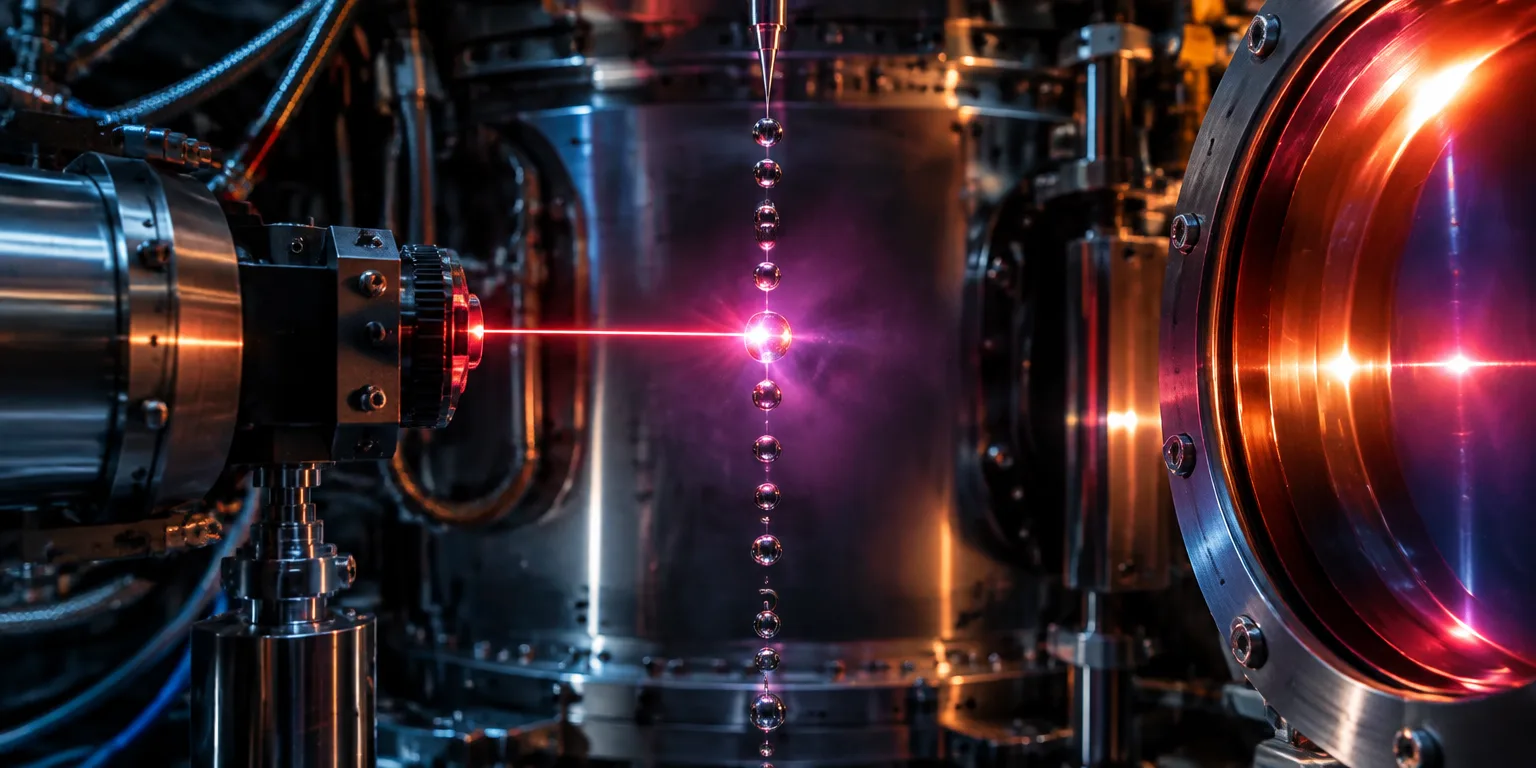
To print the world's most advanced chips, engineers had to invent a new kind of light bulb. Fifty thousand times a second, it shoots a microscopic droplet of molten tin traveling about 250 kilometers per hour, and blasts it with a laser until it becomes plasma hotter than 220,000 Kelvin, or dozens of times hotter than the Sun's surface.
That flash gives off extreme ultraviolet light, a color with a wavelength of 13.5 nanometers that can draw far tinier chip features than older light could. Tin was chosen after xenon was tried. An earlier system fired its laser into xenon gas, but xenon wasted most of its energy at the wrong wavelength and leftover xenon atoms reabsorbed the good light. Tin shines brightest right at 13.5 nanometers and converts laser energy into usable light five to 10 times more efficiently, but neutral tin atoms also swallow the light, so the tin has to be almost completely destroyed with each shot.
That is why the machine uses droplets, one at a time. Extremely pure molten tin is pushed by high pressure nitrogen through a microscopic nozzle that vibrates at high frequency. The stream first breaks into a chaotic spray of irregular droplets, which then mysteriously merge in flight into perfectly spaced, identical droplets moving at the same speed. Engineers have almost nothing to adjust except the pushing pressure and the vibration frequency.
Each droplet is then hit more than once. A first, weaker laser pulse flattens it into a pancake. In the newest machines, a second pulse puffs that pancake into a thin, low density gas. A final, powerful pulse strips the atoms and turns the cloud into plasma, which radiates the EUV light. Spreading the tin out first exposes more surface to vaporize at once, producing more light without extra debris.
The biggest problem is debris. Just 30 centimeters away sits a giant collector mirror, atomically smooth and enormously expensive, that gathers the light. A coating of tin just one nanometer thick would take it out of service, yet the machine must run for a year while vaporizing liters of tin.
The solution is hydrogen. The chamber is filled with low pressure hydrogen gas, which slows and cools flying tin and pulls tin off the mirror by forming a gas called stannane. In effect, the machine cleans itself while it runs. The balance is delicate, since too little hydrogen lets the mirror get dirty, and too much absorbs the EUV light and traps heat.
The violence inside is real. To the eye, the source looks like a globe of purple red light, and an ultra fast camera showed that after every shot a shockwave races outward into the hydrogen gas. Jos, an engineer who works on the light source at ASML, the Dutch company that makes the machines, found the blasts were exactly described by the formula used for nuclear blasts and supernovas. They are, he said, tiny little supernovas, much like a type 1A supernova in which an object fully evaporates and explodes. The math told engineers to flush hydrogen through the vessel at about 360 kilometers per hour, faster than a Category 5 hurricane, although the gas is very thin so it carries little force.
That understanding unlocked power. The two pulse pancake trick carried the source to 100 watts by 2014. With three pulses, shipping sources now reach about 500 watts at 60,000 droplets a second, and ASML has already demonstrated 100,000 droplets a second in the lab. More light simply means more chips per hour.
Questions people ask
What is plasma, and why does it make this light?
Plasma is a gas heated so far that electrons are torn from their atoms, leaving charged ions. Those ions readily jump between energy states, and in tin ions with about 10 to 14 electrons removed, the jumps release photons at 13.5 nanometers. Once the pulse ends, the plasma cools and recombines, so each droplet gives just one brief flash.
Why go to all this trouble for a shorter wavelength?
In photolithography, the smallest feature you can print scales with the wavelength of the light, a relationship known as the Rayleigh limit. Moving from 193-nanometer deep ultraviolet to 13.5-nanometer extreme ultraviolet allows much smaller transistors in a single exposure. Smaller transistors mean more computing power on the same chip.
Does the tin run out, and where does it all go?
Yes, the machine consumes tin continuously, on the order of liters over months of operation. Most is pumped out as fine particles or as stannane gas, the compound formed when hydrogen bonds to tin on the mirror. Filters and gas handling remove it, and fresh ultrapure tin is fed to the droplet generator.