The Navy hunted Soviet submarines and found singing whales instead
Sailors called it the Jezebel Monster, until scientists showed the ocean had been full of whales all along.
 Aeon · Worm munch matters
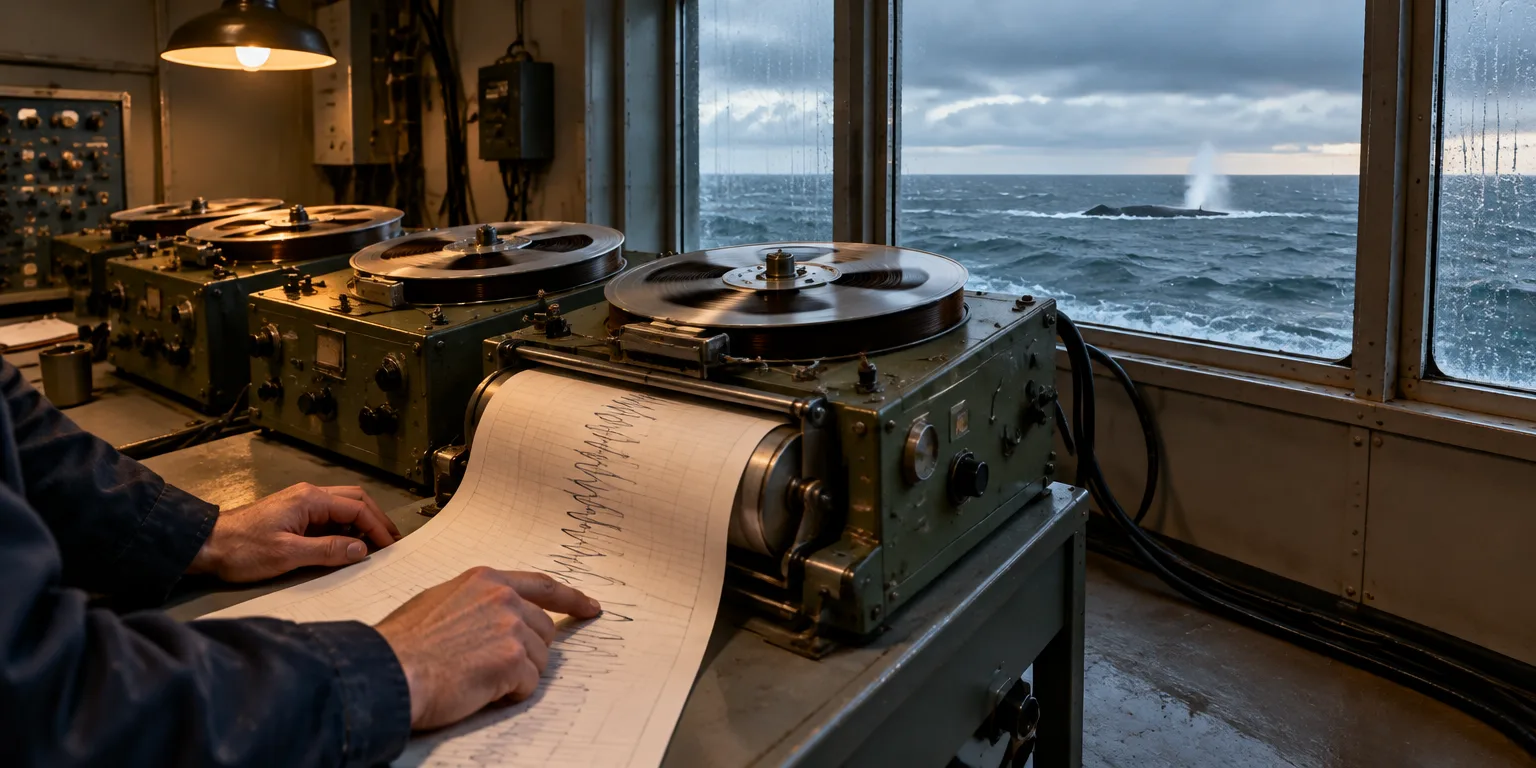
In the 1950s, the U.S. Navy laid arrays of hydrophones, or underwater microphones, on the seafloor of the Atlantic and Pacific oceans. The cables ran back to shore, where sailors monitored the sound coming up from the deep. They were listening for Soviet submarines.
The system was called the Sound Surveillance System, known as SOSUS, and it began under the code name Project Jezebel. The Navy's bet was straightforward. Enemy submarines would give themselves away by the deep hums they made, and the ocean would otherwise be quiet enough to hear them. The first half of that bet held, but the second did not.
The ocean was loud, strange, and full of sounds no one could explain. Sailors logging the tapes began flagging unknown noises, including one they blamed on the Jezebel Monster.
This is when the Navy's listening program began turning up discoveries about whales. Researchers had recently begun a technique called passive acoustic monitoring, leaving listening devices out in the wild for long stretches to capture entire soundscapes. It was especially powerful in places where people cannot stay long, like underwater, and for animals that call above or below the range of human hearing, which runs from 20 to 20,000 hertz.
Before that, whales and dolphins, which can cross vast ocean distances, had largely been studied by sightings from land or boats. People had to be in the right place at the right time and see the animal surface. With sensors that could listen around the clock, scientists could study whales without needing a sighting.
It took years of detective work by scientists who study sound in animals to solve the Jezebel Monster. The culprit was not a submarine and not a monster. It was the call of fin whales at 20 hertz. Hertz is a measure of pitch in cycles per second, and 20 hertz is about the lowest note people can hear.
Once they knew to listen, more mysteries surfaced. Two other odd undersea noises, catalogued as the boing sound and the lightsabre sound, were both eventually traced to minke whales.
The Navy had wired the ocean to hear its enemy, and heard its inhabitants instead.
Questions people ask
How does a hydrophone actually hear underwater?
A hydrophone works much like a microphone in air, except it converts underwater pressure changes into an electrical signal that can be recorded and studied. The Navy placed arrays of them on the seafloor and sent the signals by cable to shore stations. Scientists now anchor them alone or in small groups for weeks at a time to study whales, dolphins, and ocean noise.
What kind of whale makes a 20 hertz call?
Fin whales are the second largest animals on Earth, after blue whales, and they make very low, powerful calls that travel great distances underwater. A 20 hertz tone sits at the lowest limit of typical human hearing, so most people would perceive it more as a deep pulse than a clear note. Those low sounds are well suited to long range communication in the ocean.