The Oldest Hebrew Bibles Do Not All Match
The oldest surviving copies of the standard Hebrew text date only to the 800s, but older desert scrolls match both it and a rival Greek version.
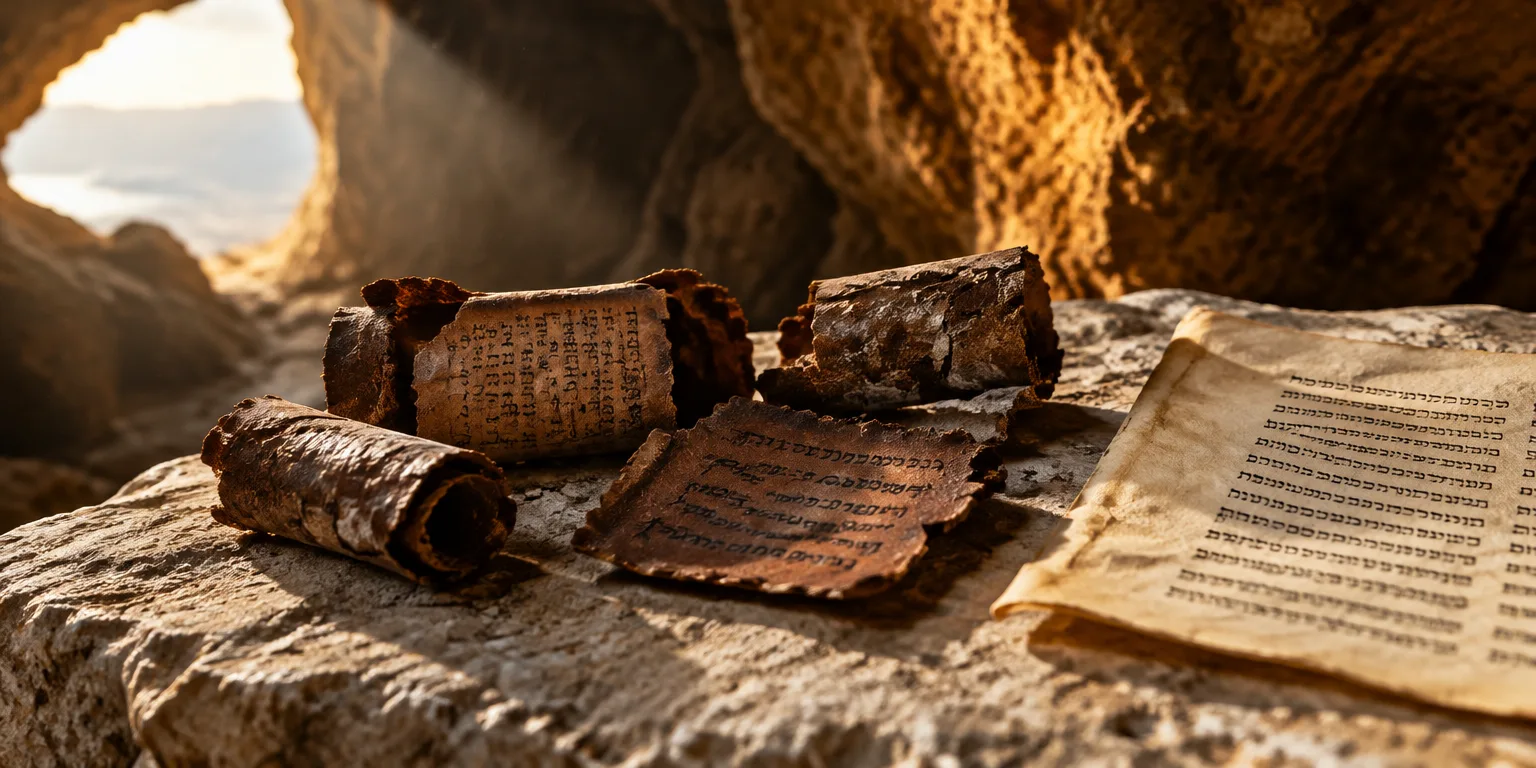
Most English Bibles get their Old Testament from a Hebrew text whose oldest surviving copies date only to the 800s A.D.
That standard is called the Masoretic Text. It takes its name from the Masoretes, a group of scribes who around the seventh century became seen as the leading authorities on the official Hebrew version, with a reputation for meticulous copying.
We do not know what earlier manuscripts the Masoretes worked from. The King James Version and most English translations use their text as the source for the Old Testament.
Then, in 1946, older copies turned up in desert caves beside the Dead Sea. Those Dead Sea Scrolls date from the 200s B.C. to the first century A.D., with the oldest scrolls about 1,000 years older than the oldest Masoretic fragments.
They are not all in one language or style. Some are in Hebrew, others in Aramaic, and still others in Greek, and some pages show Hebrew with an Aramaic rendering alongside, a reminder of the period when many Jews used Aramaic in daily life.
The surprise is how they compare. Some scrolls line up with the later Masoretic Text, while others line up with the Septuagint, the Greek version of the Scriptures.
That means there was not one uniform stream of copies in ancient times. Even in the 200s B.C., rival text families were already circulating together.
Questions people ask
What is the Septuagint?
It is a Greek translation of the Hebrew Scriptures, made in Egypt starting around the third century B.C. for Jews who spoke Greek rather than Hebrew. Early Christians widely used it, and Eastern churches continued to favor it long after the West moved to Latin.
Why would ancient scrolls mix Hebrew and Aramaic?
Hebrew remained the language of Scripture, but Aramaic had become common in daily life after the Assyrian and Babylonian conquests and exile. It made sense for some communities to keep texts, or helps for reading them, in both languages. The side-by-side pages show that mixing in practice.
How careful were the Masoretes when they copied?
They developed strict routines for counting letters and checking copies against their source, and later added notes and vowel marks to fix pronunciation. Those habits gave them their reputation for care. The limitation is that very careful copying still starts from whatever source text a scribe has.