The Spider Goats Made the Protein but Could Not Make the Silk
Getting the protein was the easy part. Turning it into fiber requires acid, shear, and a final stretch no goat can do.
 Veritasium · Is spider web really stronger than steel?
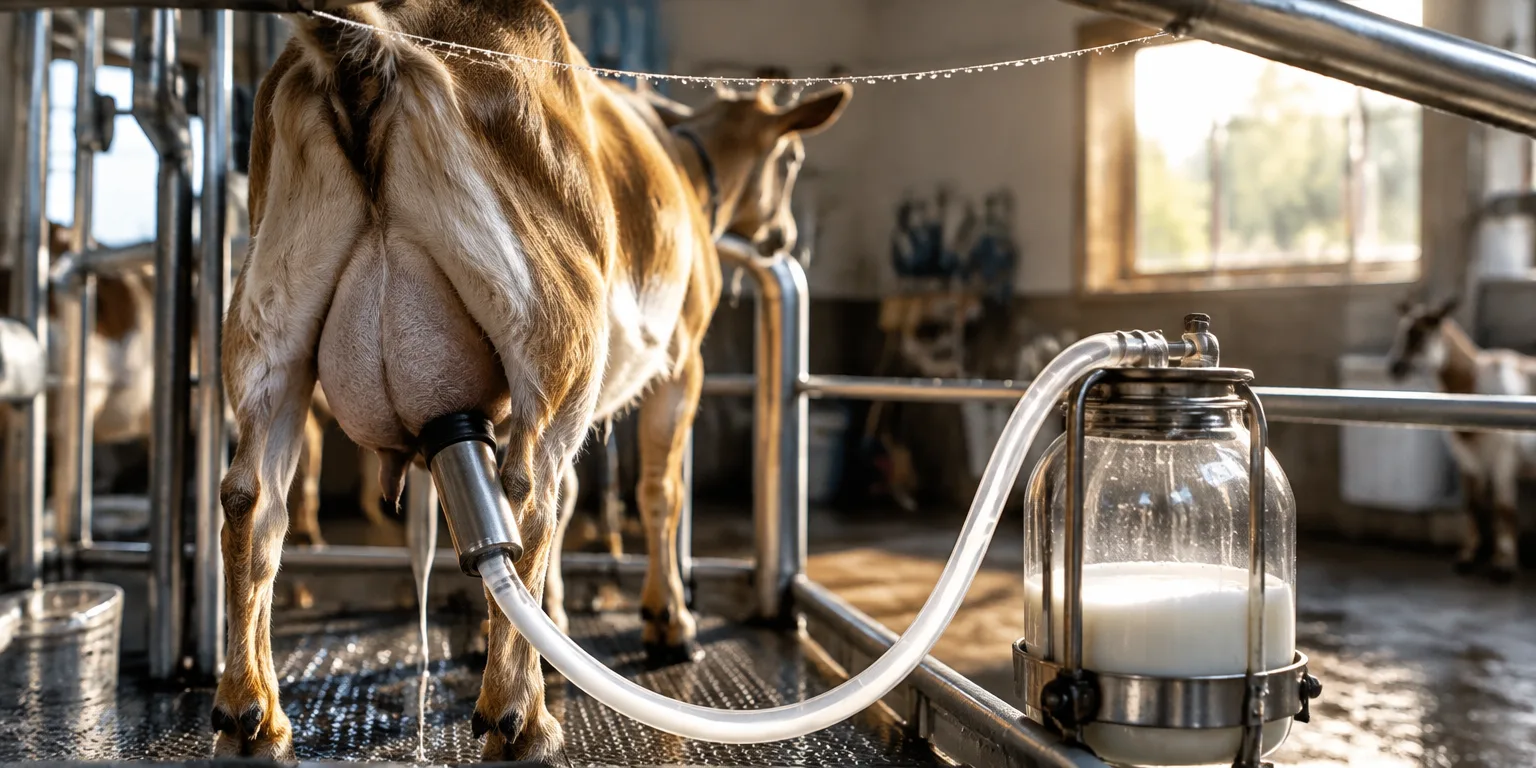
In the early 2000s, on an ordinary milking line, a herd of goats did something extraordinary. Each time they were milked, their milk came out laced with spider silk protein.
The goats were the work of Nexia, a Canadian company hunting for a way to make spider silk without spiders. The logic was simple and clever. If you want a lot of concentrated protein, look at milk, which mothers naturally load with protein to feed their young. So Nexia inserted spider silk genes into goats, and the animals produced milk rich in the raw ingredient for silk. As a protein factory, the effort succeeded.
But the milk was not silk, and that failure revealed what spider silk really is. Strength does not come from the protein recipe alone. It comes from how a spider spins it.
The same lesson emerged from other experiments of the era. Scientists put spider genes into bacteria and yeast, and purified the result as a fine white powder. A team in Germany put the genes into tobacco and potato plants in 2001, and got a thick, gelatin-like liquid. From goats, the protein arrived dissolved in milk. None of those products looked or behaved like actual spider silk.
Inside a spider, the protein is only the start. In a region called the tail of the silk gland, cells make long proteins called spidroins and release them into fluid. The proteins travel to a storage sac, where they are packed at high concentration but kept liquid by salts and acidity. Because they carry the same electrical charge, they repel each other instead of clumping.
Then comes the plumbing. The proteins form tiny bundles that flow into an S-shaped duct that gets narrower and narrower. Along the walls the liquid drags, while the center moves faster, and that sliding, called shear, stretches the bundles. Water is drawn out, the liquid grows more acidic, the repulsion fades, and the proteins link into long chains. At the spigot, the spider pulls the line through a tiny opening, and that final stretch lines the proteins shoulder to shoulder. Some sections lock into rigid crystals that resist pulling, and others stay loose and stretchy to absorb energy.
The goats could make the milk. They could not do the pull, the squeeze, and the chemistry. Any company that wants to copy spider silk at industrial scale still has to learn to spin the way a spider does.
Questions people ask
Why did scientists choose goats and milk to make spider protein?
Milk is naturally packed with protein to nourish young, so a dairy animal can produce large amounts of a foreign protein in a concentrated, harvestable fluid. Bacteria and yeast in tanks can also make spider proteins, but purifying and concentrating them at scale is expensive and difficult.
Why not just farm spiders for silk?
No. Spiders are cannibals and will eat each other if kept together, so they cannot be raised crowded in barns like silkworms or cows. Even a cooperative spider yields only about 300 yards of silk, and 100 yards is more typical.