The Steel Inside Modern Concrete Swells as It Rusts and Breaks the Concrete
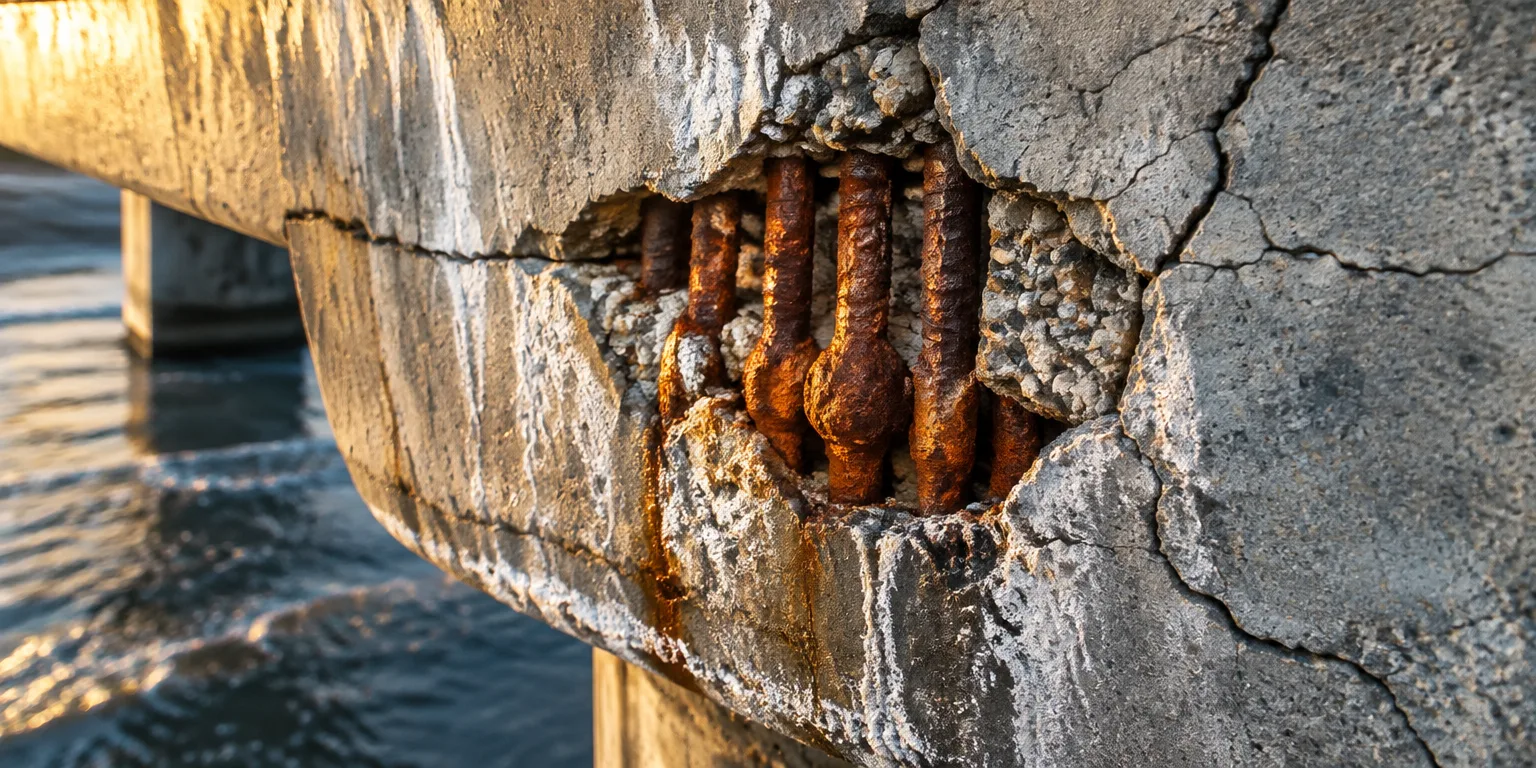
Water seeps through concrete to the steel, and the swelling rust breaks the concrete where it is weakest.
 Medieval Wisdom · Why Roman CONCRETE Lasts 2000 Years While Ours Dies in 50
Modern concrete fails early because rust on the steel inside it breaks the concrete apart.
Concrete is superb at carrying weight pressing straight down, what engineers call compressive strength. That is why it is ideal for pillars. It is weak when it is pulled or bent, what engineers call tensile strength. In the 19th century, builders answered that weakness with reinforced concrete, concrete poured around steel rods known as rebar. One material was meant to carry the load, and the other was meant to take up the stretch.
Concrete seems dense, but it is porous, and tiny cracks form over time. Moisture, air, and deicing salts work their way inward until they reach the steel. Then rust starts.
Rust needs far more room than the steel it replaces. The rust can bulk up to five to 10 times as large as the metal it came from. For every cubic centimeter of steel that turns to rust, up to 10 cubic centimeters of material try to force their way out. That expansion pushes outward with a pressure of three to four megapascals, a unit for force spread over an area.
That push strikes concrete where it is weakest. The ability of concrete to resist being pulled apart is only about 10 percent of its ability to resist being crushed, so it cannot hold back the swelling metal.
When the outer layer cracks open, the damage speeds up. Engineers call this spalling, when concrete breaks and flakes off. With the concrete over it gone, the metal meets still more water and air. Corrosion quickens, expansion grows, and still more of the surface breaks away. Metal meant to add strength ends up driving the breakup.
Questions people ask
How long does modern reinforced concrete usually last?
Typically 50 to 75 years for bridges and many other structures, much less than the 2,000 years of Roman landmarks. Lifespan depends on exposure to water, salt, and freeze-thaw cycles, plus design and maintenance. Saltwater and road salt shorten it sharply.
Can't engineers just keep water away from the steel?
Engineers do try. They use sealers, deeper concrete cover over the steel, epoxy-coated bars, and corrosion inhibitors. These measures slow water and salt, but tiny cracks eventually let them through, so protection delays rust rather than preventing it forever.
Why not build with steel that does not rust?
They can, but cost usually rules it out. Stainless steel and galvanized bars resist rust far better than ordinary carbon steel, and plastic fiber reinforcement does not rust at all. All cost more upfront, and most projects are awarded on lowest initial price rather than longest life.