The Transistor Is a Switch With No Moving Parts
A tiny voltage pulls electrons into place to complete a circuit, and removing it shuts the circuit down again.
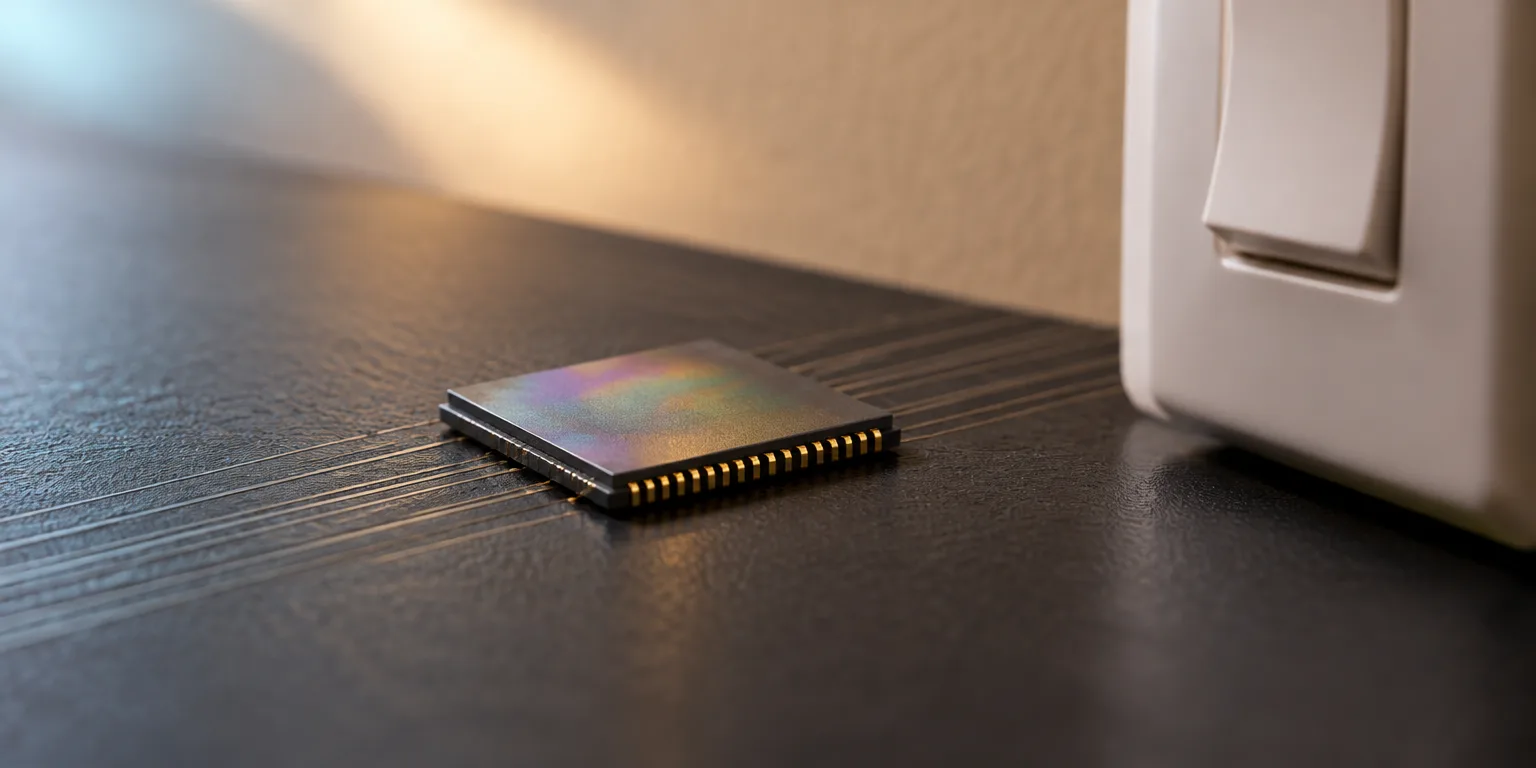
 Veritasium · How Does a Transistor Work?
Your phone holds nearly 100 million transistors. A computer holds more than a billion. Each one does the same humble job as a light switch, stopping electric current for a zero or letting it through for a one, and strings of those zeros and ones store and process information.
The difference is that nothing moves, and no finger is needed. A common kind of transistor is a tiny sandwich of treated silicon, with silicon that carries extra mobile electrons at both ends and silicon that carries mobile holes, places where an electron is missing, in the middle. It is wired at both ends, through contacts known as the source and the drain, and a third contact on top, known as the gate, which is kept from touching the silicon by a thin oxide layer.
Fresh out of the factory, the sandwich seals itself shut. Electrons drift in from the ends to fill holes in the middle, leaving the ends with few mobile charges. That empty zone is called the depletion layer, and the middle, now packed with extra electrons, repels any other electrons trying to cross. No current flows, so the switch is off.
A small positive voltage on the gate breaks the standoff. It pulls electrons up toward the gate, shrinks that repelling zone, and opens a continuous conducting channel from one end to the other. Current flows, so the switch is on.
That is the whole trick. With only voltage doing the work, the switch can flip far faster than a hand can flick, and it can be made almost invisibly small.
Questions people ask
How fast can a transistor flip on and off?
Much faster than anything mechanical. Modern processor transistors routinely switch billions of times per second, which is why billions of simple on and off decisions can add up to video, search, and games.
Why build this switch out of silicon?
Pure silicon locks almost all of its electrons into bonds with four neighbors, so it barely conducts. Adding a dash of an element with five outer electrons leaves extra mobile electrons, while adding one with three leaves mobile holes, which lets engineers build the sandwich that can block and then pass current.
Does it take a lot of power to hold the gate open?
Almost none, which is part of the appeal. Because the gate is separated from the channel by an insulating oxide, it controls current by attraction rather than by sending a large current through itself.