The U.S. has three aircraft carriers near Iran for the first time since 2003
Iran says an attack would bring retaliation against American installations and energy sites in neighboring Arab countries.
 Up First from NPR · Final Days Of Midterm Campaigning, Alaska Senate Race Controversy, Iran War Plans
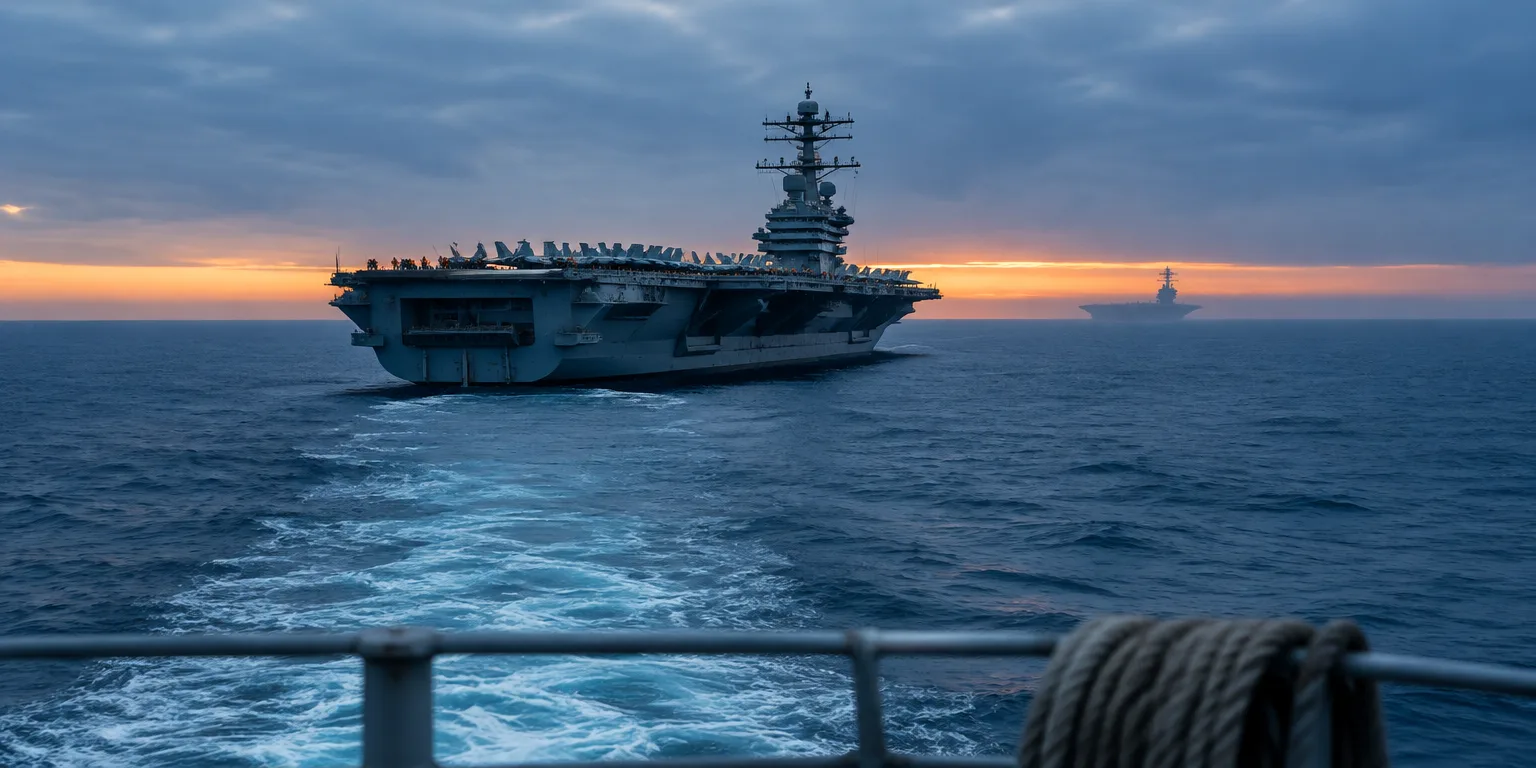
The United States has gathered three aircraft carriers near Iran, a sustained three-carrier presence in the Middle East it has not kept since 2003, the year it invaded Iraq.
Two carriers are already in the Arabian Sea. The USS Theodore Roosevelt is sailing to join them. It is uncommon for Washington to concentrate two carriers in one area, and far rarer to concentrate three. Central Command says the previous extended deployment of that size in the region came in 2003.
The naval movement has come alongside other concrete preparations. Washington has reduced staffing at several embassies, while partner nations have been holding military drills amid broad expectations that combat could restart.
Iran has warned that an attack would bring retaliation against U.S. installations and petroleum infrastructure in nearby Arab countries.
Questions people ask
What does an aircraft carrier actually do in a conflict like this?
An aircraft carrier is a large warship that serves as a floating air base, carrying dozens of warplanes plus escort ships, and allowing the United States to launch airstrikes without needing permission to use a nearby country. Having one nearby means Washington can sustain bombing, surveillance, and defense of its forces for weeks. Three multiplies the number of planes, targets that can be hit at once, and protection against retaliation.
Where is the Arabian Sea, and why does it matter?
The Arabian Sea lies south of Iran and Pakistan and northwest of India, and it connects through the Gulf of Oman to the Strait of Hormuz and the Persian Gulf. That geography matters because much of the world's oil passes through the strait. Carriers there can reach Iran quickly while also sitting near the shipping lanes Iran could threaten.
What happened in 2003 that makes the comparison important?
In March 2003, the United States invaded Iraq, arguing that leader Saddam Hussein held weapons of mass destruction that were never found. The invasion required an enormous deployment of ships, planes, and ground troops, including sustained carrier power in the region. That is why a three-carrier presence is read as a signal of possible large-scale combat, not routine patrols.