They could not just blow up the old Mississippi bridges
Fishing wreckage from the Mississippi is slow and dangerous, so engineers took the old I-74 spans apart piece by piece.
 Practical Engineering · Bridge Demolition is Complicated
On land, blowing up an old structure is often the quicker, easier, and safer choice. You get a pile of rubble that regular equipment can haul away. Over water, that pile becomes the problem.
That was the bind with the two aging Interstate 74 crossings joining Iowa and Illinois above the Mississippi. Dropping steel and concrete into the river would have meant fishing the biggest pieces out from below the waterline. For small debris, long-reach excavators can sometimes do it. For big sections, divers have to go down to fasten cables so cranes can lift each piece, which is dangerous and slow.
The river also had to keep working. That section carries heavy commercial barge traffic, and shutting the navigation channel long enough to clear wreckage would have disrupted shipping.
Then there was the wildlife. Endangered mussels, small shellfish that live on the riverbed, were living in the part of the river closed to barges, beneath one set of linked steel spans. The demolition team could not set off explosives there and could not even rest temporary bracing on the riverbed.
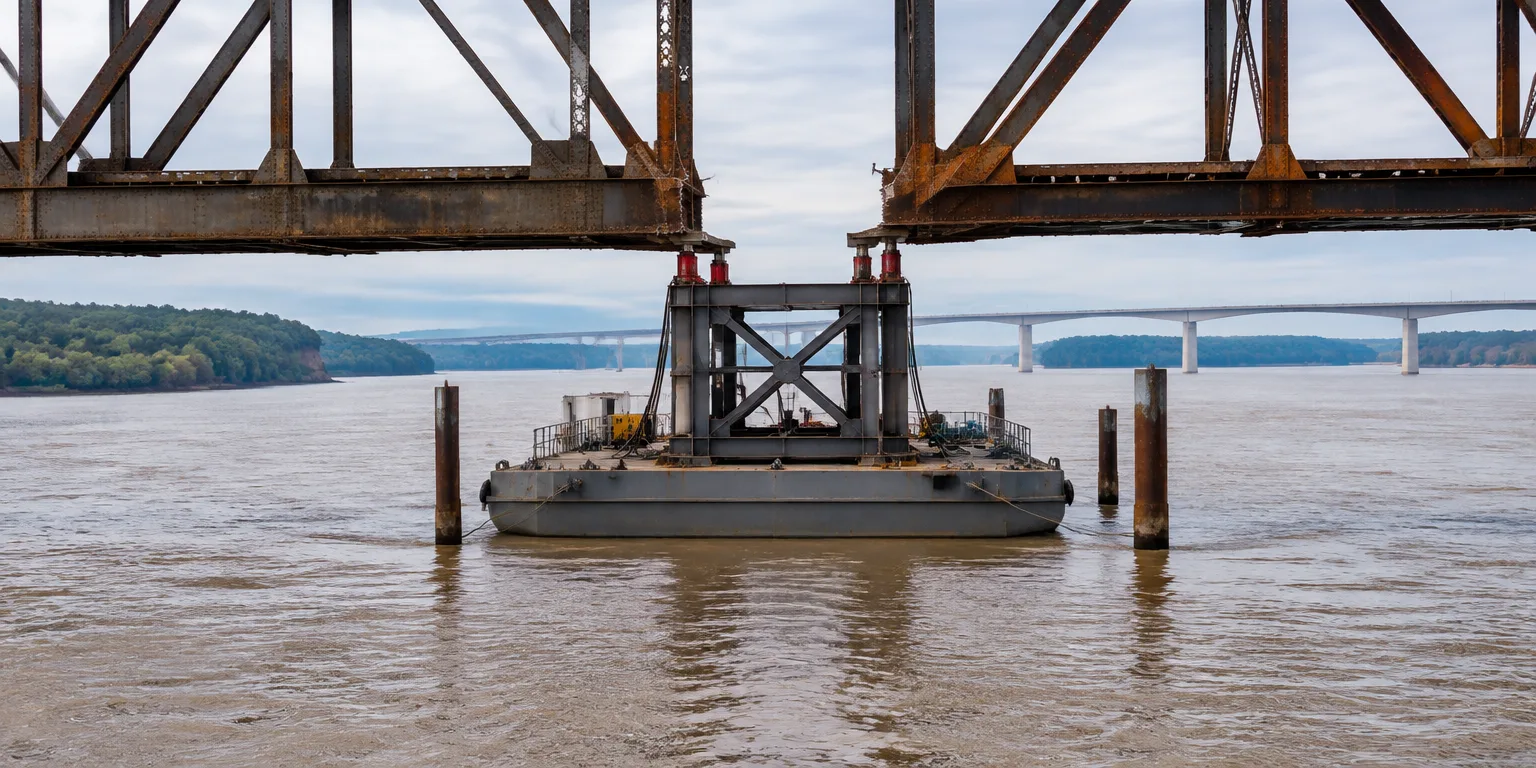
So engineers had to take that section apart in the air. Instead of installing temporary supports in the water to hold up the steel truss while it was cut into pieces, they floated the support in on a barge. On the neighboring suspension spans, every cut into stressed steel had to be sequenced in advance. Stress cannot be judged by looking, so engineers checked each weakening step in a structural computer model to make sure loads shifting through the bridge would not endanger workers, boats, or the river.
Explosives still finished the job, but only after sections had been cut and removed to weaken the structure. Workers precut steel down to flat plates so shaped charges could sever members completely and drop large pieces where barges could reach them without blocking the channel. On each main cable, workers cut the outer strands in four locations, leaving just seven strands out of 37 to hold the cable, and they precut the towers to control the direction of the fall. The blast then brought the spans down safely, and the road and navigation channel were closed only for a short time while barges moved in to lift the fallen steel from the water.
The caution lasted to the end. Afterward, crews scanned the riverbed with sonar to confirm no debris was left. One of those piers remains upright beside the replacements, and it has become good habitat for those endangered mussels.
Questions people ask
Why are freshwater mussels so sensitive to construction?
Most freshwater mussels live half buried in the riverbed and filter water to feed, so extra silt or chemicals can smother or poison them. They also depend on specific fish hosts to carry their larvae, so anything that drives those fish away breaks their life cycle. Because many U.S. species are already in decline, even a small disturbance can matter legally and biologically.
Why couldn't they just close the shipping channel for a few days?
The Upper Mississippi is a working highway for grain, fertilizer, coal, and other bulk goods moved on barges. A closure backs up tows for miles and ripples into farm deliveries and industrial supply chains. The Coast Guard and Army Corps of Engineers therefore allow only very short, scheduled closures.
How can a barge act as a bridge support?
A barge is positioned under the span and ballasted or tied with spud poles, steel posts dropped to the riverbed, to hold it roughly still. A support frame on its deck is jacked up against the bridge to carry the load while sections are cut away. The challenge is that the barge still moves slightly with current and wind, so the loads are constantly shifting.