This Computer Is a Whole Room, Programmed With Paper
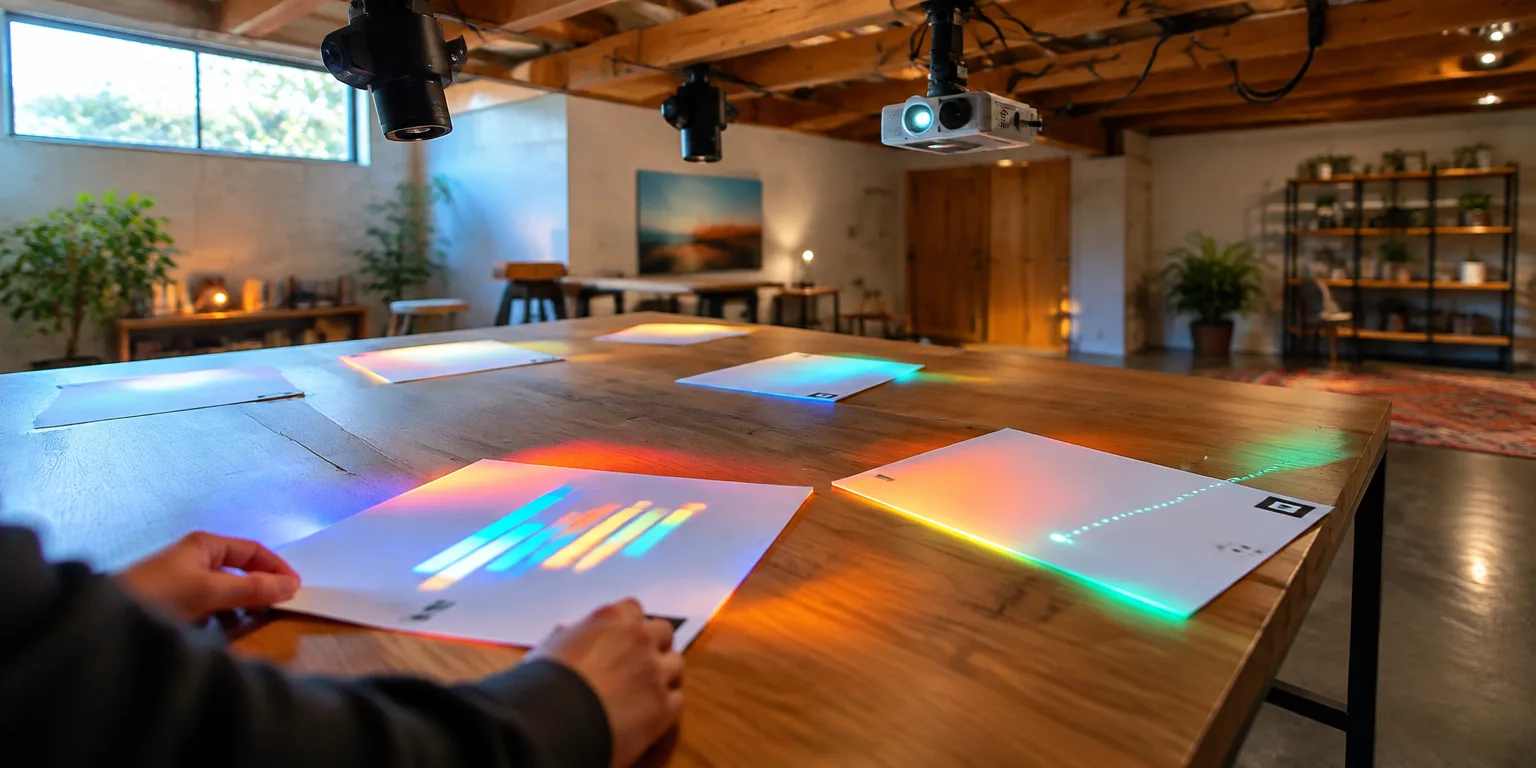
Ceiling cameras track tagged sheets of paper, projectors light up the tables and floors, and every location is measured in meters, not pixels.
 motivenotes.ai · Against Usefulness
Folk Computer does not live on a screen. It lives in the room around you.
The system, an open-source project for physical computing from Omar Rizwan and Andres Cuervo, both alumni of Bret Victor's Oakland lab Dynamicland, starts with two pieces of overhead infrastructure. Mounted cameras observe the space, and projectors shine images onto every surface, onto tables, floors, and sheets of paper.
The paper is the key part. Each sheet carries a small tag that tells the system which sheet it is, and each sheet is a running program. Move a sheet, draw on it, or place it next to another sheet, and the cameras see where it went. The projectors then display the result right where the paper sits.
That is why the software does not think in screen dots. It locates everything by real-world distance, tied to the placement of objects and people in the space. Your laptop asks where something is on a display. Folk Computer asks where your body, your hands, and your paper are in the room.
You do not use it alone, hunched over a rectangle. You program it standing up, with other people, by talking, drawing, and moving paper around.
The other decisive change is that anyone can try it. Victor's earlier Dynamicland worked the same way, with the building itself as the computer, but the knowledge stayed locked in one building in Oakland. Rizwan and Cuervo put the code on GitHub, and enthusiasts elsewhere have built their own installations.
Outsiders now add to it. A friend of the builders made a rhythm tool from paper cards, where flipping a card changes a track. The room stays the computer, but now the room can be yours.
Questions people ask
How does a piece of paper become a program?
Each sheet carries a machine-readable tag, similar to a QR code, that gives it an identity the ceiling cameras can track. The system links that identity to code, so moving, marking, or placing sheets together changes the inputs. The projector then shows the output directly on or around the paper.
What do you need to build your own?
In principle, you need overhead cameras, projectors, a computer to run the open source software, and printed paper tags. In practice, you need a room where you can mount the cameras and projectors with a clear view, plus calibration so the system knows where surfaces are. The code and setup instructions are published on GitHub.
Why measure in meters instead of pixels?
Pixels describe positions on a flat screen, which breaks down when the display is a table, a floor, and moving paper. Meters describe positions in physical space, so the system can keep track of people and objects wherever they are. That lets several people work together, because the room itself is the shared coordinate system.