Tiny Fast Chargers Work Because Their Switches Flick 20 Times Faster
Every charger turns wall power to DC and then chops it back to AC, and a new switch material does the chopping much faster.
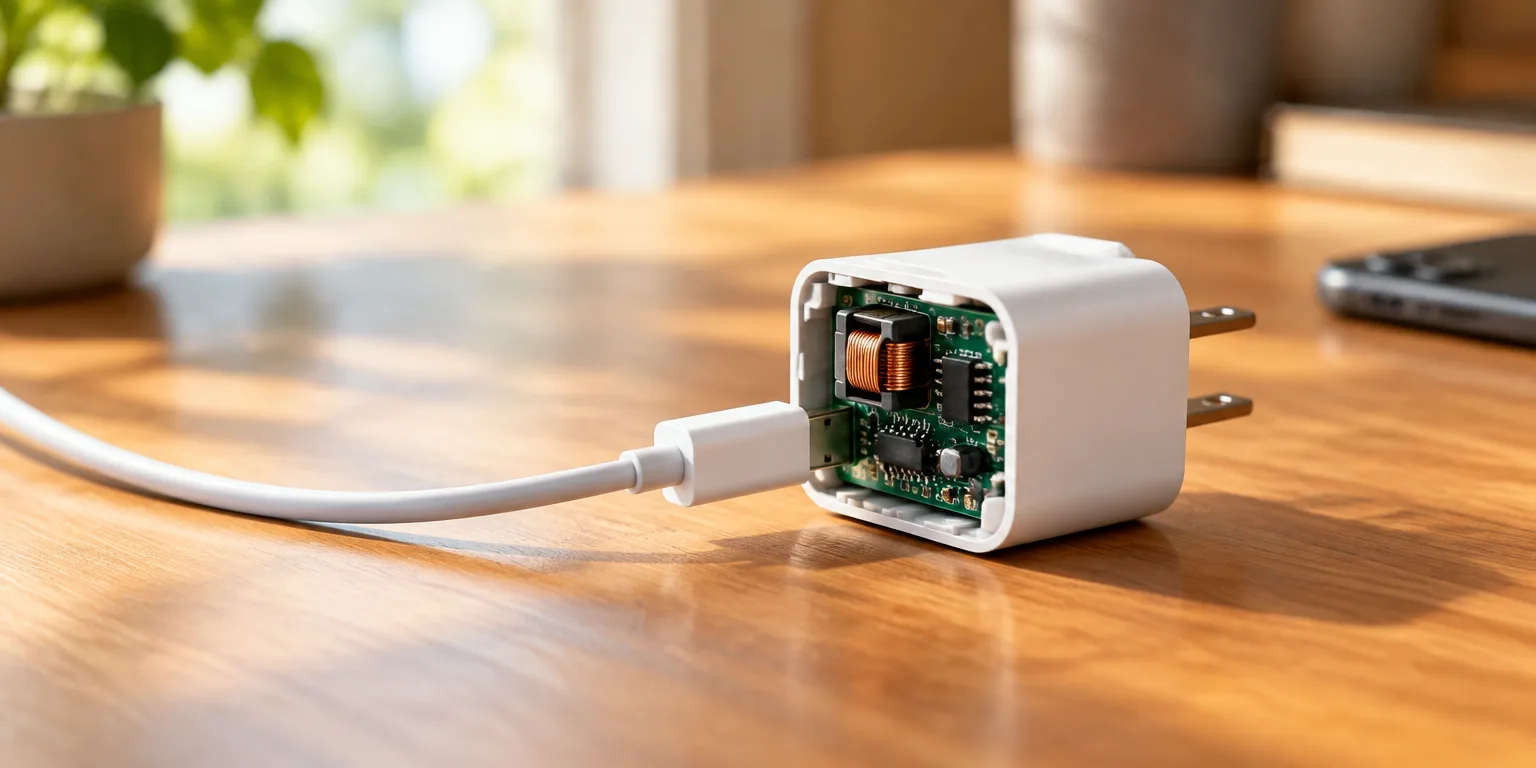
 Real Engineering · $1 vs $50 Phone Charger. What’s the difference?
The tiny, fast charger on the store shelf is fast because gallium nitride switches inside it flick power on and off 20 times faster than silicon switches can.
It starts at the wall. Power arrives as high voltage alternating current, about 100 to 240 volts with the exact level set by country, reversing direction 50 to 60 times a second. That raw supply is useless to a phone battery, which requires steady, low voltage direct current, power that flows one way.
So the first job of the circuit is to force that wall power into direct current. The next job is to lower the voltage with a transformer, a device that changes voltage using coils of wire.
That order creates a problem because a transformer cannot transform direct current, since it only works when a shifting magnetic field creates current in a second coil. So the charger first makes direct current only to chop it up again. A chip rapidly switches the direct current on and off to recreate alternating current.
How far the voltage drops depends on two things. One is windings, the loops of wire wound inside the transformer. The other is frequency, how many times per second the current is made to flip back and forth.
That higher frequency is possible because the switches are made from gallium nitride, a semiconductor material that can switch power on and off at 20 times the speed of silicon versions. Fed at that higher frequency, a transformer needs fewer windings to do the same work, making it more compact and reliable.
The smaller design can also quickly adjust because the phone reports its battery status to the charger, letting it deliver the maximum watt output while keeping the phone from getting too hot.
Questions people ask
Why does higher switching frequency make the transformer smaller?
A transformer moves power with a changing magnetic field. The faster the field changes, the more energy each winding can transfer, so fewer coils of wire are needed to drop the voltage. Fewer coils mean a smaller copper and iron core, which is why high frequency chargers can shrink.
Will a gallium-nitride charger work with my old phone?
Yes, they are designed to be backward compatible. A gallium-nitride charger talks to the phone to learn what voltage and current it can accept, then delivers only that much. You will not get faster charging from an old phone, but you will get a smaller brick.
Does faster charging damage the battery?
Heat and high voltage wear batteries down, so pushing more watts can shorten battery life if it is poorly managed. Modern fast chargers limit this by reading battery temperature and charge level many times per second and tapering power as the battery fills. That is why phones often charge very fast to 50 percent and then slow down.