To find a hidden repeat, try waves until one lights up
The trial by wave is called a Fourier transform, and it pulls the secret rhythm out of a long, repeating list of numbers.
 Computerphile · Shor's Algorithm for Quantum Computing - Computerphile
Physicists spend their careers hunting for repeating patterns, said Phil, a physicist who works on quantum computers. From locating atoms in a crystal lattice to mapping the cosmic microwave background, the faint glow left over from the early universe, much of the job is asking what waves combine to make a pattern. The math for that goes back to the 19th century French mathematician Joseph Fourier.
Take a simple striped pattern, like the bars of a crosswalk. A Fourier transform breaks it into a sum of simple sine and cosine waves, the smooth up and down curves from school math.
Two details matter: how much of each wave you need, and the phase, which is how the peaks and troughs line up. The first piece is boring. It is just flat gray, the average brightness of the picture, what engineers call the DC level. Since it never ripples, its frequency is zero.
Then the hunt begins. Try a wave that fits once across the picture, and almost nothing happens. Try one that fits twice, and still little changes. Try one that fits three times, and bingo, it contributes a huge amount. You have found the repeat.
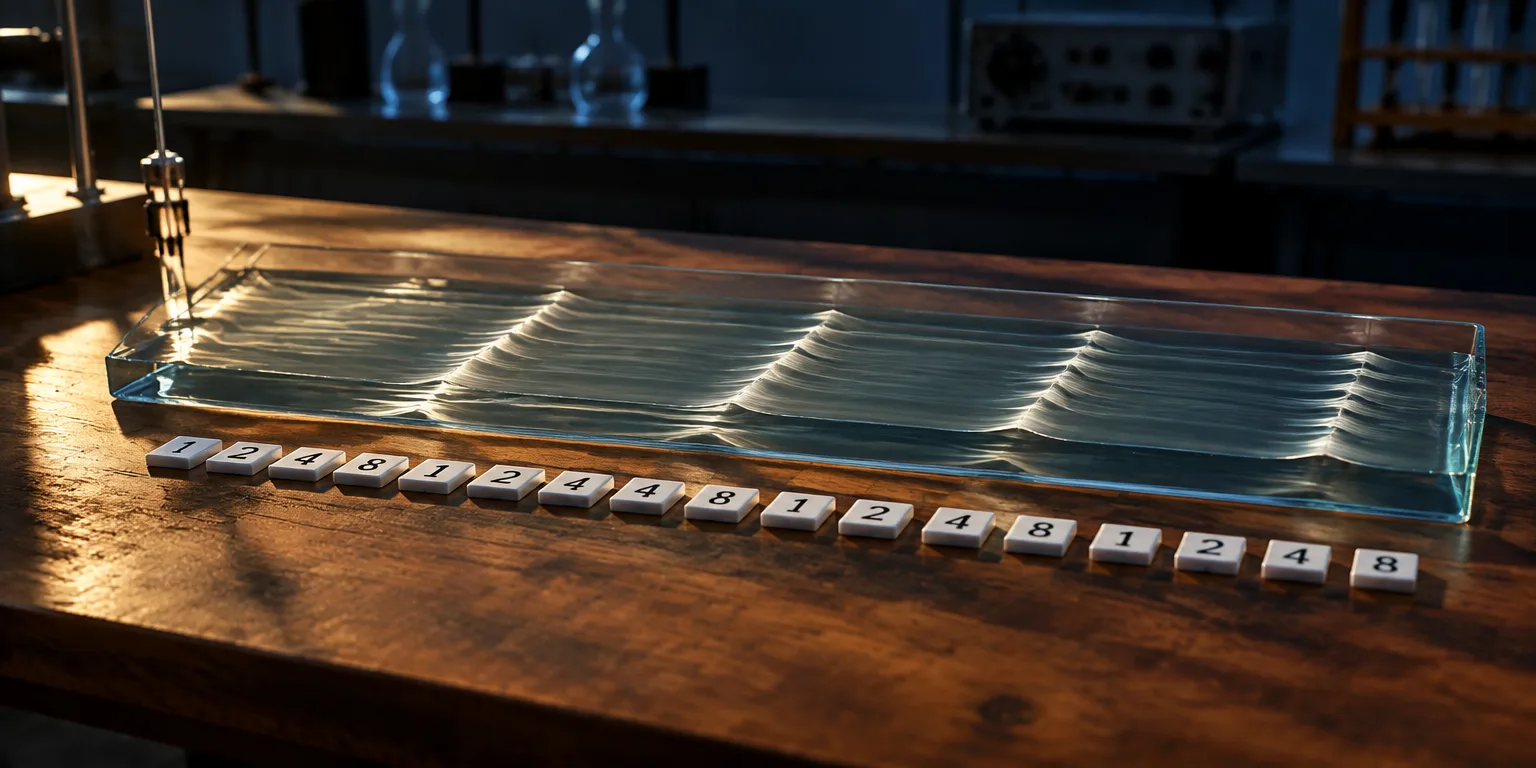
That pattern can live in space, like an image, or unfold over time, like a tune. In code breaking, the pattern is a list of numbers that repeats, such as 1, 2, 4, 8, then 1, 2, 4, 8 again.
Adding waves together to build a picture is called Fourier synthesis. Running the other way, starting with the list and asking what waves build it, is called Fourier decomposition. That reverse search is what Shor's algorithm needs, a quantum method for breaking codes by finding a number's hidden repeat.
In the small demo for the factoring problem with the number 15, the list holds 16 numbers, the sequence 1, 2, 4, 8 repeated four times. Those 16 slots are the window, and the average of the numbers in it is 3.75.
Waves that cycle once, twice, or three times across that window contribute nothing. The wave that cycles four times lights up, and the period of 4 pops out.
That fast way to find the repeat is the speedup: finding the repeat for a huge number without testing every factor. The 600 digit number is the one to be factored, and the list is the repeating sequence it produces. You could never eyeball that list, and you would never want to test every possible factor by hand. Apply the transform and the peak appears.
Questions people ask
What is the period Shor's algorithm is looking for?
The period is how long before a repeating list of numbers starts over. In Shor's method, code breaking is turned into finding that repeat length, because that length can then be used with ordinary arithmetic to work out the two prime factors.
What does phase mean here?
Phase describes whether two waves line up peak to peak or peak to trough. When peaks line up, they add up and make a bigger signal, and when a peak meets a trough, they cancel. That adding and canceling is what makes the matching frequency stand out.
Does a quantum computer literally test one wave after another?
No, at least not in this picture. A quantum computer can hold many parts of the calculation as waves at once, so interference can suppress the wrong frequencies and strengthen the right one in a single process. The trial of one cycle, two cycles, and three cycles is a way to picture the logic, not a sequence of separate runs.